Human/Mouse/Rat Ninjurin-2 Antibody Summary
Met1-Thr65
Accession # Q9NZG7
Applications
Please Note: Optimal dilutions should be determined by each laboratory for each application. General Protocols are available in the Technical Information section on our website.
Scientific Data
 View Larger
Detection of Ninjurin‑2 in Human Tonsil Ninjurin‑2 was detected in immersion fixed paraffin-embedded sections of Human Tonsil using Sheep Anti-Human/Mouse/Rat Ninjurin‑2 Antigen Affinity-purified Polyclonal Antibody (Catalog # AF5056) at 3 µg/mL for 1 hour at room temperature followed by incubation with the Anti-Sheep IgG VisUCyte™ HRP Polymer Antibody (Catalog # VC006). Before incubation with the primary antibody, tissue was subjected to heat-induced epitope retrieval using VisUCyte Antigen Retrieval Reagent-Basic (Catalog # VCTS021). Tissue was stained using DAB (brown) and counterstained with hematoxylin (blue). Specific staining was localized to cell surface on lymphocytes. View our protocol for IHC Staining with VisUCyte HRP Polymer Detection Reagents.
 View Larger
Detection of Human/Mouse/Rat Ninjurin‑2 by Western Blot. Western blot shows lysates of human thymus, mouse thymus, rat thymus, NTera‑2 human testicular embryonic carcinoma cells and HT‑29 human colon adenocarcinoma cells. PVDF membrane was probed with 1 µg/mL of Sheep Anti-Human/Mouse/Rat Ninjurin‑2 Antigen Affinity-purified Polyclonal Antibody (Catalog # AF5056) followed by HRP-conjugated Anti-Sheep IgG Secondary Antibody (Catalog # HAF016). A specific band was detected for Ninjurin‑2 at approximately ~26kDa kDa (as indicated). This experiment was conducted under reducing conditions and using Western Blot Buffer Group 1.
 View Larger
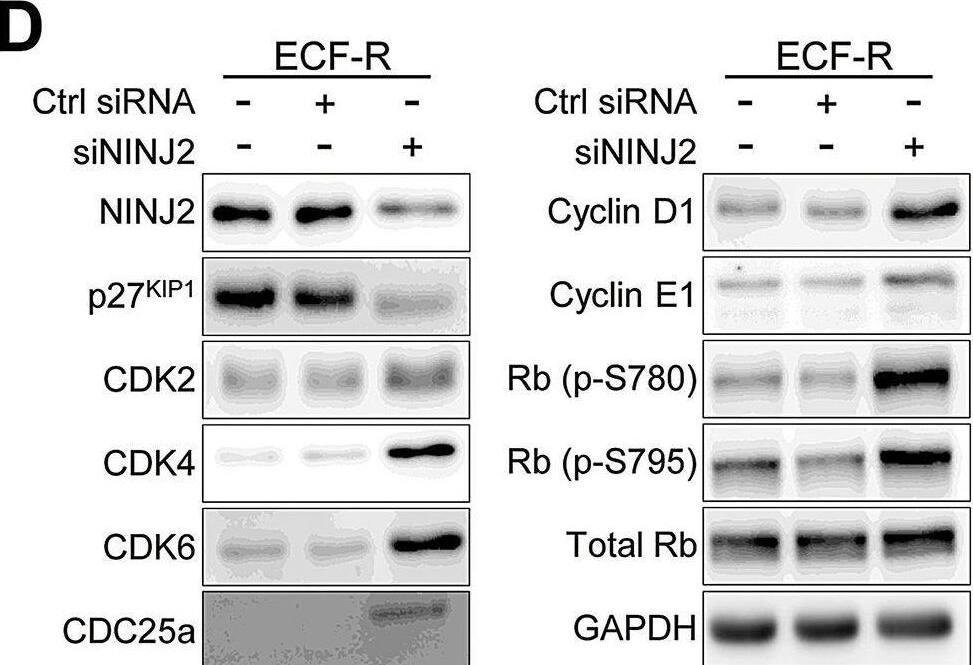
Detection of Ninjurin-2 by Western Blot NINJ2 in ECF-R regulates chemo-sensitivity and cell cycle arrest. (A) ECF-R MKN-74 cells were transduced with shRNA lentiviral particles targeting human NINJ2 (clone 1 and clone 2) or the pLKO.1-puro empty control. Viability analysis using crystal violet staining (Left) and the CCK-8 assay (Right) 3 weeks after ECF treatment in mock and NINJ2 K/D ECF-R MKN-74 cells. (B) Representative ECF IC50 values for MKN-74 cells overexpressing NINJ2 isoform-1 and isoform-3. (C) (Left) Cell cycle status of mock-, NINJ2 isoform-1-, and isoform-3-O/E MKN-74 cells. (Right) Quantification of the left FACS plots. *p < 0.05 versus mock (S-phase reduction), #p < 0.05 versus mock (G0/G1-phase increase). (D) Western blot analysis of NINJ2, p27KIP1, CDK2, CDK4, CDK6, CDC25a, cyclin D1, cyclin E1, Rb (p-S780), Rb (p-S795), total Rb, and GAPDH in scramble siRNA and NINJ2 K/D MKN-74 cells. K/D, knockdown. Data are presented as mean ± SD Image collected and cropped by CiteAb from the following open publication (https://pubmed.ncbi.nlm.nih.gov/40518514), licensed under a CC-BY license. Not internally tested by R&D Systems.
 View Larger
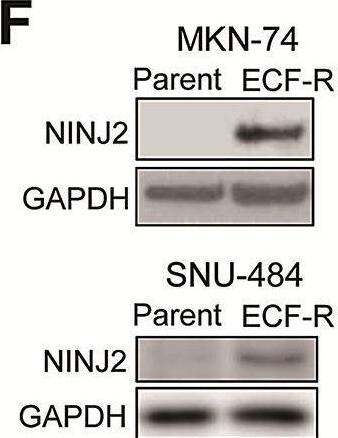
Detection of Ninjurin-2 by Western Blot NINJ2 expression in ECF-R gastric cancer cells. (A) Representative IC50 values for parent (WT) and ECF-resistant (ECF-R) MKN-74 and SNU-484 cells. The IC50 values are given in an equation using a four-parameter logistic curve. (B) Parent and ECF-R MKN-74 cells were individually transplanted into nude mice and left until the tumor reached a volume of 100 mm3. The tumor-bearing mice were given ECF, and the tumor volume was measured. *p < 0.05 versus parent at each time point. (C) (Left) Venn diagram showing top genes with 15-fold changes in the RNA-sequencing of WT and ECF-R genes related to “Integral component of plasma membrane (GO:0005887)” and “Cell adhesion (GO:0007155).” (Right) Heatmap showing the gene expression level associated with resistance and the two gene ontology categories. (D) RGV analysis for the human NINJ2 isoform based on RNA-sequencing of WT and ECF-R (hg19 base) cells. (E) mRNA levels of NINJ2 was analyzed by quantitative real-time PCR in parent and ECF-R cells from the MKN-28/74, MKN-74, MKN-45, SNU-484, SNU-520, and SNU-688 lines. (F) Protein levels of NINJ2 in parent and ECF-R MKN-74 and SNU-484 cells were determined by Western blot analysis. ECF, epirubicin, cisplatin, and 5-fluorouracil; ECF-R, ECF-resistance. Data are presented as mean ± SD Image collected and cropped by CiteAb from the following open publication (https://pubmed.ncbi.nlm.nih.gov/40518514), licensed under a CC-BY license. Not internally tested by R&D Systems.
Reconstitution Calculator
Preparation and Storage
- 12 months from date of receipt, -20 to -70 °C as supplied.
- 1 month, 2 to 8 °C under sterile conditions after reconstitution.
- 6 months, -20 to -70 °C under sterile conditions after reconstitution.
Background: Ninjurin-2
Ninjurin-2 (nerve injury-induced protein 2) is a 20‑22 kDa member of the Ninjurin family of transmembrane (TM) proteins. It is expressed by multiple cell types, including Schwann cells, myenteric plexus and sensory neurons, and lymphocytes and participates in intercellular homophilic binding. Human Ninjurin-2 is 142 amino acids (aa) in length. It has an unusual membrane orientation. There is a 65 aa N-terminal extracellular domain (ECD) (aa 1‑65) that contains one phoshorylation site at Ser3, followed by a TM segment, a cytoplasmic region, a second TM segment and a C-terminal ECD (aa 128‑142). One potential alternate start site exists 46 aa upstream of the standard form start site. Over aa 1‑65, human Ninjurin-2 is 71% aa identical to mouse Ninjurin-2.
Product Datasheets
Citations for Human/Mouse/Rat Ninjurin-2 Antibody
R&D Systems personnel manually curate a database that contains references using R&D Systems products. The data collected includes not only links to publications in PubMed, but also provides information about sample types, species, and experimental conditions.
4
Citations: Showing 1 - 4
Filter your results:
Filter by:
-
SLAMF8 and NINJ2 promote neuroinflammation and oxidative stress through TLR4 NF kappa B pathway in Alzheimer's disease
Authors: Liu, S;He, Y;Chen, H;Zhao, W;Xu, H;Bai, T;Feng, J;
Scientific reports
Species: Human, Transgenic Mouse
Sample Types: Cell Lysates, Tissue Homogenates, Whole Cells
Applications: Immunoprecipitation, Western Blot, Immunocytochemistry -
Ninj2 regulates Schwann cells development by interfering laminin-integrin signaling
Authors: Yuxia Sun, Xiang Chen, Cen Yue, Wenyi Yang, Shu Zhang, Zhimin Ou et al.
Theranostics
-
Dysmyelination by Oligodendrocyte‐Specific Ablation of Ninj2 Contributes to Depressive‐Like Behaviors
Authors: Yuxia Sun, Xiang Chen, Zhimin Ou, Yue Wang, Wenjing Chen, Tongjin Zhao et al.
Advanced Science
-
Dysmyelination by Oligodendrocyte‐Specific Ablation of Ninj2 Contributes to Depressive‐Like Behaviors
Authors: Yuxia Sun, Xiang Chen, Zhimin Ou, Yue Wang, Wenjing Chen, Tongjin Zhao et al.
Advanced Science
Species: Mouse
Sample Types: Cell Lysates, Whole Tissue
Applications: Immunohistochemistry, Western Blot
FAQs
No product specific FAQs exist for this product, however you may
View all Antibody FAQsReviews for Human/Mouse/Rat Ninjurin-2 Antibody
There are currently no reviews for this product. Be the first to review Human/Mouse/Rat Ninjurin-2 Antibody and earn rewards!
Have you used Human/Mouse/Rat Ninjurin-2 Antibody?
Submit a review and receive an Amazon gift card.
$25/€18/£15/$25CAN/¥75 Yuan/¥2500 Yen for a review with an image
$10/€7/£6/$10 CAD/¥70 Yuan/¥1110 Yen for a review without an image
