Human SOD3/EC-SOD Antibody Summary
Trp19-Ala240
Accession # P08294
Applications
Please Note: Optimal dilutions should be determined by each laboratory for each application. General Protocols are available in the Technical Information section on our website.
Scientific Data
 View Larger
Detection of Human SOD3/EC‑SOD by Western Blot. Western blot shows lysates of human aorta tissue. PVDF Membrane was probed with 0.2 µg/mL of Goat Anti-Human SOD3/EC-SOD Antigen Affinity-purified Polyclonal Antibody (Catalog # AF3420) followed by HRP-conjugated Anti-Goat IgG Secondary Antibody (Catalog # HAF017). A specific band was detected for SOD3/EC-SOD at approximately 30 kDa (as indicated). This experiment was conducted under reducing conditions and using Immunoblot Buffer Group 2.
 View Larger
SOD3/EC‑SOD in Human Kidney. SOD3/EC-SOD was detected in immersion fixed paraffin-embedded sections of human kidney using Goat Anti-Human SOD3/EC-SOD Antigen Affinity-purified Polyclonal Antibody (Catalog # AF3420) at 5 µg/mL overnight at 4 °C. Tissue was stained using the Anti-Goat HRP-DAB Cell & Tissue Staining Kit (brown; Catalog # CTS008) and counterstained with hematoxylin (blue). Specific staining was localized to the cytoplasm of epithelial cells in convoluted tubules. View our protocol for Chromogenic IHC Staining of Paraffin-embedded Tissue Sections.
 View Larger
Detection of Human SOD3/EC‑SOD by Simple WesternTM. Simple Western lane view shows lysates of human kidney tissue, loaded at 0.2 mg/mL. A specific band was detected for SOD3/EC-SOD at approximately 38 kDa (as indicated) using 10 µg/mL of Goat Anti-Human SOD3/EC-SOD Antigen Affinity-purified Polyclonal Antibody (Catalog # AF3420) followed by 1:50 dilution of HRP-conjugated Anti-Goat IgG Secondary Antibody (Catalog # HAF109). This experiment was conducted under reducing conditions and using the 12-230 kDa separation system.
 View Larger
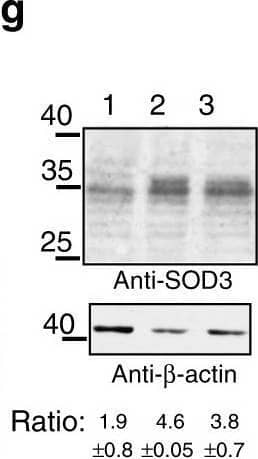
Detection of Mouse SOD3/EC-SOD by Western Blot SOD3-induced VEC expression requires SOD3 enzyme activity and NO. g SOD3 levels in cells as in f; bottom, filter rehybridized with actin. SOD3/actin ratio indicated (n = 3). h FITC-dextran permeability of 1G11-mock and -SOD3 monolayers, untreated or VEGF-pretreated (n = 9). Image collected and cropped by CiteAb from the following open publication (https://pubmed.ncbi.nlm.nih.gov/29422508), licensed under a CC-BY license. Not internally tested by R&D Systems.
 View Larger
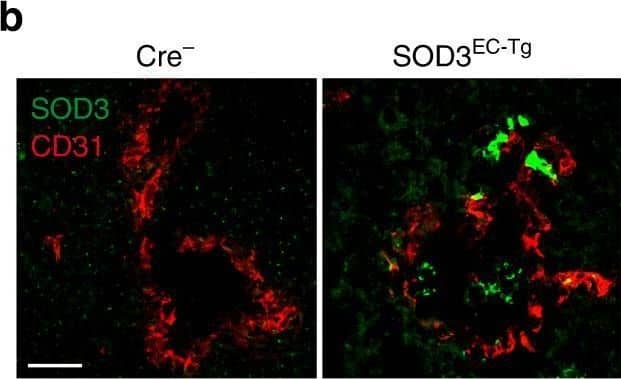
Detection of Mouse SOD3/EC-SOD by Immunohistochemistry EC-specific SOD3 expression is sufficient to increase Doxo effect. a Conditional expression allele for the SOD3-IRES-GFP gene at the ROSA26 locus. b SOD3 (green) and CD31 (red) detection in sections from tumors grown in Cre-expressing and Cre− mice after tamoxifen induction. c LLC tumor growth kinetics in SOD3EC-Tg and control (Cre−) mice. Arrows indicate tamoxifen and Doxo treatments (n = 10/group). d Doxo quantification in extracts of tumors dissected at day 16 from control and SOD3EC-Tg mice (n = 15 or 17 mice/group). e, f Images and quantification of lectin-FITC-perfused and CD31-stained vessels in control and SOD3EC-Tg tumors (0.7–1.2 cm3) dissected at day 20. g CD31 staining of control and SOD3EC-Tg tumors at end point. h–l CD31+ structure density (h), mean area covered by CD31+ structures (i), mean vessel length (j) and diameter (k), and the number of vessel branches (l), determined in images as in g. m CD31 (green) and VEC (red) staining of tumors grafted in SOD3EC-Tg and control mice. Bottom panels show red staining in a magnified area. n Quantification of the VEC area in CD31+ structures from images as in m. o Vessel permeability determined by FITC-lectin and Texas Red-dextran in tumors dissected at day 17 from control and SOD3EC-Tg mice. For b, e–o, 10–20 images were analyzed from 5 mice/group; *p < 0.05, **p < 0.01, two-tailed Student’s t-test. Bar, 50 μm Image collected and cropped by CiteAb from the following open publication (https://pubmed.ncbi.nlm.nih.gov/29422508), licensed under a CC-BY license. Not internally tested by R&D Systems.
 View Larger
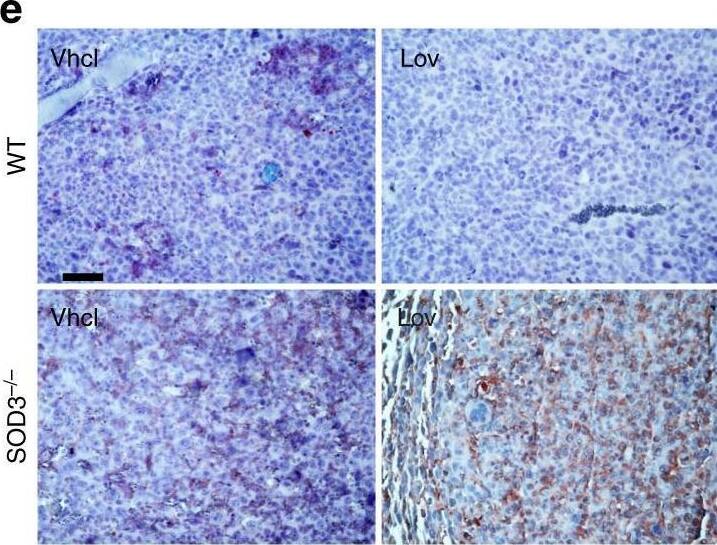
Detection of Mouse SOD3/EC-SOD by Immunohistochemistry SOD3 upregulation enhances Doxo chemotherapeutic effects. a, b LLC tumor growth kinetics in Vhcl-, Lov-, Doxo+Vhcl-, or Doxo+Lov-treated WT (a) and SOD3−/− mice (b). Arrows indicate treatment schedule (n = 10 mice/group). c Tumors from WT or SOD3−/− mice treated as above were dissected on day 16 and Doxo was quantified in tumor extracts. d Vhcl- and Lov-treated tumors from WT or SOD3−/− mice were dissected on day 18 (<1 cm3), and SOD3 and CD31 were detected in cryosections by immunohistochemistry (IHC); the two-color merge is shown (n = 10 fields/group; 4 mice/group). e 3-NT detection in paraffin sections of LLC tumors as in d (n = 15 fields/group; 4 mice/group). f LLC-GFP cells were implanted in WT or SOD3−/− mice, Lov-treated as in a, and tumors were dissected on day 21. LLC cells, ECs, and leukocytes were isolated by cell sorting and SOD3 mRNA was determined by qPCR. Data shown as mean ± SEM of triplicates (n = 5 mice/group). g Detection of SOD3 expression (red) and CD31 (green) in sections of Ad-C- or Ad-mSOD3-injected LLC tumors (dissected on day 18); nuclei are DAPI-stained (blue). Arrows in the SOD3 panel indicate the position of CD31+ cells. Bottom panel shows SOD3 fluorescence intensity quantified by ImageJ (15 images/group; 4 mice/group). h Growth kinetics of Ad-C- or Ad-mSOD3-injected LLC tumors. Arrows indicate treatment schedule (n = 9 mice/group). i Doxo quantification in extracts of tumors dissected on day 16 from mice treated as in h. *p < 0.05, **p < 0.01, ***p < 0.001 one-way ANOVA with Dunnett’s post-hoc test using Vhcl group as reference (a, b) or two-tailed Student’s t-test (f–i). Bar, 10 μm (d, g) and 50 μm (e) Image collected and cropped by CiteAb from the following open publication (https://pubmed.ncbi.nlm.nih.gov/29422508), licensed under a CC-BY license. Not internally tested by R&D Systems.
Reconstitution Calculator
Preparation and Storage
- 12 months from date of receipt, -20 to -70 °C as supplied.
- 1 month, 2 to 8 °C under sterile conditions after reconstitution.
- 6 months, -20 to -70 °C under sterile conditions after reconstitution.
Background: SOD3/EC-SOD
Superoxide Dismutases (SODs), originally identified as Indophenoloxidase (IPO), are enzymes that catalyze the conversion of naturally-occuring, but harmful, superoxide radicals into molecular oxygen and hydrogen peroxide. Superoxide Dismutases 3, SOD3, also known as extracellular (EC) SOD, is tetrameric glycoprotein with an apparent subunit molecular weight of about 30 kDa. Three isoenzymes of SOD have been identified and are functionally related but have very modest sequence homology. SOD3 shares 23% and 17% sequence identity with SOD1 and SOD2, respectively. SOD3 shares ~64% sequence homology with mouse and rat SOD3. Like SOD1, SOD3 binds one Cu2+ and Zn2+ ions per subunit but differs in sequence and tissue distribution. SOD3 is a secretory protein and is synthesized with a putative 18-amino acid signal peptide preceding the 222 amino acids in the mature SOD3. SOD3 is found in plasma, lymph, and synovial fluid as well as in tissues. SOD3 binds on the surface of endothelial cells through the heparan sulfate proteoglycan and eliminates the oxygen radicals from the NADP-dependent oxidative system of neutrophils.
Product Datasheets
Citations for Human SOD3/EC-SOD Antibody
R&D Systems personnel manually curate a database that contains references using R&D Systems products. The data collected includes not only links to publications in PubMed, but also provides information about sample types, species, and experimental conditions.
3
Citations: Showing 1 - 3
Filter your results:
Filter by:
-
GATA3 induces mitochondrial biogenesis in primary human CD4+ T cells during DNA damage
Authors: LA Callender, J Schroth, EC Carroll, C Garrod-Ket, LEL Romano, E Hendy, A Kelly, P Lavender, AN Akbar, JP Chapple, SM Henson
Nature Communications, 2021-06-07;12(1):3379.
Species: Human
Sample Types: Cell Lysates
Applications: Western Blot -
SOD3 improves the tumor response to chemotherapy by stabilizing endothelial HIF-2?
Authors: E Mira, L Carmona-Ro, B Pérez-Vill, J Casas, MJ Fernández-, D Martínez-R, P Martín-Gon, I Heras-Muri, M Paz-Cabeza, M Tardáguila, TD Oury, S Martín-Pui, RA Lacalle, G Fabriás, E Díaz-Rubio, S Mañes
Nat Commun, 2018-02-08;9(1):575.
Species: Human
Sample Types: Whole Tissue
Applications: IHC-P -
Rejuvenation of mesenchymal stem cells by extracellular vesicles inhibits the elevation of reactive oxygen species
Authors: Vuong Cat Khanh, Toshiharu Yamashita, Kinuko Ohneda, Chiho Tokunaga, Hideyuki Kato, Motoo Osaka et al.
Scientific Reports
FAQs
No product specific FAQs exist for this product, however you may
View all Antibody FAQsReviews for Human SOD3/EC-SOD Antibody
There are currently no reviews for this product. Be the first to review Human SOD3/EC-SOD Antibody and earn rewards!
Have you used Human SOD3/EC-SOD Antibody?
Submit a review and receive an Amazon gift card.
$25/€18/£15/$25CAN/¥75 Yuan/¥2500 Yen for a review with an image
$10/€7/£6/$10 CAD/¥70 Yuan/¥1110 Yen for a review without an image
