Recombinant Human TGF-beta 1 Protein
R&D Systems | Catalog # 240-B

Please see our Next Generation Human Recombinant TGF-beta 1 (11409-BH). It combines R&D Systems quality with scalability that allows for lower price points and a solid supply chain.
Key Product Details
- R&D Systems CHO-derived Recombinant Human TGF-beta 1 Protein (240-B)
- Quality control testing to verify active proteins with lot specific assays by in-house scientists
- All R&D Systems proteins are covered with a 100% guarantee
Source
Accession Number
Structure / Form
Applications
Product Specifications
Source
Ala279-Ser390
Purity
Endotoxin Level
N-terminal Sequence Analysis
Predicted Molecular Mass
SDS-PAGE
24 kDa, non-reducing conditions
Activity
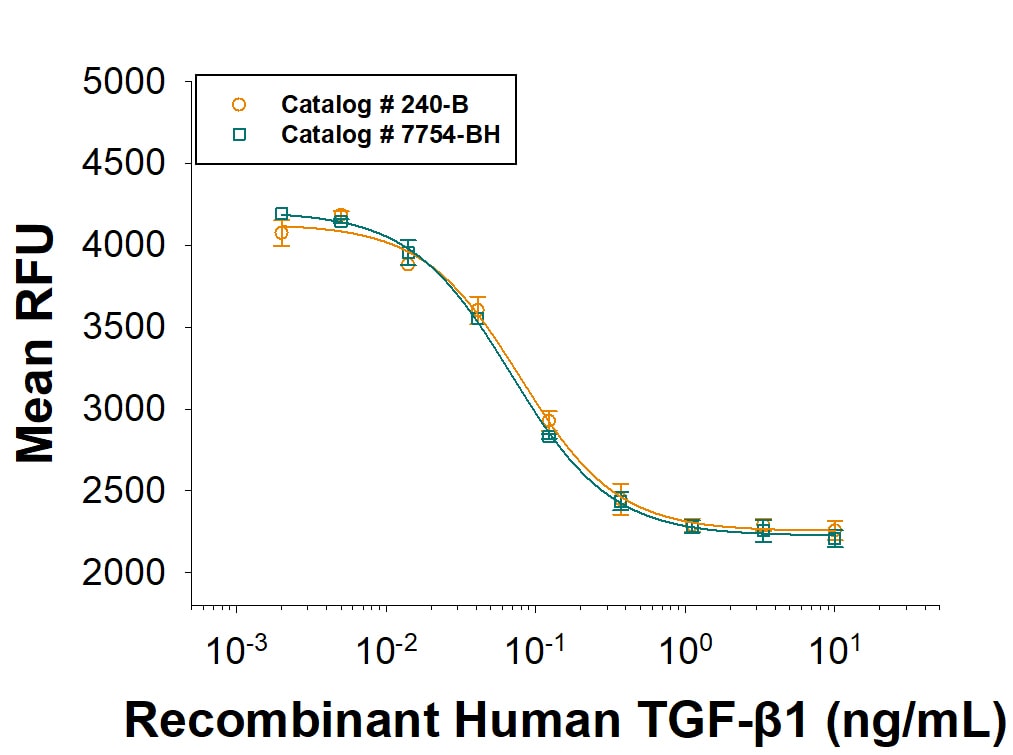
The ED50 for this effect is 0.0400-0.200 ng/mL.
Reviewed Applications
Read 2 reviews rated 5 using 240-B in the following applications:
Scientific Data Images for Recombinant Human TGF-beta 1 Protein
Equivalent bioactivity of CHO-derived and HEK293-derived Recombinant Human TGF‑ beta 1.
Equivalent bioactivity of CHO-derived (Catalog # 240-B) and HEK293-derived (7754-BH) Recombinant Human TGF‑ beta 1 as measured by its ability to inhibit the IL-4-dependent proliferation of HT‑2 mouse T cell. (orange, green, respectively).
Formulation, Preparation, and Storage
Carrier Free
What does CF mean?CF stands for Carrier Free (CF). We typically add Bovine Serum Albumin (BSA) as a carrier protein to our recombinant proteins. Adding a carrier protein enhances protein stability, increases shelf-life, and allows the recombinant protein to be stored at a more dilute concentration. The carrier free version does not contain BSA.
What formulation is right for me?In general, we advise purchasing the recombinant protein with BSA for use in cell or tissue culture, or as an ELISA standard. In contrast, the carrier free protein is recommended for applications, in which the presence of BSA could interfere.
Carrier: 240-B
| Formulation | Lyophilized from a 0.2 μm filtered solution in Acetonitrile and TFA with BSA as a carrier protein. |
| Reconstitution | Purified recombinant human TGF-beta 1 is an extremely hydrophobic protein that adheres strongly to surfaces. To ensure recovery, reconstitute 2 μg vials at 20 μg/mL in sterile 4 mM HCl containing 1 mg/mL human or bovine serum albumin. Reconstitute 10 μg or larger vials at 100 μg/mL in sterile 4 mM HCl containing 1 mg/mL human or bovine serum albumin. |
| Shipping | The product is shipped at ambient temperature. Upon receipt, store it immediately at the temperature recommended below. |
| Stability & Storage | Use a manual defrost freezer and avoid repeated freeze-thaw cycles.
|
Carrier Free: 240-B/CF
| Formulation | Lyophilized from a 0.2 μm filtered solution in Acetonitrile and TFA. |
| Reconstitution | Reconstitute 2 µg vials at 20 µg/mL in sterile 4 mM HCl containing at least 0.1% human or bovine serum albumin. Reconstitute 10 µg or larger vials at 100 µg/mL in sterile 4 mM HCl. |
| Shipping | The product is shipped at ambient temperature. Upon receipt, store it immediately at the temperature recommended below. |
| Stability & Storage | Use a manual defrost freezer and avoid repeated freeze-thaw cycles.
|
Calculators
Background: TGF-beta 1
References
- Derynck, R. and K. Miyazono (2008) Cold Spring Harbor Laboratory Press, 29.
- Dunker, N. and K. Krieglstein (2000) Eur. J. Biochem. 267:6982.
- Wahl, S.M. (2006) Immunol. Rev. 213:213.
- Chang, H. et al. (2002) Endocr. Rev. 23:787.
- Lin, J.S. et al. (2006) Reproduction 132:179.
- Hinck, A.P. et al. (1996) Biochemistry 35:8517.
- Mittl, P.R.E. et al. (1996) Protein Sci. 5:1261.
- Derynck, R. et al. (1985) Nature 316:701.
- Miyazono, K. et al. (1988) J. Biol. Chem. 263:6407.
- Oklu, R. and R. Hesketh (2000) Biochem. J. 352:601.
- de Caestecker, M. et al. (2004) Cytokine Growth Factor Rev. 15:1.
- Zuniga, J.E. et al. (2005) J. Mol. Biol. 354:1052.
Long Name
Alternate Names
Gene Symbol
UniProt
Additional TGF-beta 1 Products
Product Documents for Recombinant Human TGF-beta 1 Protein
Certificate of Analysis
To download a Certificate of Analysis, please enter a lot or batch number in the search box below.
Note: Certificate of Analysis not available for kit components.
Product Specific Notices for Recombinant Human TGF-beta 1 Protein
For research use only
Related Research Areas
Citations for Recombinant Human TGF-beta 1 Protein
 Powered by Bioz
Customer Reviews for Recombinant Human TGF-beta 1 Protein (2)
Have you used Recombinant Human TGF-beta 1 Protein?
Submit a review and receive an Amazon gift card!
$25/€18/£15/$25CAN/¥2500 Yen for a review with an image
$10/€7/£6/$10CAN/¥1110 Yen for a review without an image
Submit a review
-
Application: In vitro bioactivity in cell cultureVerified Customer | Posted 03/03/2026Activated HDFs with this.
-
Application: Cell ProliferationVerified Customer | Posted 07/11/2025
There are no reviews that match your criteria.
FAQs for Recombinant Human TGF-beta 1 Protein
-
Q: Can Recombinant Human TGF beta 1 Protein (Catalog # 240-B or 240-B/CF) be reconstituted in PBS or water?
A: Recombinant Human TGF beta 1 Protein (Catalog # 240-B or 240-B/CF) needs to be reconstituted to 100 μg/mL in sterile 4 mM HCl containing 0.1% BSA or 4 mM HCl. This protein is hydrophobic by nature, so it requires an acidic buffer for reconstitution to go completely into solution. Stability testing has been evaluated on the protein with these reconstitution conditions; we can guarantee performance under these reconstitution conditions. When the protein is diluted with the cell culture media or buffers to the working concentration, the concentration of the acid should be buffered or negligible.
-
Q: Has the half-life of recombinant human TGF beta 1 been determined?
A: While our Recombinant Human TGF-beta 1 Protein has been evaluated for bioactivity, the half-life of a specific protein will depend on experimental conditions, including the cell number, density, and media content. It is up to the end-user to determine the appropriate concentration and timing when adding Recombinant Human TGF-beta 1 Protein to individual experiments. For techniques and methodologies, we recommend reviewing our list of publications under the Citations tab on the product-specific web page to find reported use of our products in similar experimental layouts.
-
Q: Is the Recombinant Human TGF-beta 1 Protein (Catalog # 240-B) supplied as the active or latent form?
A: Human TGF-beta 1 is latent when it is bound to another protein, the latency-associated peptide (LAP), but it is active when it is not bound to this peptide. Recombinant Human TGF-beta 1 Protein (Catalog # 240-B) contains only the TGF-beta 1 protein (without LAP), thus it is supplied as the active form of TGF-beta 1.
-
Q: Will Recombinant Human TGF-beta 1 support the maintenance of either human or non-human cultured cells?
A: TGF-beta 1 performs multiple cellular functions, including cell growth, proliferation, differentiation and apoptosis. It would be necessary to determine the specific conditions for cell growth/proliferation for the cells being cultured.
-
Q: Can Recombinant Human TGF beta 1 Protein (Catalog # 240-B or 240-B/CF) be reconstituted in PBS or water?
A: Recombinant Human TGF beta 1 Protein (Catalog # 240-B or 240-B/CF) needs to be reconstituted to 100 μg/mL in sterile 4 mM HCl containing 0.1% BSA or 4 mM HCl. This protein is hydrophobic by nature, so it requires an acidic buffer for reconstitution to go completely into solution. Stability testing has been evaluated on the protein with these reconstitution conditions; we can guarantee performance under these reconstitution conditions. When the protein is diluted with the cell culture media or buffers to the working concentration, the concentration of the acid should be buffered or negligible.
-
Q: Has the half-life of recombinant human TGF beta 1 been determined?
A: While our Recombinant Human TGF-beta 1 Protein has been evaluated for bioactivity, the half-life of a specific protein will depend on experimental conditions, including the cell number, density, and media content. It is up to the end-user to determine the appropriate concentration and timing when adding Recombinant Human TGF-beta 1 Protein to individual experiments. For techniques and methodologies, we recommend reviewing our list of publications under the Citations tab on the product-specific web page to find reported use of our products in similar experimental layouts.
-
Q: Is the Recombinant Human TGF-beta 1 Protein (Catalog # 240-B) supplied as the active or latent form?
A: Human TGF-beta 1 is latent when it is bound to another protein, the latency-associated peptide (LAP), but it is active when it is not bound to this peptide. Recombinant Human TGF-beta 1 Protein (Catalog # 240-B) contains only the TGF-beta 1 protein (without LAP), thus it is supplied as the active form of TGF-beta 1.
-
Q: Will Recombinant Human TGF-beta 1 support the maintenance of either human or non-human cultured cells?
A: TGF-beta 1 performs multiple cellular functions, including cell growth, proliferation, differentiation and apoptosis. It would be necessary to determine the specific conditions for cell growth/proliferation for the cells being cultured.
-
Q: Can Recombinant Human TGF beta 1 Protein (Catalog # 240-B or 240-B/CF) be reconstituted in PBS or water?
A: Recombinant Human TGF beta 1 Protein (Catalog # 240-B or 240-B/CF) needs to be reconstituted to 100 μg/mL in sterile 4 mM HCl containing 0.1% BSA or 4 mM HCl. This protein is hydrophobic by nature, so it requires an acidic buffer for reconstitution to go completely into solution. Stability testing has been evaluated on the protein with these reconstitution conditions; we can guarantee performance under these reconstitution conditions. When the protein is diluted with the cell culture media or buffers to the working concentration, the concentration of the acid should be buffered or negligible.
-
Q: Has the half-life of recombinant human TGF beta 1 been determined?
A: While our Recombinant Human TGF-beta 1 Protein has been evaluated for bioactivity, the half-life of a specific protein will depend on experimental conditions, including the cell number, density, and media content. It is up to the end-user to determine the appropriate concentration and timing when adding Recombinant Human TGF-beta 1 Protein to individual experiments. For techniques and methodologies, we recommend reviewing our list of publications under the Citations tab on the product-specific web page to find reported use of our products in similar experimental layouts.
-
Q: Is the Recombinant Human TGF-beta 1 Protein (Catalog # 240-B) supplied as the active or latent form?
A: Human TGF-beta 1 is latent when it is bound to another protein, the latency-associated peptide (LAP), but it is active when it is not bound to this peptide. Recombinant Human TGF-beta 1 Protein (Catalog # 240-B) contains only the TGF-beta 1 protein (without LAP), thus it is supplied as the active form of TGF-beta 1.
-
Q: Will Recombinant Human TGF-beta 1 support the maintenance of either human or non-human cultured cells?
A: TGF-beta 1 performs multiple cellular functions, including cell growth, proliferation, differentiation and apoptosis. It would be necessary to determine the specific conditions for cell growth/proliferation for the cells being cultured.
-
Q: Can Recombinant Human TGF beta 1 Protein (Catalog # 240-B or 240-B/CF) be reconstituted in PBS or water?
A: Recombinant Human TGF beta 1 Protein (Catalog # 240-B or 240-B/CF) needs to be reconstituted to 100 μg/mL in sterile 4 mM HCl containing 0.1% BSA or 4 mM HCl. This protein is hydrophobic by nature, so it requires an acidic buffer for reconstitution to go completely into solution. Stability testing has been evaluated on the protein with these reconstitution conditions; we can guarantee performance under these reconstitution conditions. When the protein is diluted with the cell culture media or buffers to the working concentration, the concentration of the acid should be buffered or negligible.
-
Q: Has the half-life of recombinant human TGF beta 1 been determined?
A: While our Recombinant Human TGF-beta 1 Protein has been evaluated for bioactivity, the half-life of a specific protein will depend on experimental conditions, including the cell number, density, and media content. It is up to the end-user to determine the appropriate concentration and timing when adding Recombinant Human TGF-beta 1 Protein to individual experiments. For techniques and methodologies, we recommend reviewing our list of publications under the Citations tab on the product-specific web page to find reported use of our products in similar experimental layouts.
-
Q: Is the Recombinant Human TGF-beta 1 Protein (Catalog # 240-B) supplied as the active or latent form?
A: Human TGF-beta 1 is latent when it is bound to another protein, the latency-associated peptide (LAP), but it is active when it is not bound to this peptide. Recombinant Human TGF-beta 1 Protein (Catalog # 240-B) contains only the TGF-beta 1 protein (without LAP), thus it is supplied as the active form of TGF-beta 1.
-
Q: Will Recombinant Human TGF-beta 1 support the maintenance of either human or non-human cultured cells?
A: TGF-beta 1 performs multiple cellular functions, including cell growth, proliferation, differentiation and apoptosis. It would be necessary to determine the specific conditions for cell growth/proliferation for the cells being cultured.
Associated Pathways
 Embryonic and Induced Pluripotent Stem Cell Differentiation Pathways & Lineage-specific Markers
 IL-2 Signaling Pathways and their Primary Biological Effects in Different Immune Cell Types
 IL-4 Signaling Pathways and their Primary Biological Effects in Different Immune Cell Types
 IL-9 Signaling Pathways and their Primary Biological Effects in Different Immune Cell Types
 Mesenchymal Stem Cell Differentiation Pathways & Lineage-specific Markers
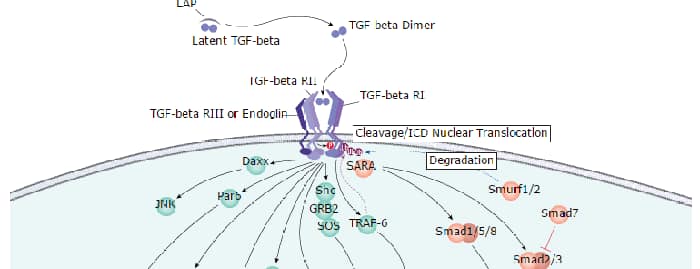
 TGF-beta Signaling Pathways
 Th17 Differentiation Pathway