Human BMPR-IB/ALK-6 PE-conjugated Antibody Summary
Lys14-Arg126
Accession # O00238
Applications
Please Note: Optimal dilutions should be determined by each laboratory for each application. General Protocols are available in the Technical Information section on our website.
Scientific Data
 View Larger
Detection of BMPR‑IB/ALK‑6 in PC‑3 Human Cell Line by Flow Cytometry. PC-3 human prostate cancer cell line was stained with Mouse Anti-Human BMPR-IB/ALK-6 PE-conjugated Monoclonal Antibody (Catalog # FAB5051P, filled histogram) or isotype control antibody (Catalog # IC0041P, open histogram). View our protocol for Staining Membrane-associated Proteins.
 View Larger
Detection of BMPR-IB/ALK-6 in Human iPS cells differentiated to Mesoderm by Flow Cytometry. Human iPS cells differentiated to mesoderm (using Catalog # SC030B) were stained with Mouse Anti-Human BMPR-IB/ALK-6 PE-conjugated Monoclonal Antibody (Catalog # FAB5051P, filled histogram) or isotype control antibody (Catalog # IC0041P, open histogram). View our protocol for Staining Membrane-associated Proteins.
 View Larger
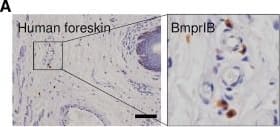
Detection of BMPR-IB/ALK-6 by Immunohistochemistry Characterization of BmprIB+ dermal cells. (A): Immunohistochemical staining of BmprIB in human foreskin. (B): Percentage evaluation of BmprIB expression in freshly isolated human dermal cells by flow cytometry. Histograms of BmprIB expression (left; 3.5% ± 0.4%) and isotype control (right). (C): Cell morphology under phase‐contrast microscopy. (D): The proliferative potential was assessed with the Alamar Blue assay in usDCs and BmprIB+ cells. Cell numbers were quantified by the absorbance wavelength at 570 nm using a spectrophotometer at 24, 48, 72, and 96 hours. Data represented the mean of three individuals and each of them was the mean of triplicate experiments. The osteogenic potential of BmprIB+ cells was demonstrated by ALP staining (E) and ARS staining (F). (G): The mRNA expression levels of ALP (at day 7) and OCN, OPN, and BSP (at day 21) were analyzed by real‐time polymerase chain reaction after osteogenic induction. Data represent the mean ± SD (n = 3). ∗, p <.05 indicates statistical significance. Scale bars = 50 µm. Abbreviations: ALP, alkaline phosphatase; ARS, alizarin red S stain; BmprIB, bone morphogenetic protein receptor type IB; usDC, unsorted dermal cell. Image collected and cropped by CiteAb from the following open publication (https://pubmed.ncbi.nlm.nih.gov/28170187), licensed under a CC-BY license. Not internally tested by R&D Systems.
Reconstitution Calculator
Preparation and Storage
- 12 months from date of receipt, 2 to 8 °C as supplied.
Background: BMPR-IB/ALK-6
Cellular responses to bone morphogenetic proteins (BMPs) have been shown to be mediated by the formation of hetero-oligomeric complexes of the type I and type II serine/threonine kinase receptors. BMP receptor IB (BMPR-IB), also known as activin receptor-like kinase (ALK)-6, is one of seven known type I serine/threonine kinases that are required for the signal transduction of TGF-beta family cytokines. In contrast to the TGF-beta receptor system in which the type I receptor does not bind TGF-beta in the absence of the type II receptor, type I receptors involved in BMP signaling (including BMPR-IA, BMPR-IB/ALK-6, and ActR-I/ALK-2) can independently bind the various BMP family proteins in the absence of type II receptors. Recombinant soluble BMPR-IB binds BMP-4 with high-affinity in solution and is a potent BMP-4 antagonist in vitro. BMPR-IB is expressed in various tissues during embryogenesis. In adult tissues, BMPR-IB is only found in the brain. The extracellular domain of BMPR-IB shares little amino acid sequence identity with the other mammalian ALK type I receptor kinases, but the cysteine residues are conserved. Human and mouse BMPR-IB are highly conserved and share 98% amino acid sequence identity.
- Kawabata, M. et al. (1998) Cytokine and Growth Factor Reviews 9:49.
- Ebendal, T. et al. (1998) J. Neuroscience Research 51:139.
Product Datasheets
Citations for Human BMPR-IB/ALK-6 PE-conjugated Antibody
R&D Systems personnel manually curate a database that contains references using R&D Systems products. The data collected includes not only links to publications in PubMed, but also provides information about sample types, species, and experimental conditions.
4
Citations: Showing 1 - 4
Filter your results:
Filter by:
-
Activation of Activin receptor-like kinases curbs mucosal inflammation and proliferation in chronic rhinosinusitis with nasal polyps
Authors: L Tengroth, J Arebro, O Larsson, C Bachert, SK Georén, LO Cardell
Sci Rep, 2018-01-24;8(1):1561.
Species: Human
Sample Types: Whole Cells
Applications: Flow Cytometry -
A Selective Cell Population from Dermis Strengthens Bone Regeneration
Authors: Tingliang Wang, Jinguang He, Yang Zhang, Wenjun Shi, Jiasheng Dong, Ming Pei et al.
Stem Cells Translational Medicine
-
A Selective Cell Population From Dermis Strengthens Bone Regeneration
Stem Cells Transl Med, 2016-01-01;0(0):.
Species: Human
Sample Types: Whole Cells
Applications: Cell Selection -
Bone morphogenetic protein receptor IB as a marker for enrichment of osteogenic precursor-like cells in human dermis.
Authors: He J, Dong J, Wang T
Arch. Dermatol. Res., 2011-06-05;303(8):581-90.
Species: Human
Sample Types: Whole Cells
Applications: Flow Cytometry
FAQs
No product specific FAQs exist for this product, however you may
View all Antibody FAQsReviews for Human BMPR-IB/ALK-6 PE-conjugated Antibody
There are currently no reviews for this product. Be the first to review Human BMPR-IB/ALK-6 PE-conjugated Antibody and earn rewards!
Have you used Human BMPR-IB/ALK-6 PE-conjugated Antibody?
Submit a review and receive an Amazon gift card.
$25/€18/£15/$25CAN/¥75 Yuan/¥2500 Yen for a review with an image
$10/€7/£6/$10 CAD/¥70 Yuan/¥1110 Yen for a review without an image
