Human Cathepsin V Antibody Summary
Val18-Val334
Accession # O60911
Applications
Please Note: Optimal dilutions should be determined by each laboratory for each application. General Protocols are available in the Technical Information section on our website.
Scientific Data
 View Larger
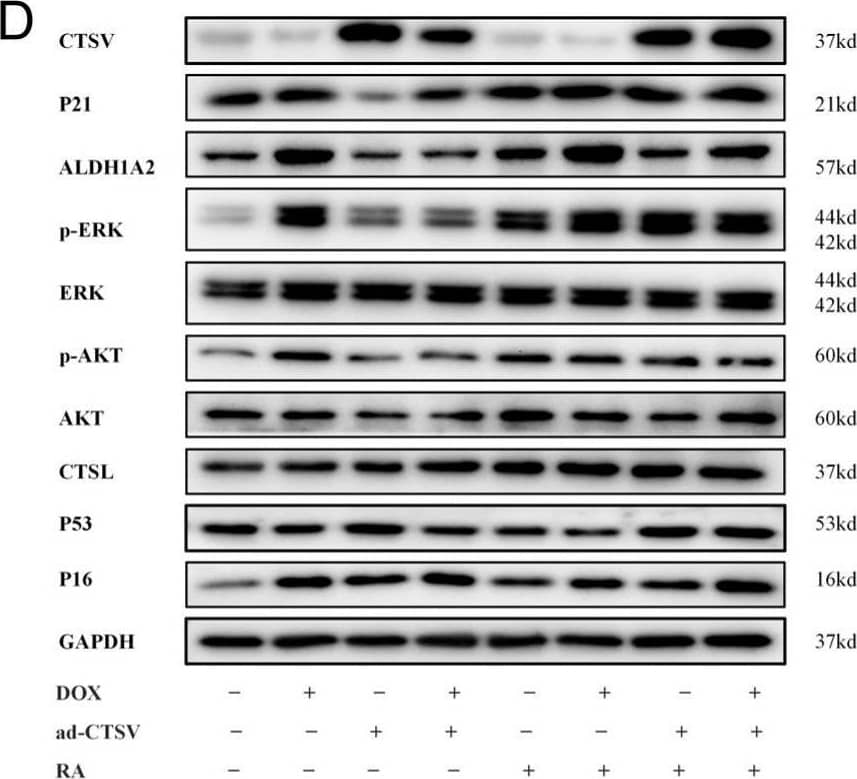
Detection of Cathepsin V by Western Blot CTSV attenuates DOX-induced cellular senescence. (A). HUVECs were treated with ad-negative control (NC) or ad-CTSV (MOI = 10) for 8 h and simulated with 100 nM doxorubicin (DOX) and 1 μM RA for 24 h after incubated in complete growth medium for 40 h. SA-beta -gal activity was analyzed (blue staining for the senescent cells, scale bar = 50 μm, n = 4). (B) EdU assay of the cell proliferation ability in HUVECs treated with DOX, RA and ad-CTSV (red staining for the EdU, blue staining for Hoechst, scale bar = 25 μm, n = 4). (C) Representative image of the wound healing assay and the quantification of wound area in HUVECs (scale bar = 100 μm, n = 4). (D) Western blot of CTSV, ALDH1A2, P21, p-ERK1/2, ERK1/2, p-AKT, AKT, CTSL, P53, and P16 in HUVECs treated with DOX, RA and ad-CTSV (n = 4). (E) Relative mRNA level of CTSV, ALDH1A2, P21, IL-1 beta, IL-6, and ICAM-1 (n = 4). (F) RA concentration in HUVECs treated with DOX, RA, and ad-CTSV (n = 4). Data are presented as mean ± SEM. One-way ANOVA test was used. * p < 0.05, ** p < 0.01, *** p < 0.001. Image collected and cropped by CiteAb from the following open publication (https://pubmed.ncbi.nlm.nih.gov/36671735), licensed under a CC-BY license. Not internally tested by R&D Systems.
 View Larger
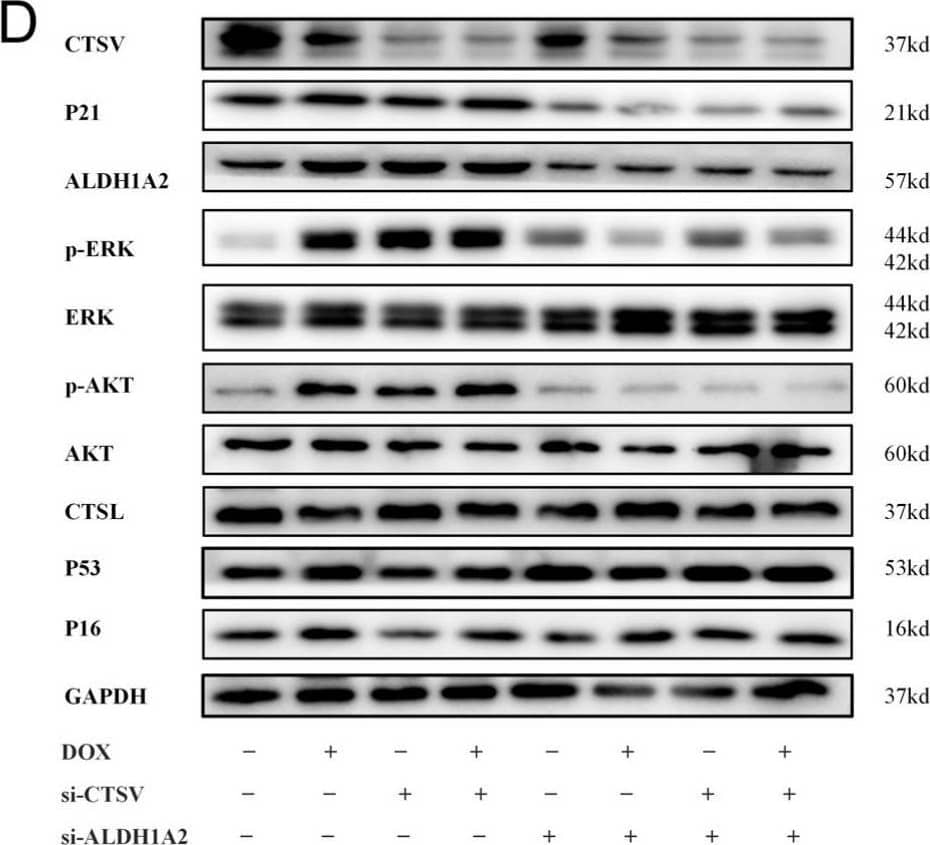
Detection of Cathepsin V by Western Blot Inhibition of CTSV induces cellular senescence. (A) HUVECs were treated with si-negative control (NC), si-CTSV, si-ALDH1A2 or si-CTSV + si-ALDH1A2 for 24 h and simulated with 100 nM doxorubicin (DOX) for 24 h after incubated in complete growth medium for 24 h. SA-beta -gal activity was analyzed (blue staining for the senescent cells, scale bar = 50 μm, n = 4). (B) EdU assay of the cell proliferation ability in HUVECs treated with DOX, si-CTSV and si-ALDH1A2 (red staining for the EdU, blue staining for Hoechst, scale bar = 25 μm, n = 4). (C) Representative image of the wound healing assay and the quantification of wound area in HUVECs (scale bar = 100 μm, n = 4). (D) Western blot of CTSV, ALDH1A2, P21, p-ERK1/2, ERK1/2, p-AKT, AKT, CTSL, P53 and P16 in HUVECs treated with DOX and siRNAs (n = 4). (E) Relative mRNA level of CTSV, ALDH1A2, P21, IL-1 beta, IL-6 and ICAM-1 (n = 4). (F) RA concentration in HUVECs treated with DOX and siRNAs (n = 4). Data are presented as mean ± SEM. One-way ANOVA test was used. * p < 0.05, ** p < 0.01, *** p < 0.001. Image collected and cropped by CiteAb from the following open publication (https://pubmed.ncbi.nlm.nih.gov/36671735), licensed under a CC-BY license. Not internally tested by R&D Systems.
 View Larger
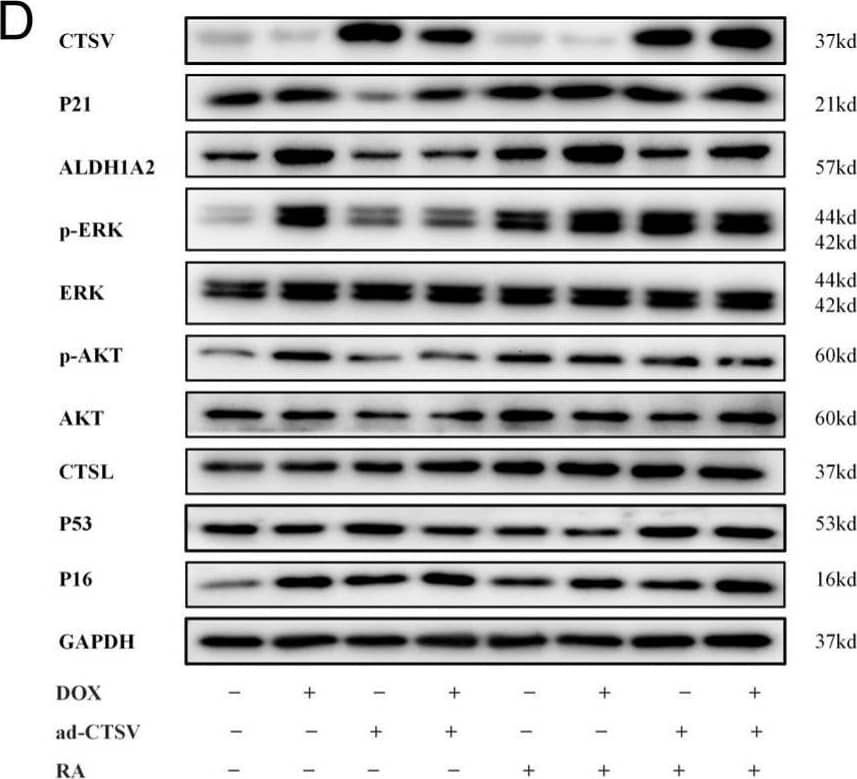
Detection of Cathepsin V by Western Blot CTSV attenuates DOX-induced cellular senescence. (A). HUVECs were treated with ad-negative control (NC) or ad-CTSV (MOI = 10) for 8 h and simulated with 100 nM doxorubicin (DOX) and 1 μM RA for 24 h after incubated in complete growth medium for 40 h. SA-beta -gal activity was analyzed (blue staining for the senescent cells, scale bar = 50 μm, n = 4). (B) EdU assay of the cell proliferation ability in HUVECs treated with DOX, RA and ad-CTSV (red staining for the EdU, blue staining for Hoechst, scale bar = 25 μm, n = 4). (C) Representative image of the wound healing assay and the quantification of wound area in HUVECs (scale bar = 100 μm, n = 4). (D) Western blot of CTSV, ALDH1A2, P21, p-ERK1/2, ERK1/2, p-AKT, AKT, CTSL, P53, and P16 in HUVECs treated with DOX, RA and ad-CTSV (n = 4). (E) Relative mRNA level of CTSV, ALDH1A2, P21, IL-1 beta, IL-6, and ICAM-1 (n = 4). (F) RA concentration in HUVECs treated with DOX, RA, and ad-CTSV (n = 4). Data are presented as mean ± SEM. One-way ANOVA test was used. * p < 0.05, ** p < 0.01, *** p < 0.001. Image collected and cropped by CiteAb from the following open publication (https://pubmed.ncbi.nlm.nih.gov/36671735), licensed under a CC-BY license. Not internally tested by R&D Systems.
 View Larger
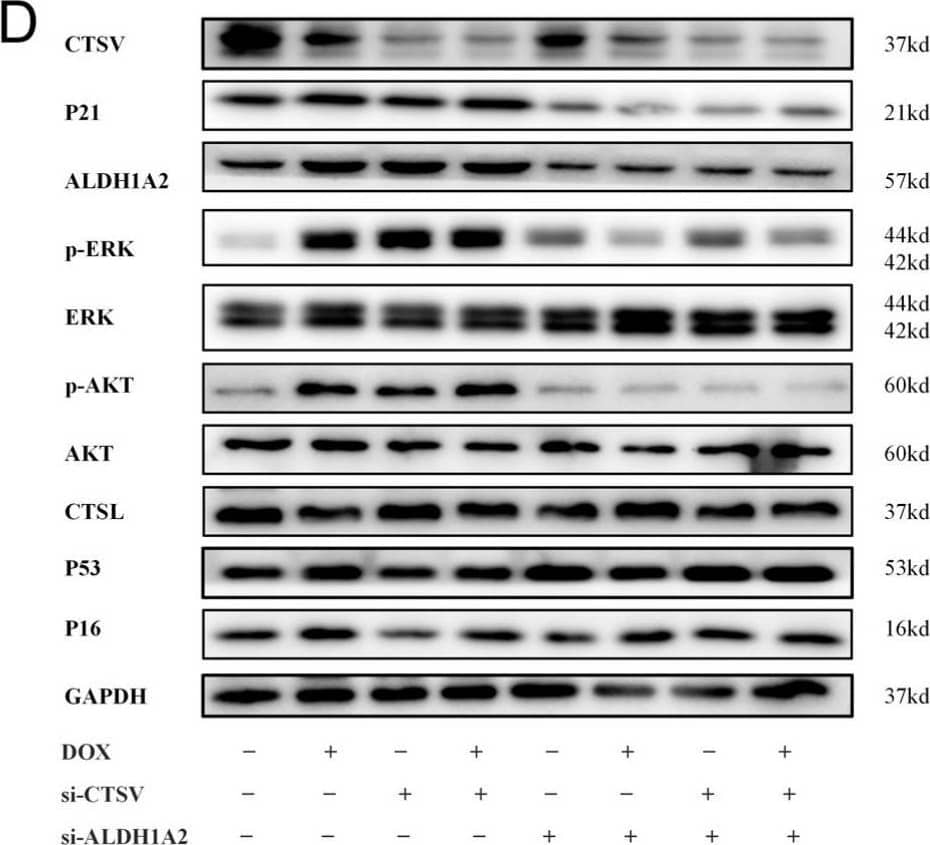
Detection of Cathepsin V by Western Blot Inhibition of CTSV induces cellular senescence. (A) HUVECs were treated with si-negative control (NC), si-CTSV, si-ALDH1A2 or si-CTSV + si-ALDH1A2 for 24 h and simulated with 100 nM doxorubicin (DOX) for 24 h after incubated in complete growth medium for 24 h. SA-beta -gal activity was analyzed (blue staining for the senescent cells, scale bar = 50 μm, n = 4). (B) EdU assay of the cell proliferation ability in HUVECs treated with DOX, si-CTSV and si-ALDH1A2 (red staining for the EdU, blue staining for Hoechst, scale bar = 25 μm, n = 4). (C) Representative image of the wound healing assay and the quantification of wound area in HUVECs (scale bar = 100 μm, n = 4). (D) Western blot of CTSV, ALDH1A2, P21, p-ERK1/2, ERK1/2, p-AKT, AKT, CTSL, P53 and P16 in HUVECs treated with DOX and siRNAs (n = 4). (E) Relative mRNA level of CTSV, ALDH1A2, P21, IL-1 beta, IL-6 and ICAM-1 (n = 4). (F) RA concentration in HUVECs treated with DOX and siRNAs (n = 4). Data are presented as mean ± SEM. One-way ANOVA test was used. * p < 0.05, ** p < 0.01, *** p < 0.001. Image collected and cropped by CiteAb from the following open publication (https://pubmed.ncbi.nlm.nih.gov/36671735), licensed under a CC-BY license. Not internally tested by R&D Systems.
Reconstitution Calculator
Preparation and Storage
- 12 months from date of receipt, -20 to -70 °C as supplied.
- 1 month, 2 to 8 °C under sterile conditions after reconstitution.
- 6 months, -20 to -70 °C under sterile conditions after reconstitution.
Background: Cathepsin V
Cathepsin V, also known as cathepsin L2 and cathepsin U, is a lysosomal cysteine protease expressed in the thymus, testis, and corneal epithelium. It may play a role in tumor progression since it is expressed in colorectal and breast carcinomas but not in normal colon, mammary gland, or peritumoral tissues. Additionally, it may be involved in corneal physiology. The amino acid sequence of human Cathepsin V shares 99%, 83% and 76% identical with that of chimpanzee, dog and mouse/rat, respectively.
Product Datasheets
Citation for Human Cathepsin V Antibody
R&D Systems personnel manually curate a database that contains references using R&D Systems products. The data collected includes not only links to publications in PubMed, but also provides information about sample types, species, and experimental conditions.
1 Citation: Showing 1 - 1
-
Critical Role of Cathepsin L/V in Regulating Endothelial Cell Senescence
Authors: Chan Li, Zhaoya Liu, Mengshi Chen, Liyang Zhang, Ruizheng Shi, Hua Zhong
Biology (Basel)
FAQs
No product specific FAQs exist for this product, however you may
View all Antibody FAQsReviews for Human Cathepsin V Antibody
There are currently no reviews for this product. Be the first to review Human Cathepsin V Antibody and earn rewards!
Have you used Human Cathepsin V Antibody?
Submit a review and receive an Amazon gift card.
$25/€18/£15/$25CAN/¥75 Yuan/¥2500 Yen for a review with an image
$10/€7/£6/$10 CAD/¥70 Yuan/¥1110 Yen for a review without an image
