Human/Mouse Lipoprotein Lipase/LPL Antibody Summary
Accession # P06858
*Small pack size (-SP) is supplied either lyophilized or as a 0.2 µm filtered solution in PBS.
Applications
Please Note: Optimal dilutions should be determined by each laboratory for each application. General Protocols are available in the Technical Information section on our website.
Scientific Data
 View Larger
Detection of Human Lipoprotein Lipase/LPL by Western Blot. Western blot shows lysates of THP-1 human acute monocytic leukemia cell line. PVDF membrane was probed with 1 µg/mL of Goat Anti-Human/Mouse Lipoprotein Lipase/LPL Antigen Affinity-purified Polyclonal Antibody (Catalog # AF7197) followed by HRP-conjugated Anti-Goat IgG Secondary Antibody (Catalog # HAF017). A specific band was detected for Lipoprotein Lipase/LPL at approximately 55 kDa (as indicated). This experiment was conducted under reducing conditions and using Immunoblot Buffer Group 1.
 View Larger
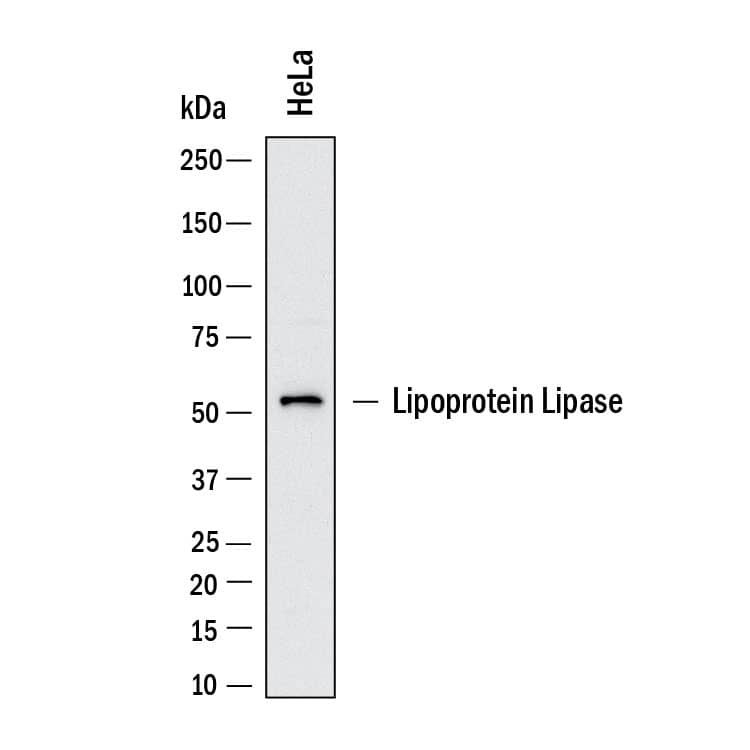
Detection of Human Lipoprotein Lipase/LPL by Western Blot. Western Blot shows lysates of HeLa human cervical epithelial carcinoma cell line. PVDF membrane was probed with 1 µg/ml of Goat Anti-Human/Mouse Lipoprotein Lipase/LPL Antigen Affinity-purified Polyclonal Antibody (Catalog # AF7197) followed by HRP-conjugated Anti-Goat IgG Secondary Antibody (Catalog # HAF017). A specific band was detected for Lipoprotein Lipase/LPL at approximately 55 kDa (as indicated). This experiment was conducted under reducing conditions and using Western Blot Buffer Group 1.
 View Larger
Detection of Human and Mouse Lipoprotein Lipase/LPL by Western Blot. Western blot shows lysates of SH-SY5Y human neuroblastoma cell line and NMuMG mouse mammary gland epithelial cell line. PVDF membrane was probed with 1 µg/mL of Goat Anti-Human Lipoprotein Lipase/LPL Antigen Affinity-purified Polyclonal Antibody (Catalog # AF7197) followed by HRP-conjugated Anti-Goat IgG Secondary Antibody (Catalog # HAF019). A specific band was detected for Lipoprotein Lipase/LPL at approximately 56 kDa (as indicated). This experiment was conducted under reducing conditions and using Immunoblot Buffer Group 1.
 View Larger
Lipoprotein Lipase/LPL in SH‑SY5Y Human Cell Line. Lipoprotein Lipase/LPL was detected in immersion fixed SH-SY5Y human neuroblastoma cell line using Goat Anti-Human Lipoprotein Lipase/LPL Antigen Affinity-purified Polyclonal Antibody (Catalog # AF7197) at 10 µg/mL for 3 hours at room temperature. Cells were stained using the NorthernLights™ 557-conjugated Anti-Goat IgG Secondary Antibody (red, upper panel; Catalog # NL001) and counterstained with DAPI (blue, lower panel). Specific staining was localized to cell surfaces and cytoplasm. View our protocol for Fluorescent ICC Staining of Cells on Coverslips. This application has not been tested in mouse samples.
 View Larger
Lipoprotein Lipase/LPL in Human Heart. Lipoprotein Lipase/LPL was detected in immersion fixed paraffin-embedded sections of human heart using Goat Anti-Human/Mouse Lipoprotein Lipase/LPL Antigen Affinity-purified Polyclonal Antibody (Catalog # AF7197) at 3 µg/mL for 1 hour at room temperature followed by incubation with the Anti-Goat IgG VisUCyte™ HRP Polymer Antibody (Catalog # VC004). Tissue was stained using DAB (brown) and counterstained with hematoxylin (blue). Specific staining was localized to cardiomyocytes. View our protocol for IHC Staining with VisUCyte HRP Polymer Detection Reagents.
 View Larger
Detection of Lipoprotein Lipase/LPL by Western Blot Obesity in Par-4-/- mice is rescued by deletion of C3. (A) Par-4 and C3 double knockout (DKO) mice are not obese. Weight of age-matched DKO (n=13, 10, 8 and 4 for each time point respectively) and Par-4+/+ (n=27, 16, 9, 5 for each time point respectively) male mice was determined over the course of 7 months; representative images of Par-4+/+ and DKO at 5-6 months are shown. (B) DKO mice do not show increased fat accumulation. Six-month-old DKO (n=8) and Par-4+/+ (n=7) male mice were examined for fat mass by Echo-MRI and adipocyte hypertrophy. (C) Triglyceride absorption is similar in DKO, C3KO and Par-4+/+ mice. DKO (n=5-6), C3-/- (n=4) and Par-4+/+ (n=11) male mice were fasted overnight and injected intraperitoneally with tyloxapol, 30 min before oral gavage of olive oil. Plasma was collected at the indicated time intervals after fat load, and triglycerides were quantified. Plasma was also subjected to western blot analysis for ApoB48. ApoB48 levels in the plasma were normalized to albumin in corresponding Coomassie blue gels, and fold change at each time point is shown (n=4). (D) LPL is upregulated in the adipose tissue of AKO and Par-4-/- mice. LPL protein levels were determined by western blot analysis in visceral adipose tissue and heart from AKO, Par-4-/- and Par-4+/+ mice (n=3). (E) LPL is not increased in the adipose tissue of DKO mice. LPL protein levels were determined by western blot analysis in visceral adipose tissue and heart from Par-4+/+ (n=4) and DKO (n= 4) male mice. LPL levels were normalized to beta -tubulin levels and fold change was calculated. Mean ± SEM, *P < 0.05, **P < 0.01, by the Student’s t-test. Also see Figures S6, S13. Image collected and cropped by CiteAb from the following open publication (https://pubmed.ncbi.nlm.nih.gov/35425699), licensed under a CC-BY license. Not internally tested by R&D Systems.
 View Larger
Detection of Lipoprotein Lipase/LPL by Western Blot Obesity in Par-4-/- mice is rescued by deletion of C3. (A) Par-4 and C3 double knockout (DKO) mice are not obese. Weight of age-matched DKO (n=13, 10, 8 and 4 for each time point respectively) and Par-4+/+ (n=27, 16, 9, 5 for each time point respectively) male mice was determined over the course of 7 months; representative images of Par-4+/+ and DKO at 5-6 months are shown. (B) DKO mice do not show increased fat accumulation. Six-month-old DKO (n=8) and Par-4+/+ (n=7) male mice were examined for fat mass by Echo-MRI and adipocyte hypertrophy. (C) Triglyceride absorption is similar in DKO, C3KO and Par-4+/+ mice. DKO (n=5-6), C3-/- (n=4) and Par-4+/+ (n=11) male mice were fasted overnight and injected intraperitoneally with tyloxapol, 30 min before oral gavage of olive oil. Plasma was collected at the indicated time intervals after fat load, and triglycerides were quantified. Plasma was also subjected to western blot analysis for ApoB48. ApoB48 levels in the plasma were normalized to albumin in corresponding Coomassie blue gels, and fold change at each time point is shown (n=4). (D) LPL is upregulated in the adipose tissue of AKO and Par-4-/- mice. LPL protein levels were determined by western blot analysis in visceral adipose tissue and heart from AKO, Par-4-/- and Par-4+/+ mice (n=3). (E) LPL is not increased in the adipose tissue of DKO mice. LPL protein levels were determined by western blot analysis in visceral adipose tissue and heart from Par-4+/+ (n=4) and DKO (n= 4) male mice. LPL levels were normalized to beta -tubulin levels and fold change was calculated. Mean ± SEM, *P < 0.05, **P < 0.01, by the Student’s t-test. Also see Figures S6, S13. Image collected and cropped by CiteAb from the following open publication (https://pubmed.ncbi.nlm.nih.gov/35425699), licensed under a CC-BY license. Not internally tested by R&D Systems.
Reconstitution Calculator
Preparation and Storage
- 12 months from date of receipt, -20 to -70 °C as supplied.
- 1 month, 2 to 8 °C under sterile conditions after reconstitution.
- 6 months, -20 to -70 °C under sterile conditions after reconstitution.
Background: Lipoprotein Lipase/LPL
LPL (LipoProtein Lipase; also LIPD) is a 53-56 kDa glycoprotein member of the Lipase family, AB Hydrolase superfamily of molecules. It is produced by multiple cell types, including adipocytes, skelelal muscle cells and macrophages. Once secreted, the circulating enzyme ultimately becomes immobilized on the surface of endothelium by binding to cell surface heparan sulfate. Here, it hydrolyzes triglycerides embedded in chylomicrons and VLDLs by homodimerizing and interacting with apoC2. Mature human LPL is 448 amino acids (aa) in length. It contains an enzymatic region (aa 37-334) plus one protein-interaction PLAT domain (aa 341-465). Over aa 28-154, human LPL shares 91% aa identity with mouse LPL.
Product Datasheets
Citations for Human/Mouse Lipoprotein Lipase/LPL Antibody
R&D Systems personnel manually curate a database that contains references using R&D Systems products. The data collected includes not only links to publications in PubMed, but also provides information about sample types, species, and experimental conditions.
12
Citations: Showing 1 - 10
Filter your results:
Filter by:
-
Sulfur Amino Acid Restriction Enhances Exercise Capacity in Mice by Boosting Fat Oxidation in Muscle
Authors: Mann, CG;MacArthur, MR;Zhang, J;Gong, S;AbuSalim, JE;Hunter, CJ;Lu, W;Agius, T;Longchamp, A;Allagnat, F;Rabinowitz, J;Mitchell, JR;De Bock, K;Mitchell, SJ;
bioRxiv : the preprint server for biology
Species: Mouse, Transgenic Mouse
Sample Types: Tissue Homogenates
Applications: Western Blot -
ANGPTL3 (Angiopoietin-Like 3) Preferentially Resides on High-Density Lipoprotein in the Human Circulation, Affecting Its Activity
Authors: Kraaijenhof, JM;Tromp, TR;Nurmohamed, NS;Reeskamp, LF;Langenkamp, M;Levels, JHM;Boekholdt, SM;Wareham, NJ;Hoekstra, M;Stroes, ESG;Hovingh, GK;Grefhorst, A;
Journal of the American Heart Association
Species: Mouse
Sample Types: Cell Culture Supernates
Applications: Western Blot -
The mechanisms to dispose of misfolded proteins in the endoplasmic reticulum of adipocytes
Authors: Wu, SA;Shen, C;Wei, X;Zhang, X;Wang, S;Chen, X;Torres, M;Lu, Y;Lin, LL;Wang, HH;Hunter, AH;Fang, D;Sun, S;Ivanova, MI;Lin, Y;Qi, L;
Nature communications
Species: Mouse, Transgenic Mouse
Sample Types: Cell Lysates, Whole Tissue
Applications: Immunogold Electron Microscopy, Immunohistochemistry, Immunoprecipitation, Western Blot -
High producer variant of lipoprotein lipase may protect from hepatocellular carcinoma in alcohol-associated cirrhosis
Authors: Franziska Schmalz, Janett Fischer, Hamish Innes, Stephan Buch, Christine Möller, Madlen Matz-Soja et al.
JHEP Reports
-
Tumor Suppressor Par-4 Regulates Complement Factor C3 and Obesity
Authors: Nathalia Araujo, James Sledziona, Sunil K. Noothi, Ravshan Burikhanov, Nikhil Hebbar, Saptadwipa Ganguly et al.
Frontiers in Oncology
-
Limited extent and consequences of pancreatic SARS-CoV-2 infection
Authors: Verena van der Heide, Sonia Jangra, Phillip Cohen, Raveen Rathnasinghe, Sadaf Aslam, Teresa Aydillo et al.
Cell Reports
-
Characterization of lipoprotein lipase storage vesicles in 3T3-L1 adipocytes
Authors: B Roberts, C Yang, S Neher
Journal of Cell Science, 2021-01-01;0(0):.
Species: Mouse
Sample Types: Cell Lysates, Whole Cells
Applications: ICC, Western Blot -
ANGPTL8 has both endocrine and autocrine effects on substrate utilization
Authors: Federico Oldoni, Haili Cheng, Serena Banfi, Viktoria Gusarova, Jonathan C. Cohen, Helen H. Hobbs
JCI Insight
-
Effects of acute hyperinsulinemia on skeletal muscle mitochondrial function, reactive oxygen species production, and metabolism in premenopausal women
Authors: Jonathan L. Warren, Sule Bulur, Fernando Ovalle, Samuel T. Windham, Barbara A. Gower, Gordon Fisher
Metab. Clin. Exp.
-
Firemaster� 550 and its components isopropylated triphenyl phosphate and triphenyl phosphate enhance adipogenesis and transcriptional activity of peroxisome proliferator activated receptor (Ppar?) on the adipocyte protein 2 (aP2) promoter
Authors: EWY Tung, S Ahmed, V Peshdary, E Atlas
PLoS ONE, 2017-04-24;12(4):e0175855.
Species: Mouse
Sample Types: Cell Lysates
Applications: Western Blot -
Bisphenol S- and bisphenol A-induced adipogenesis of murine preadipocytes occurs through direct peroxisome proliferator-activated receptor gamma activation
Authors: S Ahmed, E Atlas
International Journal of Obesity
Species: Mouse
Sample Types: Cell Lysates
Applications: Western Blot -
Disrupted glucose homeostasis and skeletal muscle-specific glucose uptake in an exocyst knockout mouse model
Authors: Fujimoto BA, Young M, Nakamura N et al.
The Journal of biological chemistry
FAQs
No product specific FAQs exist for this product, however you may
View all Antibody FAQsReviews for Human/Mouse Lipoprotein Lipase/LPL Antibody
There are currently no reviews for this product. Be the first to review Human/Mouse Lipoprotein Lipase/LPL Antibody and earn rewards!
Have you used Human/Mouse Lipoprotein Lipase/LPL Antibody?
Submit a review and receive an Amazon gift card.
$25/€18/£15/$25CAN/¥75 Yuan/¥2500 Yen for a review with an image
$10/€7/£6/$10 CAD/¥70 Yuan/¥1110 Yen for a review without an image

