Human/Mouse/Rat eIF4E Antibody Summary
Met1-Val217
Accession # P06730
Applications
Please Note: Optimal dilutions should be determined by each laboratory for each application. General Protocols are available in the Technical Information section on our website.
Scientific Data
 View Larger
eIF4E in MCF-7 Human Cell Line. eIF4E was detected in immersion fixed MCF-7 human breast cancer cell line using 10 µg/mL Mouse Anti-Human/Mouse/Rat eIF4E Monoclonal Antibody (Catalog # MAB3228) for 3 hours at room temperature. Cells were stained with the NorthernLights™ 557-conjugated Anti-Mouse IgG Secondary Antibody (red; Catalog # NL007) and counterstained with DAPI (blue). View our protocol for Fluorescent ICC Staining of Cells on Coverslips.
 View Larger
Detection of Human/Mouse/Rat eIF4E by Western Blot. Western blot shows lysates of MCF-7 human breast cancer cell line, Balb/3T3 mouse embryonic fibroblast cell line, and PC-12 rat adrenal pheochromocytoma cell line. PVDF membrane was probed with 0.1 µg/mL of Mouse Anti-Human/Mouse/Rat eIF4E Monoclonal Antibody (Catalog # MAB3228) followed by HRP-conjugated Anti-Mouse IgG Secondary Antibody (Catalog # HAF007). A specific band was detected for eIF4E at approximately 25 kDa (as indicated). This experiment was conducted under reducing conditions and using Immunoblot Buffer Group 1.
 View Larger
Western Blot Shows Human eIF4E Specificity by Using Knockout Cell Line. Western blot shows lysates of MCF-7 human breast cancer parental cell line and eIF4E knockout MCF-7 cell line (KO). PVDF membrane was probed with 0.5 µg/mL of Mouse Anti-Human/Mouse/Rat eIF4E Monoclonal Antibody (Catalog # MAB3228) followed by HRP-conjugated Anti-Mouse IgG Secondary Antibody (Catalog # HAF018). A specific band was detected for eIF4E at approximately 25 kDa (as indicated) in the parental MCF-7 cell line, but is not detectable in knockout MCF-7 cell line. GAPDH (Catalog # MAB5718) is shown as a loading control. This experiment was conducted under reducing conditions and using Immunoblot Buffer Group 1.
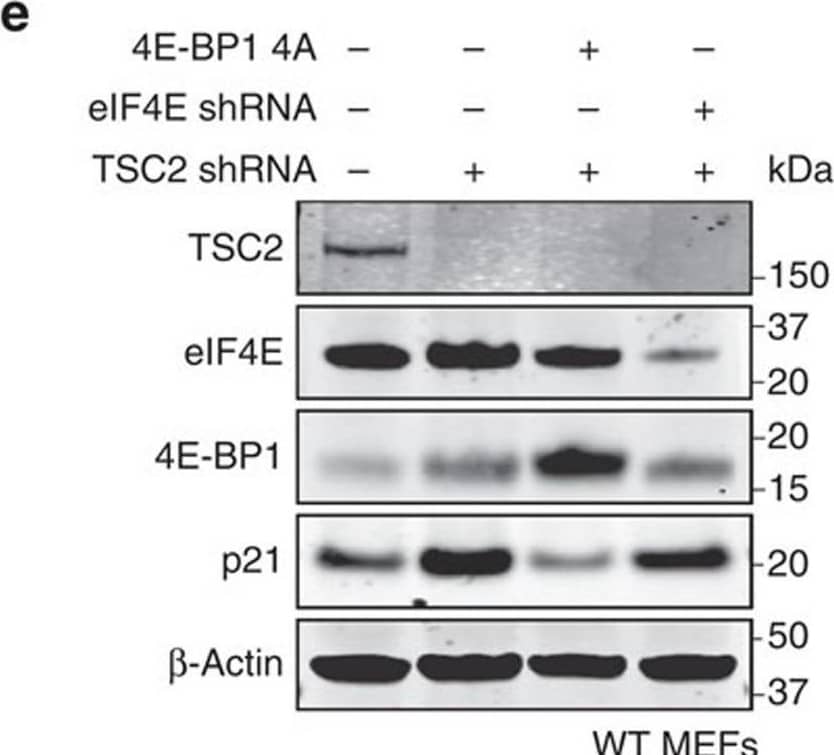 View Larger
Detection of eIF4E by Western Blot mTORC1-mediated upregulation of p21 requires 4E-BP1 phosphorylation.(a) Effect of mTOR inhibitors torin-1 (250 nM) and rapamycin (100 nM) on p21 levels in different cell lines. Cells were treated for 24 h with the indicated drugs and protein levels were subsequently analysed by western blot. (b) Protein levels in MEFs infected simultaneously with lentiviruses expressing either scramble or TSC2 shRNAs together with control or 4E-BP1-4A. (c) Protein levels in U2OS, HCT116 and 293T cells transfected with 4E-BP1-4A mutant alone (U2OS and HCT116 cells) or in combination with pBabe-p21 plasmid (293T cells). (d) Western blot depicting protein levels in MEFs following co-infection with lentiviruses expressing the indicated shRNAs. (e) Primary MEFs were infected with lentiviruses expressing scramble, TSC2 or eIF4E shRNAs in combination with control or 4E-BP1-4A. Protein levels were measured by immunoblotting. For each panel, all the western blots correspond to samples from the same experiment; in some cases, samples were distributed in several electrophoretic gels run in parallel. Image collected and cropped by CiteAb from the following open publication (https://pubmed.ncbi.nlm.nih.gov/26832959), licensed under a CC-BY license. Not internally tested by R&D Systems.
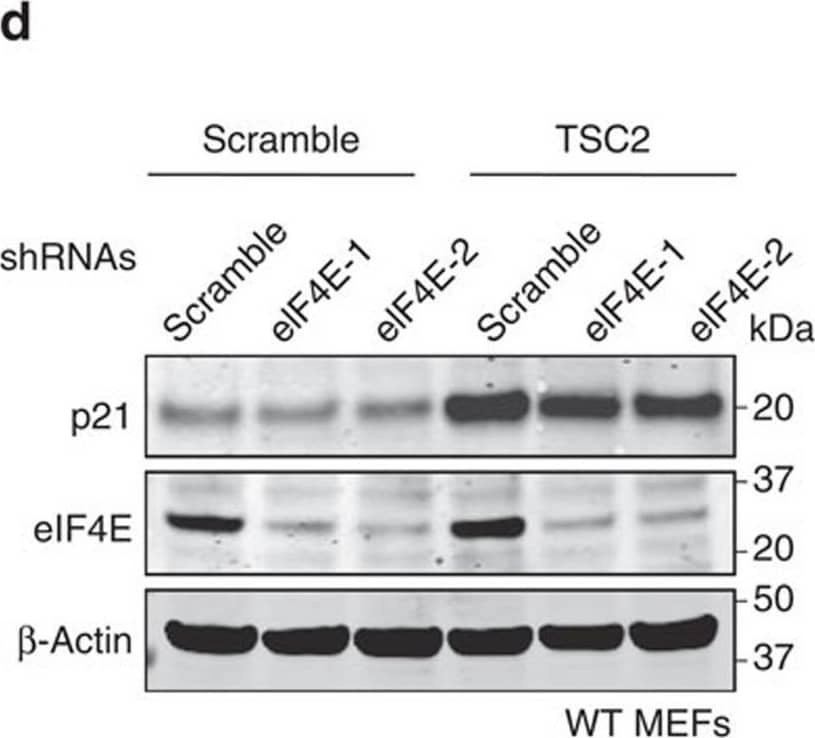 View Larger
Detection of eIF4E by Western Blot mTORC1-mediated upregulation of p21 requires 4E-BP1 phosphorylation.(a) Effect of mTOR inhibitors torin-1 (250 nM) and rapamycin (100 nM) on p21 levels in different cell lines. Cells were treated for 24 h with the indicated drugs and protein levels were subsequently analysed by western blot. (b) Protein levels in MEFs infected simultaneously with lentiviruses expressing either scramble or TSC2 shRNAs together with control or 4E-BP1-4A. (c) Protein levels in U2OS, HCT116 and 293T cells transfected with 4E-BP1-4A mutant alone (U2OS and HCT116 cells) or in combination with pBabe-p21 plasmid (293T cells). (d) Western blot depicting protein levels in MEFs following co-infection with lentiviruses expressing the indicated shRNAs. (e) Primary MEFs were infected with lentiviruses expressing scramble, TSC2 or eIF4E shRNAs in combination with control or 4E-BP1-4A. Protein levels were measured by immunoblotting. For each panel, all the western blots correspond to samples from the same experiment; in some cases, samples were distributed in several electrophoretic gels run in parallel. Image collected and cropped by CiteAb from the following open publication (https://pubmed.ncbi.nlm.nih.gov/26832959), licensed under a CC-BY license. Not internally tested by R&D Systems.
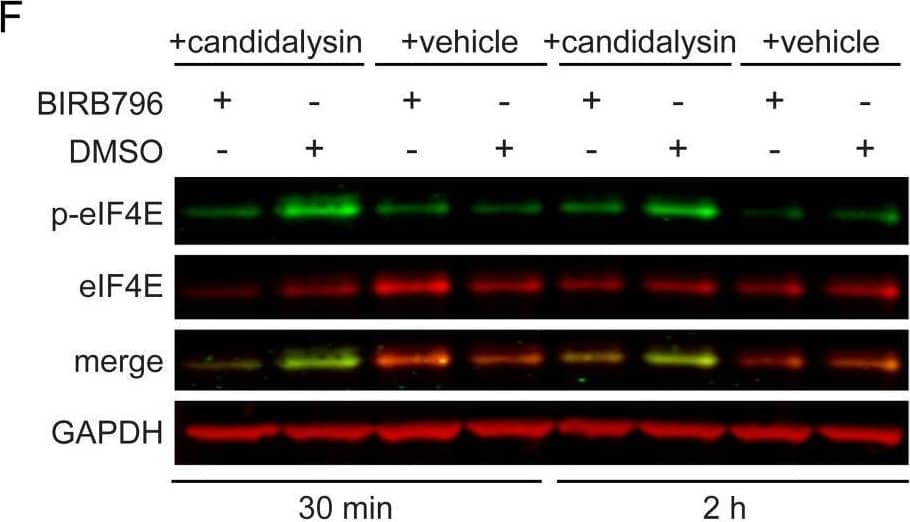 View Larger
Detection of eIF4E by Western Blot p38 and ERK1/2 trigger distinct patterns of cytokine release. A, Heatmap of the release of IL-1 alpha, IL-1 beta, IL-6, GM-CSF, and G-CSF by TR146 OECs at 24 h post-candidalysin stimulation in the presence of BIRB796, SP600125, Trametinib, or Gefitinib. The heatmap was generated from the data in fig. S2A. B, Release of GM-CSF from TR146 cells transfected with a pool of Hsp27-targeted siRNAs 72 h prior to candidalysin stimulation for 24 h. Graph shows means of three biological replicates + SD and is expressed as fold change relative to siRNA control + candidalysin. C, Relative expression of IL6 6 h post-candidalysin stimulation in the presence of BIRB796. Graph shows means of three biological replicates + SD and is expressed as fold change relative to DMSO + candidalysin. D and E, IL-6 released into the supernatant D, and present in cell extracts E, before (0 h), after 6 h and after 24 h of candidalysin treatment with or without BIRB796. Graphs show means of three biological replicates + SD and are expressed as fold change relative to DMSO + candidalysin at 24 h. F, Representative immunoblot showing phosphorylated (p-) and total eIF4E 30 min and 2 h post-candidalysin stimulation in the presence of BIRB796. Immunoblots are representative of three biological replicates. GAPDH is a loading control. G, Graphical quantification of immunoblots as in F. Scatter plot shows the mean ± SD of three biological replicates expressed as ratios of p-eIF4E/eIF4E. Statistical significance for B and C was quantified by one sample t test compared to a hypothetical value = 1. Statistical significance in D, E and G was quantified by paired t-tests as indicated in the graphs. *P < 0.05, **P < 0.01, ***P < 0.001. Image collected and cropped by CiteAb from the following open publication (https://pubmed.ncbi.nlm.nih.gov/35380879), licensed under a CC-BY license. Not internally tested by R&D Systems.
Reconstitution Calculator
Preparation and Storage
- 12 months from date of receipt, -20 to -70 °C as supplied.
- 1 month, 2 to 8 °C under sterile conditions after reconstitution.
- 6 months, -20 to -70 °C under sterile conditions after reconstitution.
Background: eIF4E
eIF4E (eukaryotic initiation factor 4E) interacts with the 7-methyl-GTP cap structure to facilitate the initiation and rate of translation of mRNA. Together with eIF4G and eIF4A, it forms the eIF4F complex. eIF4E activity has been shown to play a role in cell cycle progression, tumorigenesis, embryonic development, nuclear export and synaptic plasticity.
Product Datasheets
Citations for Human/Mouse/Rat eIF4E Antibody
R&D Systems personnel manually curate a database that contains references using R&D Systems products. The data collected includes not only links to publications in PubMed, but also provides information about sample types, species, and experimental conditions.
3
Citations: Showing 1 - 3
Filter your results:
Filter by:
-
The Candida albicans toxin candidalysin mediates distinct epithelial inflammatory responses through p38 and EGFR-ERK pathways
Authors: Spyridoula-Angeliki Nikou, Chunsheng Zhou, James S. Griffiths, Natalia K. Kotowicz, Bianca M. Coleman, Mary J. Green et al.
Science Signaling
-
Quantitative proteomic analysis of gastric cancer tissue reveals novel proteins in platelet-derived growth factor B signaling pathway
Authors: Fang Liu, Yuan Zhang, Tingting Men, Xingyue Jiang, Chunhua Yang, He Li et al.
Oncotarget
-
Single-Cell Spatial MIST for Versatile, Scalable Detection of Protein Markers
Authors: Meah, A;Vedarethinam, V;Bronstein, R;Gujarati, N;Jain, T;Mallipattu, SK;Li, Y;Wang, J;
Biosensors
Species: Mouse
Sample Types: Complex Sample Type
Applications: IHC
FAQs
No product specific FAQs exist for this product, however you may
View all Antibody FAQsReviews for Human/Mouse/Rat eIF4E Antibody
Average Rating: 5 (Based on 1 Review)
Have you used Human/Mouse/Rat eIF4E Antibody?
Submit a review and receive an Amazon gift card.
$25/€18/£15/$25CAN/¥75 Yuan/¥2500 Yen for a review with an image
$10/€7/£6/$10 CAD/¥70 Yuan/¥1110 Yen for a review without an image
Filter by:


