Human/Mouse/Rat Fibromodulin/FMOD Antibody Summary
Asp75-Ile376
Accession # Q06828
Applications
Please Note: Optimal dilutions should be determined by each laboratory for each application. General Protocols are available in the Technical Information section on our website.
Scientific Data
 View Larger
Detection of Human/Mouse/Rat Fibromodulin by Western Blot. Western blot shows lysates of human cartilage, human ovarian cancer, and rat uterine tissue. PVDF membrane was probed with 0.3 µg/mL of Sheep Anti-Human/Mouse/Rat Fibromodulin Antigen Affinity-purified Polyclonal Antibody (Catalog # AF5945) followed by HRP-conjugated Anti-Sheep IgG Secondary Antibody (Catalog # HAF016). A specific band was detected for Fibromodulin at approximately 60 kDa (as indicated). This experiment was conducted under reducing conditions and using Immunoblot Buffer Group 8.
 View Larger
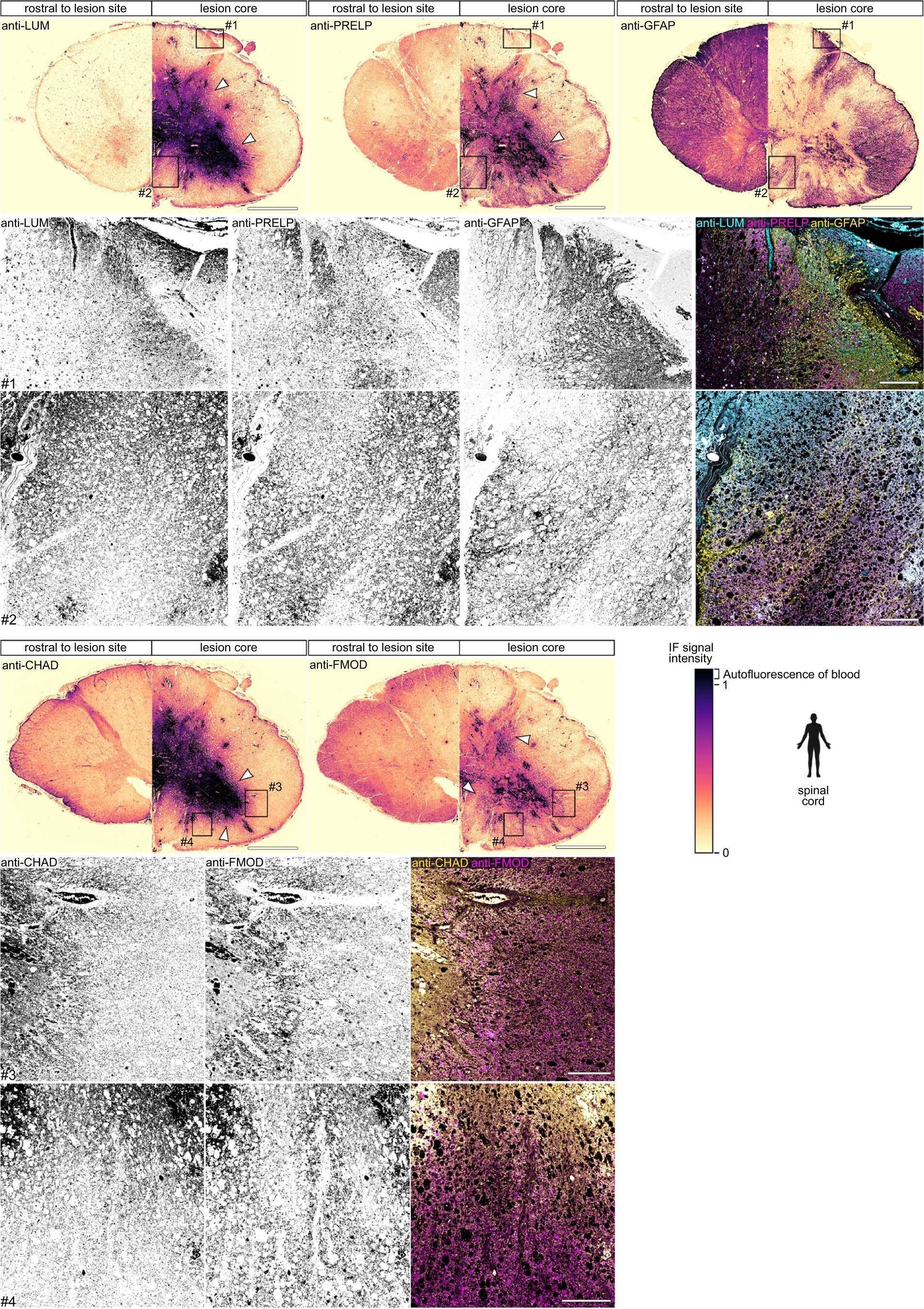
Detection of Zebrafish Fibromodulin/FMOD by Immunohistochemistry SLRPs are enriched in human spinal cord lesions.Anti-LUM, anti-PRELP, anti-CHAD, and anti-FMOD immunoreactivity is increased (arrowheads; see calibration bar of lookup table (LUT)) in the epicenter of the injured human spinal cord at nine days-post injury, as compared to rostral control segments of the same patient. Note that immunoreactivity is mainly observed in proximity to the hemorrhage (black; see calibration bar of LUT). Also note that with the exception of blood-derived autofluorescence, individual channels show distinct pattern of immunofluorescence (IF) signal (insets). Shown are transversal sections (dorsal is up). Similar results were obtained for anti-LUM in five out of six cases, for anti-PRELP and anti-FMOD in four out of six cases, and anti-CHAD in two out of six cases (Supplementary Table 3). Scale bars: 2 mm, 200 µm (insets). The human icon in the panel was created using BioRender. Image collected and cropped by CiteAb from the following open publication (https://pubmed.ncbi.nlm.nih.gov/37884489), licensed under a CC-BY license. Not internally tested by R&D Systems.
Reconstitution Calculator
Preparation and Storage
- 12 months from date of receipt, -20 to -70 °C as supplied.
- 1 month, 2 to 8 °C under sterile conditions after reconstitution.
- 6 months, -20 to -70 °C under sterile conditions after reconstitution.
Background: Fibromodulin/FMOD
Fibromodulin (FMOD; also FM and collagen-binding 59 kDa protein) is a secreted, 60‑70 kDa class II member of the SLRP family of matrix proteins. It is expressed by a variety of cell types, including keratinocytes, fibroblasts and chrondrocytes, and is known to bind to type I and XII collagen, plus TGF-beta. Fibromodulin is posited to displace lumican binding to collagen, generating 3D collagen fibrils from simple lumican-induced collagen dimers. Mature human Fibromodulin is 358 amino acids (aa) in length (aa 19‑376). It contains 12 LRRs (Leu-rich repeats) (aa 98‑376), with the seventh and eleventh LRR principally responsible for collagen type I binding. Fibromodulin contains varying amounts of keratan sulfate, and undergoes significant tyrosine sulfation. There is one splice form that shows a deletion of aa 88‑101. Over aa 76‑376, human Fibromodulin shares 96% aa identity with mouse and rat Fibromodulin.
Product Datasheets
Citation for Human/Mouse/Rat Fibromodulin/FMOD Antibody
R&D Systems personnel manually curate a database that contains references using R&D Systems products. The data collected includes not only links to publications in PubMed, but also provides information about sample types, species, and experimental conditions.
1 Citation: Showing 1 - 1
-
Small leucine-rich proteoglycans inhibit CNS regeneration by modifying the structural and mechanical properties of the lesion environment
Authors: Kolb, J;Tsata, V;John, N;Kim, K;Möckel, C;Rosso, G;Kurbel, V;Parmar, A;Sharma, G;Karandasheva, K;Abuhattum, S;Lyraki, O;Beck, T;Müller, P;Schlü beta ler, R;Frischknecht, R;Wehner, A;Krombholz, N;Steigenberger, B;Beis, D;Takeoka, A;Blümcke, I;Möllmert, S;Singh, K;Guck, J;Kobow, K;Wehner, D;
Nature communications
Species: Human, Mouse
Sample Types: Whole Tissue
Applications: Immunohistochemistry
FAQs
No product specific FAQs exist for this product, however you may
View all Antibody FAQsReviews for Human/Mouse/Rat Fibromodulin/FMOD Antibody
There are currently no reviews for this product. Be the first to review Human/Mouse/Rat Fibromodulin/FMOD Antibody and earn rewards!
Have you used Human/Mouse/Rat Fibromodulin/FMOD Antibody?
Submit a review and receive an Amazon gift card.
$25/€18/£15/$25CAN/¥75 Yuan/¥2500 Yen for a review with an image
$10/€7/£6/$10 CAD/¥70 Yuan/¥1110 Yen for a review without an image

