Human/Mouse/Rat Glutathione Peroxidase 4/GPX4 Antibody

Human/Mouse/Rat Glutathione Peroxidase 4/GPX4 Antibody Summary
Gly74-Phe168
Accession # P36969
Applications
Please Note: Optimal dilutions should be determined by each laboratory for each application. General Protocols are available in the Technical Information section on our website.
Scientific Data
View Larger
Detection of Human/Mouse/Rat Glutathione Peroxidase 4 by Western Blot. Western blot shows lysates of mouse, human, and rat liver tissue. PVDF membrane was probed with 0.5 µg/mL of Human/Mouse/Rat Glutathione Peroxidase 4 Monoclonal Antibody (Catalog # MAB5457) followed by HRP-conjugated Anti-Mouse IgG Secondary Antibody (Catalog # HAF007). A specific band was detected for Glutathione Peroxidase 4 at approximately 21 kDa (as indicated). This experiment was conducted under reducing conditions and using Immunoblot Buffer Group 2.
View Larger
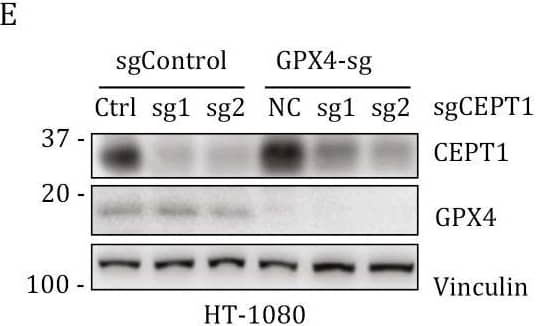
Detection of Glutathione Peroxidase 4/GPX4 by Western Blot CEPT1 inhibits ferroptosis. (E) Western blot analysis of indicated protein levels in control (sgCtrl) and CEPT1-GPX4 single and double knockout HT-1080 cells. (F and G) Relative lipid peroxidation and cell death by PI staining in the control (sgCtrl) and CEPT1-GPX4 single or double knockout HT-1080 cells with or without 5 µmol/L ferrostatin-1 (Fer-1) for 48 (F) or 72 (G) h. (H) Cell death was measured by PI staining in 786-O cells overexpressing CEPT1 or transfected with empty vector (EV) treated with DMSO or 50 nmol/L RSL3 for 24 h. (I) Cell death was measured by PI staining in 786-O cells overexpressing CEPT1 or transfected with empty vector (EV) cultured in cystine-containing (+Cystine) or cystine-free (−Cystine) medium for 24 h. (J) Cell death was measured by PI staining in 786-O cells overexpressing CEPT1 or transfected with empty vector (EV) with treatment of DMSO or 10 µmol/L erastin for 24 h. (K) Tumor volumes over time in control (sgControl) and CEPT1-knockout (sgCEPT1) HT-1080 cells-derived xenografts under the indicated treatments. (L) End-point weights of HT-1080 xenograft tumors with indicated genotypes treated with IKE or vehicle. (M–O) Representative immunochemical images (M) from HT-1080 xenograft tumors with indicated genotypes treated with IKE or vehicle and corresponding immunoreactive scores of cleaved caspase-3 (N) or 4-HNE (O). Image collected and cropped by CiteAb from the following open publication (https://academic.oup.com/proteincell/article/15/9/686/7618045), licensed under a CC-BY license. Not internally tested by R&D Systems.
View Larger
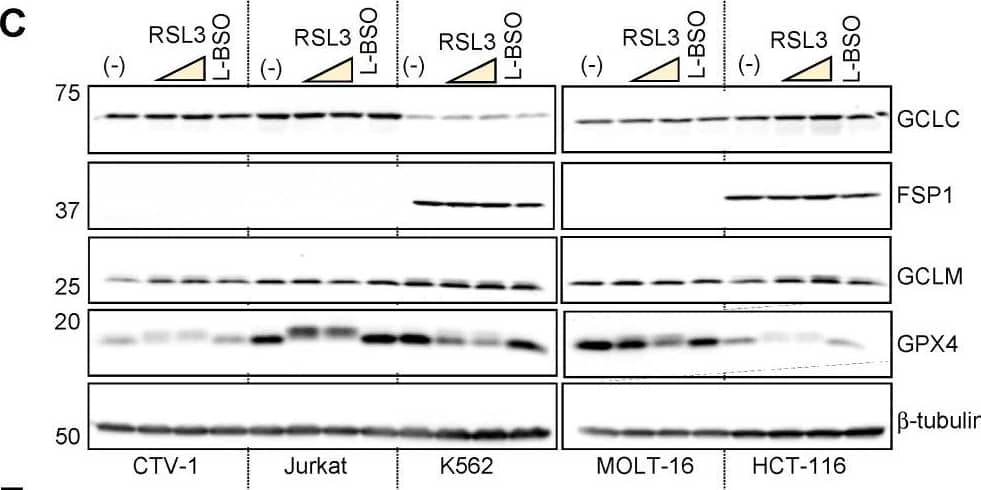
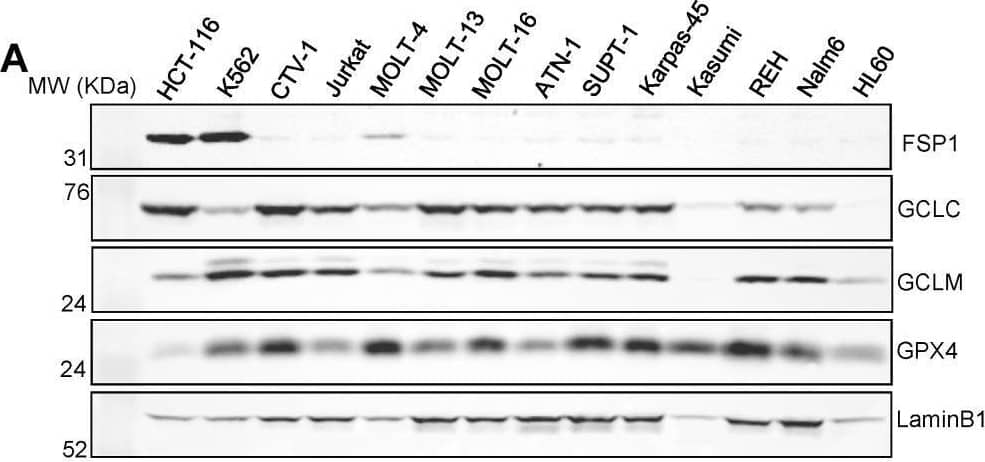
Detection of Glutathione Peroxidase 4/GPX4 by Western Blot FSP1 is silenced in acute lymphoblastic leukemia (ALL) cell lines. A. Immune blot detection of FSP1, GCLC, GCLM, and GPX4 in total protein extracts from the cell lines depicted in the figure. LaminB1 was used as loading control. B. RT-qPCR analysis of the expression of FSP1 in MOLT-16, CTV-1, Jurkat and HCT-116. Data are plotted as expression relative to the level of RNA detected in MOLT-16 (mean ± SD, one-way ANOVA corrected for multiple comparison using a Tukey test, ****P < 0.0001, ***P = 0.0004). C. Immune blot detection of FSP1, GCLC, GCLM, and GPX4 in total protein extracts from the cell lines exposed to 1S,3S-RSL3 (RSL3) or l-buthionine sulfoximine (L-BSO) for 24 h. The concentrations used were 0.25 and 1 μmol L−1 RSL3 for CTV-1, Jurkat, K562 and HCT-116. For MOLT-16 RSL3 was used at 0.05 and 0.25 μmol L−1. L-BSO was used at 100 μmol L−1 in all the cell lines. D. Quantification of FSP1 immuneblot shown in C. The data plotted correspond to 3 independent biological replicates. b-tubulin was used as loading control. E. Quantification of GCLC, GCLM and GPX4 immuneblots shown in Fig. 3C. The data plotted correspond to 3 independent biological replicates. b-tubulin was used as loading control (mean ± SD; n = 3). Image collected and cropped by CiteAb from the following open publication (https://pubmed.ncbi.nlm.nih.gov/35944469), licensed under a CC-BY license. Not internally tested by R&D Systems.
View Larger
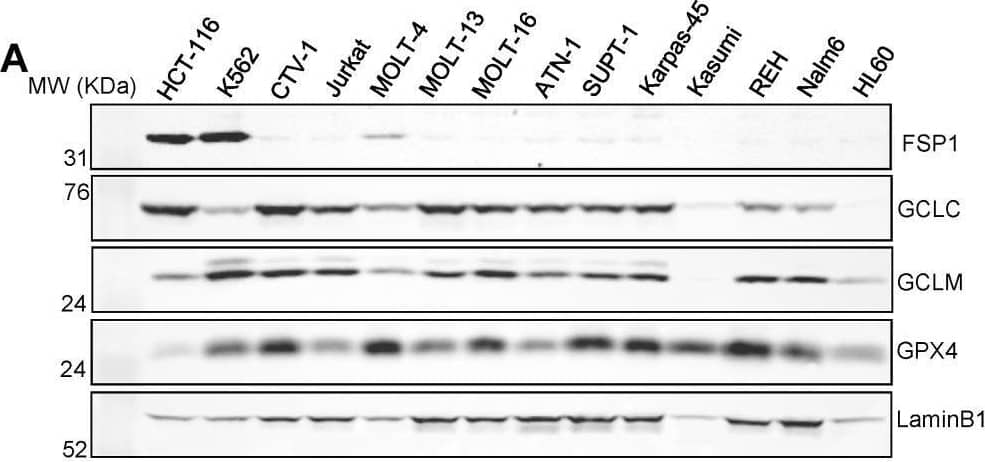
Detection of Glutathione Peroxidase 4/GPX4 by Western Blot FSP1 is silenced in acute lymphoblastic leukemia (ALL) cell lines. A. Immune blot detection of FSP1, GCLC, GCLM, and GPX4 in total protein extracts from the cell lines depicted in the figure. LaminB1 was used as loading control. B. RT-qPCR analysis of the expression of FSP1 in MOLT-16, CTV-1, Jurkat and HCT-116. Data are plotted as expression relative to the level of RNA detected in MOLT-16 (mean ± SD, one-way ANOVA corrected for multiple comparison using a Tukey test, ****P < 0.0001, ***P = 0.0004). C. Immune blot detection of FSP1, GCLC, GCLM, and GPX4 in total protein extracts from the cell lines exposed to 1S,3S-RSL3 (RSL3) or l-buthionine sulfoximine (L-BSO) for 24 h. The concentrations used were 0.25 and 1 μmol L−1 RSL3 for CTV-1, Jurkat, K562 and HCT-116. For MOLT-16 RSL3 was used at 0.05 and 0.25 μmol L−1. L-BSO was used at 100 μmol L−1 in all the cell lines. D. Quantification of FSP1 immuneblot shown in C. The data plotted correspond to 3 independent biological replicates. b-tubulin was used as loading control. E. Quantification of GCLC, GCLM and GPX4 immuneblots shown in Fig. 3C. The data plotted correspond to 3 independent biological replicates. b-tubulin was used as loading control (mean ± SD; n = 3). Image collected and cropped by CiteAb from the following open publication (https://pubmed.ncbi.nlm.nih.gov/35944469), licensed under a CC-BY license. Not internally tested by R&D Systems.
View Larger
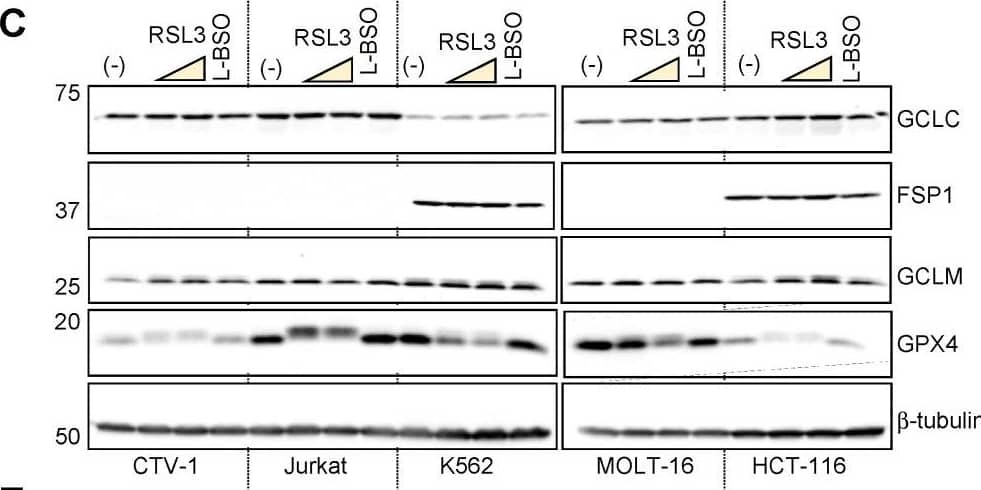
Detection of Glutathione Peroxidase 4/GPX4 by Western Blot FSP1 is silenced in acute lymphoblastic leukemia (ALL) cell lines. A. Immune blot detection of FSP1, GCLC, GCLM, and GPX4 in total protein extracts from the cell lines depicted in the figure. LaminB1 was used as loading control. B. RT-qPCR analysis of the expression of FSP1 in MOLT-16, CTV-1, Jurkat and HCT-116. Data are plotted as expression relative to the level of RNA detected in MOLT-16 (mean ± SD, one-way ANOVA corrected for multiple comparison using a Tukey test, ****P < 0.0001, ***P = 0.0004). C. Immune blot detection of FSP1, GCLC, GCLM, and GPX4 in total protein extracts from the cell lines exposed to 1S,3S-RSL3 (RSL3) or l-buthionine sulfoximine (L-BSO) for 24 h. The concentrations used were 0.25 and 1 μmol L−1 RSL3 for CTV-1, Jurkat, K562 and HCT-116. For MOLT-16 RSL3 was used at 0.05 and 0.25 μmol L−1. L-BSO was used at 100 μmol L−1 in all the cell lines. D. Quantification of FSP1 immuneblot shown in C. The data plotted correspond to 3 independent biological replicates. b-tubulin was used as loading control. E. Quantification of GCLC, GCLM and GPX4 immuneblots shown in Fig. 3C. The data plotted correspond to 3 independent biological replicates. b-tubulin was used as loading control (mean ± SD; n = 3). Image collected and cropped by CiteAb from the following open publication (https://pubmed.ncbi.nlm.nih.gov/35944469), licensed under a CC-BY license. Not internally tested by R&D Systems.
View Larger
Detection of Glutathione Peroxidase 4/GPX4 by Western Blot FSP1 is silenced in acute lymphoblastic leukemia (ALL) cell lines. A. Immune blot detection of FSP1, GCLC, GCLM, and GPX4 in total protein extracts from the cell lines depicted in the figure. LaminB1 was used as loading control. B. RT-qPCR analysis of the expression of FSP1 in MOLT-16, CTV-1, Jurkat and HCT-116. Data are plotted as expression relative to the level of RNA detected in MOLT-16 (mean ± SD, one-way ANOVA corrected for multiple comparison using a Tukey test, ****P < 0.0001, ***P = 0.0004). C. Immune blot detection of FSP1, GCLC, GCLM, and GPX4 in total protein extracts from the cell lines exposed to 1S,3S-RSL3 (RSL3) or l-buthionine sulfoximine (L-BSO) for 24 h. The concentrations used were 0.25 and 1 μmol L−1 RSL3 for CTV-1, Jurkat, K562 and HCT-116. For MOLT-16 RSL3 was used at 0.05 and 0.25 μmol L−1. L-BSO was used at 100 μmol L−1 in all the cell lines. D. Quantification of FSP1 immuneblot shown in C. The data plotted correspond to 3 independent biological replicates. b-tubulin was used as loading control. E. Quantification of GCLC, GCLM and GPX4 immuneblots shown in Fig. 3C. The data plotted correspond to 3 independent biological replicates. b-tubulin was used as loading control (mean ± SD; n = 3). Image collected and cropped by CiteAb from the following open publication (https://pubmed.ncbi.nlm.nih.gov/35944469), licensed under a CC-BY license. Not internally tested by R&D Systems.
View Larger
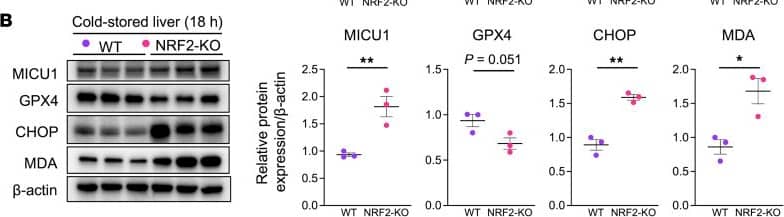
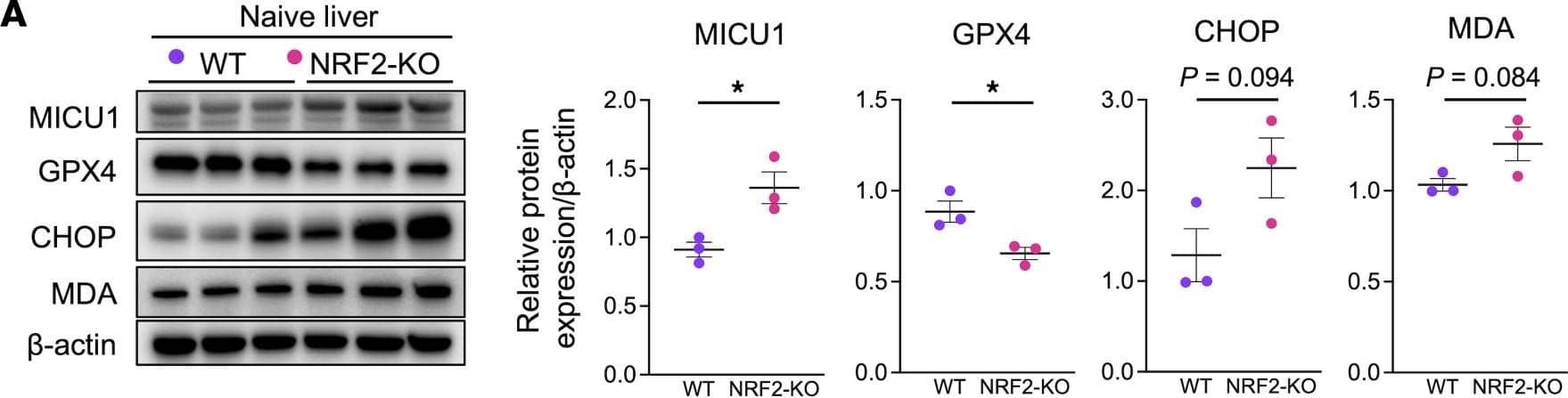
Detection of Glutathione Peroxidase 4/GPX4 by Western Blot GPX4 pathway is dispensable in cold stress–induced liver injury. Western blot–assisted detection and relative intensity ratio of MICU1, GPX4, CHOP, and MDA in WT and NRF2-deficient (NRF2-KO) (A) naive livers and (B) 18-hour cold-stored livers. Expression of beta -actin served as the internal control and was used for normalization (n = 3/group). (C) WT livers stored in UW solution (4°C/18 h) with/without RSL3 (GPX4 inhibitor) were perfused with PBS (2 mL) through a cuff placed at the portal vein to collect liver flush from inferior vena cava. (D) Western blot–assisted detection of MDA and HMGB1 in the liver flush (5 μL) from cold-stored livers (n = 4/group). (E) LDH and (F) AST/ALT levels (U/L) in the liver flush (n = 4/group). Purple circle: WT livers; pink circle: NRF2-KO livers. Data are shown as mean ± SEM. *P < 0.05, **P < 0.01, Student’s t test (A and B), 1-way ANOVA followed by Tukey’s HSD test (D−F). Image collected and cropped by CiteAb from the following open publication (https://pubmed.ncbi.nlm.nih.gov/38329125), licensed under a CC-BY license. Not internally tested by R&D Systems.
View Larger
Detection of Glutathione Peroxidase 4/GPX4 by Western Blot GPX4 pathway is dispensable in cold stress–induced liver injury. Western blot–assisted detection and relative intensity ratio of MICU1, GPX4, CHOP, and MDA in WT and NRF2-deficient (NRF2-KO) (A) naive livers and (B) 18-hour cold-stored livers. Expression of beta -actin served as the internal control and was used for normalization (n = 3/group). (C) WT livers stored in UW solution (4°C/18 h) with/without RSL3 (GPX4 inhibitor) were perfused with PBS (2 mL) through a cuff placed at the portal vein to collect liver flush from inferior vena cava. (D) Western blot–assisted detection of MDA and HMGB1 in the liver flush (5 μL) from cold-stored livers (n = 4/group). (E) LDH and (F) AST/ALT levels (U/L) in the liver flush (n = 4/group). Purple circle: WT livers; pink circle: NRF2-KO livers. Data are shown as mean ± SEM. *P < 0.05, **P < 0.01, Student’s t test (A and B), 1-way ANOVA followed by Tukey’s HSD test (D−F). Image collected and cropped by CiteAb from the following open publication (https://pubmed.ncbi.nlm.nih.gov/38329125), licensed under a CC-BY license. Not internally tested by R&D Systems.
Reconstitution Calculator
Preparation and Storage
- 12 months from date of receipt, -20 to -70 °C as supplied.
- 1 month, 2 to 8 °C under sterile conditions after reconstitution.
- 6 months, -20 to -70 °C under sterile conditions after reconstitution.
Background: Glutathione Peroxidase 4/GPX4
Glutathione Peroxidase 4 (GPX4; also known as PHGPx) is a monomeric, 21 kDa member of the glutathione peroxidase family of proteins. It is widely expressed and serves to both protect cell membranes from phospholipid and cholesterol hydroperoxidases, and form an inactive enzyme structural component of the sperm mitochondrial capsule. Human GPX4 is 197 amino acids (aa) in length and contains a mitochondrial targeting sequence (aa 1‑27) and an enzymatically active selenocysteine at Sec73. During sperm maturation, the targeting sequence is cleaved, and GPX4 may form inactive covalently-linked oligomers. There are multiple splice variants. One is ubiquitously expressed, cytoplasmic, and shows an alternate start site at Met28. A second is 226 aa in length, nuclear, and shows an Arg-rich 65 aa substitution for aa 1‑28. Over amino acids 74‑168, human GPX4 shares 93% aa identity with mouse GPX4.
Product Datasheets
Citations for Human/Mouse/Rat Glutathione Peroxidase 4/GPX4 Antibody
R&D Systems personnel manually curate a database that contains references using R&D Systems products. The data collected includes not only links to publications in PubMed, but also provides information about sample types, species, and experimental conditions.
24
Citations: Showing 1 - 10
Filter your results:
Filter by:
-
Chronic intake of Dioscorea esculenta suppresses testicular atrophy, enhances the ability of protection from inflammation in type 2 diabetes rats
Authors: Tatara, K;Sato, K;
The Journal of steroid biochemistry and molecular biology
Species: Rat
Sample Types: Tissue Homogenates
Applications: Western Blot -
BRCA1-mediated dual regulation of ferroptosis exposes a vulnerability to GPX4 and PARP co-inhibition in BRCA1-deficient cancers
Authors: Lei, G;Mao, C;Horbath, AD;Yan, Y;Cai, S;Yao, J;Jiang, Y;Sun, M;Liu, X;Cheng, J;Xu, Z;Lee, H;Li, Q;Lu, Z;Zhuang, L;Chen, MK;Alapati, A;Yap, TA;Hung, MC;You, MJ;Piwnica-Worms, H;Gan, B;
Cancer discovery
Species: Human
Sample Types: Cell Lysates
Applications: Western Blot -
Oxidative stress induces mitochondrial iron overload and ferroptotic cell death
Authors: Chen, Y;Guo, X;Zeng, Y;Mo, X;Hong, S;He, H;Li, J;Fatima, S;Liu, Q;
Scientific reports
Species: Rat
Sample Types: Cell Culture Supernates
Applications: Western Blot -
Ferulic acid protects HepG2 cells and mouse liver from iron-induced damage
Authors: Kose, T;Moreno-Fernandez, J;Vera-Aviles, M;Sharp, PA;Latunde-Dada, GO;
Biochemistry and biophysics reports
Species: Mouse
Sample Types: Tissue Homogenates
Applications: Western Blot -
Mitochondrial defects leading to arrested spermatogenesis and ferroptosis in the PARL deficient mouse model of Leigh Syndrome
Authors: Enrico Radaelli, Charles-Antoine Assenmacher, Jillian Verrelle, Esha Banerjee, Florence Manero, Salim Khiati et al.
eLife
Species: Mouse, Transgenic Mouse
Sample Types: Tissue Homogenates
Applications: Western Blot -
Reply to: DHODH inhibitors sensitize to ferroptosis by FSP1 inhibition
Authors: Mao, C;Liu, X;Yan, Y;Olszewski, K;Gan, B;
Nature
Species: Human
Sample Types: Cell Lysates
Applications: Western Blot -
Circulating hemopexin modulates anthracycline cardiac toxicity in patients and in mice
Authors: J Liu, S Lane, R Lall, M Russo, L Farrell, M Debreli Co, C Curtin, R Araujo-Gut, M Scherrer-C, BH Trachtenbe, J Kim, E Tolosano, A Ghigo, RE Gerszten, A Asnani
Science Advances, 2022-12-23;8(51):eadc9245.
Species: Mouse
Sample Types: Tissue Lysate
Applications: Western Blot -
Upregulation of Nrf2 Signalling and the Inhibition of Erastin-Induced Ferroptosis by Ferulic Acid in MIN6 Cells
Authors: T Kose, PA Sharp, GO Latunde-Da
International Journal of Molecular Sciences, 2022-12-14;23(24):.
Species: Mouse
Sample Types: Cell Lysates
Applications: Western Blot -
An iron-deficient diet prevents alcohol- or diethylnitrosamine-induced acute hepatotoxicity in mice by inhibiting ferroptosis
Authors: Zelong Gao, Dongyao Wang, Hongwei Zhang, Jianxin Yang, Min Li, Hongtao Lu et al.
Current Research in Food Science
-
Acute lymphoblastic leukemia necessitates GSH-dependent ferroptosis defenses to overcome FSP1-epigenetic silencing
Authors: LB Pontel, A Bueno-Cost, AE Morellato, J Carvalho S, G Roué, M Esteller
Redox Biology, 2022-07-31;55(0):102408.
Species: Human
Sample Types: Cell Lysates
Applications: Western Blot -
Erythroid lineage Jak2V617F expression promotes atherosclerosis through erythrophagocytosis and macrophage ferroptosis
Authors: Wenli Liu, Nataliya Östberg, Mustafa Yalcinkaya, Huijuan Dou, Kaori Endo-Umeda, Yang Tang et al.
Journal of Clinical Investigation
-
A ferroptosis defense mechanism mediated by glycerol-3-phosphate dehydrogenase 2 in mitochondria
Authors: Shiqi Wu, Chao Mao, Lavanya Kondiparthi, Masha V. Poyurovsky, Kellen Olszewski, Boyi Gan
Proceedings of the National Academy of Sciences
-
A targetable CoQ-FSP1 axis drives ferroptosis- and radiation-resistance in KEAP1 inactive lung cancers
Authors: P Koppula, G Lei, Y Zhang, Y Yan, C Mao, L Kondiparth, J Shi, X Liu, A Horbath, M Das, W Li, MV Poyurovsky, K Olszewski, B Gan
Nature Communications, 2022-04-22;13(1):2206.
Species: Human
Sample Types: Cell Lysates
Applications: Western Blot -
A targetable LIFR-NF-kappaB-LCN2 axis controls liver tumorigenesis and vulnerability to ferroptosis
Authors: F Yao, Y Deng, Y Zhao, Y Mei, Y Zhang, X Liu, C Martinez, X Su, RR Rosato, H Teng, Q Hang, S Yap, D Chen, Y Wang, MM Chen, M Zhang, H Liang, D Xie, X Chen, H Zhu, JC Chang, MJ You, Y Sun, B Gan, L Ma
Nature Communications, 2021-12-17;12(1):7333.
Species: Human, Mouse
Sample Types: Cell Lysates, Tissue Homogenates
Applications: Western Blot -
Disrupting CISD2 function in cancer cells primarily impacts mitochondrial labile iron levels and triggers TXNIP expression
Authors: Karmi O, Sohn YS, Zandalinas SI et al.
Free Radical Biology and Medicine
-
A Combined Drug Treatment That Reduces Mitochondrial Iron and Reactive Oxygen Levels Recovers Insulin Secretion in NAF-1-Deficient Pancreatic Cells
Authors: Ola Karmi, Yang-Sung Sohn, Henri-Baptiste Marjault, Tal Israeli, Gil Leibowitz, Konstantinos Ioannidis et al.
Antioxidants (Basel)
-
DHODH-mediated ferroptosis defence is a targetable vulnerability in cancer
Authors: C Mao, X Liu, Y Zhang, G Lei, Y Yan, H Lee, P Koppula, S Wu, L Zhuang, B Fang, MV Poyurovsky, K Olszewski, B Gan
Nature, 2021-05-12;0(0):.
Species: Human
Sample Types: Cell Lysates
Applications: Western Blot -
mTORC1 couples cyst(e)ine availability with GPX4 protein synthesis and ferroptosis regulation
Authors: Y Zhang, RV Swanda, L Nie, X Liu, C Wang, H Lee, G Lei, C Mao, P Koppula, W Cheng, J Zhang, Z Xiao, L Zhuang, B Fang, J Chen, SB Qian, B Gan
Nature Communications, 2021-03-11;12(1):1589.
Species: Human
Sample Types: Cell Lysates
Applications: Western Blot -
Energy-stress-mediated AMPK activation inhibits ferroptosis
Authors: H Lee, F Zandkarimi, Y Zhang, JK Meena, J Kim, L Zhuang, S Tyagi, L Ma, TF Westbrook, GR Steinberg, D Nakada, BR Stockwell, B Gan
Nat. Cell Biol., 2020-02-06;22(2):225-234.
Species: Human
Sample Types: Cell Lysates
Applications: Western Blot -
The role of ferroptosis in ionizing radiation-induced cell death and tumor suppression
Authors: Guang Lei, Yilei Zhang, Pranavi Koppula, Xiaoguang Liu, Jie Zhang, Steven H. Lin et al.
Cell Research
-
Epigenetic regulation of AURKA by miR-4715-3p in upper gastrointestinal cancers
Authors: A Gomaa, D Peng, Z Chen, M Soutto, K Abouelezz, A Corvalan, W El-Rifai
Sci Rep, 2019-11-18;9(1):16970.
Species: Human
Sample Types: Cell Lysates
Applications: Western Blot -
Reduced expression of the ferroptosis inhibitor glutathione peroxidase‐4 in multiple sclerosis and experimental autoimmune encephalomyelitis
Authors: Che‐Lin Hu, Mara Nydes, Kara L. Shanley, Itzy E. Morales Morales Pantoja, Tamara A. Howard, Oscar A. Bizzozero
Journal of Neurochemistry
-
Targeting redox homeostasis in rhabdomyosarcoma cells: GSH-depleting agents enhance auranofin-induced cell death
Authors: KJ Habermann, L Grünewald, S van Wijk, S Fulda
Cell Death Dis, 2017-10-05;8(10):e3067.
Species: Human
Sample Types: Cell Lysates
Applications: Western Blot -
Impairment of antioxidant defense via glutathione depletion sensitizes acute lymphoblastic leukemia cells for Smac mimetic-induced cell death.
Authors: Schoeneberger H, Belz K, Schenk B, Fulda S
Oncogene, 2014-11-10;34(31):4032-43.
Species: Human
Sample Types: Cell Lysates
Applications: Western Blot
FAQs
No product specific FAQs exist for this product, however you may
View all Antibody FAQsReviews for Human/Mouse/Rat Glutathione Peroxidase 4/GPX4 Antibody
There are currently no reviews for this product. Be the first to review Human/Mouse/Rat Glutathione Peroxidase 4/GPX4 Antibody and earn rewards!
Have you used Human/Mouse/Rat Glutathione Peroxidase 4/GPX4 Antibody?
Submit a review and receive an Amazon gift card.
$25/€18/£15/$25CAN/¥75 Yuan/¥2500 Yen for a review with an image
$10/€7/£6/$10 CAD/¥70 Yuan/¥1110 Yen for a review without an image
