Human/Mouse/Rat Phospho-Chk1 (S317) Antibody Summary
Applications
Please Note: Optimal dilutions should be determined by each laboratory for each application. General Protocols are available in the Technical Information section on our website.
Scientific Data
 View Larger
Detection of Human Phospho-Chk1 (S317) by Western Blot. Western blot shows lysates of HeLa human cervical epithelial carcinoma cell line untreated (-) or exposed (+) to 50 J/m2UV-C for the indicated time. PVDF membrane was probed with 1 µg/mL Rabbit Anti-Human/Mouse/Rat Phospho-Chk1 (S317) Antigen Affinity-purified Polyclonal Antibody (Catalog # AF2054) followed by HRP-conjugated Anti-Rabbit IgG Secondary Antibody (Catalog # HAF008). A specific band for Phospho-Chk1 (S317) was detected at approximately 56 kDa (as indicated). The phospho-specificity of this antibody was supported by decreased labeling following treatment with 600 U lambda-phosphatase (lambda-PPase) for 1 hour. This experiment was conducted under reducing conditions and using Immunoblot Buffer Group 1.
 View Larger
Detection of Human Phospho-Chk1 (S317) by Simple WesternTM. Simple Western lane view shows lysates of HeLa human cervical epithelial carcinoma cell line untreated (-) or treated (+) with 50 J/m2ultraviolet light (UV) for 2 hours, loaded at 0.2 mg/mL. A specific band was detected for Phospho-Chk1 (S317) at approximately 60 kDa (as indicated) using 10 µg/mL of Rabbit Anti-Human/Mouse/Rat Phospho-Chk1 (S317) Antigen Affinity-purified Polyclonal Antibody (Catalog # AF2054). This experiment was conducted under reducing conditions and using the 12-230 kDa separation system.
 View Larger
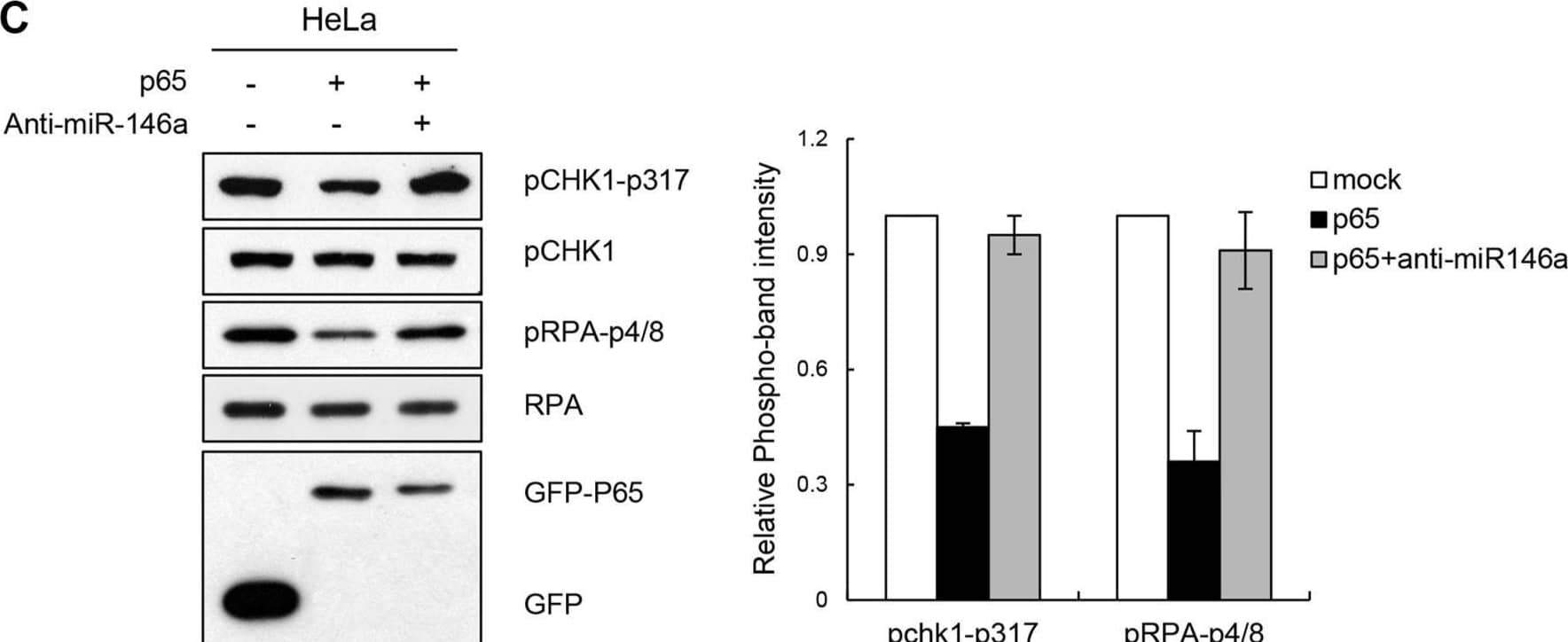
Detection of Phospho-Chk1 (S317) by Western Blot NF-kappa B reiterating miR146a function in the FA pathway and replication fork restart(A) Two days after transfection of cells with p65 cDNA and anti-miR146a in combination as indicated, cells were treated with 5 mM HU for 5 h. The levels of FANCM and p63 proteins, and FANCD2 ubiquitination were measured by western blotting. (B) After undergoing the same treatment as (A) HeLa cells were analyzed for FANCD2 foci formation. Results are shown as the mean ± SD (n = 3); **P < 0.01. (C) Under the same conditions described in (A) cell lysates were analyzed by western blotting with antibodies against pCHK1-S317, CHK1, pRPA-S4/8, RPA, and GFP. Right, quantitation of pCHK1-S317 and pRPA-S4/8 expression. Results are shown as the mean ± SD (n = 3). (D) GES-1 cells transfected with p65 construct were applied to DNA fiber analysis. Resulting images of DNA fibers of p65-overexpressing cells compared with control cells (top). CldU tract length distribution was determined (bottom). (E) HeLa or GES-1 cells with the same treatment as A were subjected to gamma -H2AX detection. Results are shown as the mean ± SD (n = 3); **P < 0.01. (F) HeLa and GES-1 cells were transfected with p65 construct and Anti-miR146a in combinations as indicated and were treated with different doses of HU for 5 hr. Cell survival thereafter was measured using clonogenic survival assay. Results are shown as the mean ± SD (n = 3); **P < 0.01. Image collected and cropped by CiteAb from the following open publication (https://pubmed.ncbi.nlm.nih.gov/27351285), licensed under a CC-BY license. Not internally tested by R&D Systems.
 View Larger
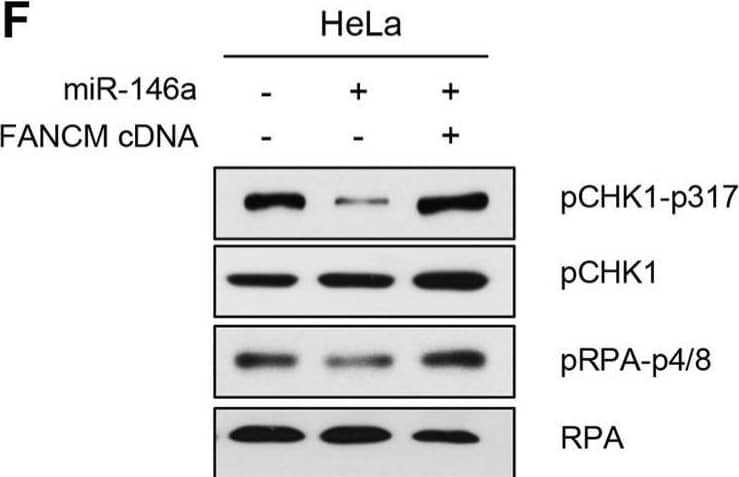
Detection of Phospho-Chk1 (S317) by Western Blot Effect of miR146a on FANCD2 monoubiquitination and the FA pathway(A and B) HeLa cells were transfected with miR146a in the absence or presence of anti-miR146a (A) or miR146a-insensitive FANCM cDNA (B). After a 48 h transfection, the cells were treated with 5 mM HU for 5 h. The protein levels of FANCM and FANCD2 were measured by western blotting. Monoubiquitinated FANCD2 is indicated as the upper band of doublet protein bands corresponding to FANCD2. (C and D) After HeLa cells underwent the same treatment as (A and B) cells were analyzed for FANCD2 foci formation. DAPI was used for nuclear staining. Results are shown as the mean ± SD (n = 3); **P < 0.01. (E and F) Indicated cells were treated with 5 mM HU for 5 hr. Cell lysates were analyzed by Western blotting with antibodies against pCHK1-S317, CHK1, pRPA-S4/8, and RPA. Image collected and cropped by CiteAb from the following open publication (https://pubmed.ncbi.nlm.nih.gov/27351285), licensed under a CC-BY license. Not internally tested by R&D Systems.
 View Larger
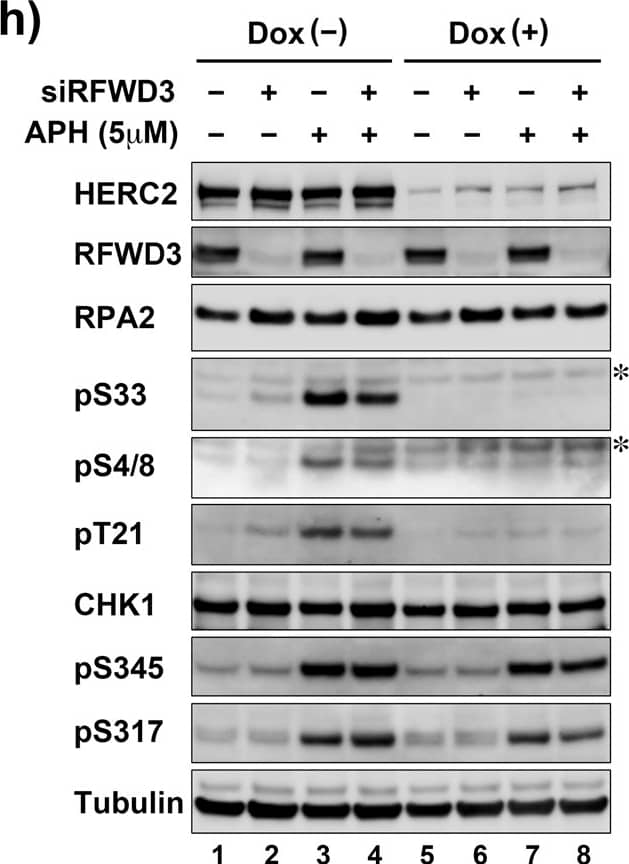
Detection of Phospho-Chk1 (S317) by Western Blot Depletion of HERC2 inhibit ATR-mediated phosphorylation of RPA2 induced by low-level replication stress. (a–d) HeLa-shHERC2 cells were induced or not with Dox, treated or not with the indicated genotoxic agents, and subjected to immunoblotting with the indicated antibodies. (e–h) HeLa-shHERC2 cells were transfected with siRNA specific to ATR (e,f) or RFWD3 (g,h) induced or not with Dox, treated or not with indicated concentration of HU (e,g) or APH (f,h), and subjected to immunoblotting with the indicated antibodies. The asterisks indicates non-specific bands. Image collected and cropped by CiteAb from the following open publication (https://pubmed.ncbi.nlm.nih.gov/31582797), licensed under a CC-BY license. Not internally tested by R&D Systems.
 View Larger
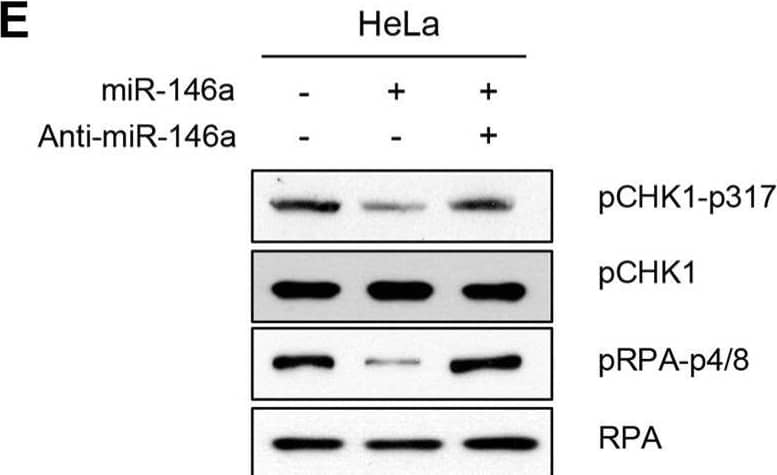
Detection of Phospho-Chk1 (S317) by Western Blot Effect of miR146a on FANCD2 monoubiquitination and the FA pathway(A and B) HeLa cells were transfected with miR146a in the absence or presence of anti-miR146a (A) or miR146a-insensitive FANCM cDNA (B). After a 48 h transfection, the cells were treated with 5 mM HU for 5 h. The protein levels of FANCM and FANCD2 were measured by western blotting. Monoubiquitinated FANCD2 is indicated as the upper band of doublet protein bands corresponding to FANCD2. (C and D) After HeLa cells underwent the same treatment as (A and B) cells were analyzed for FANCD2 foci formation. DAPI was used for nuclear staining. Results are shown as the mean ± SD (n = 3); **P < 0.01. (E and F) Indicated cells were treated with 5 mM HU for 5 hr. Cell lysates were analyzed by Western blotting with antibodies against pCHK1-S317, CHK1, pRPA-S4/8, and RPA. Image collected and cropped by CiteAb from the following open publication (https://pubmed.ncbi.nlm.nih.gov/27351285), licensed under a CC-BY license. Not internally tested by R&D Systems.
Reconstitution Calculator
Preparation and Storage
- 12 months from date of receipt, -20 to -70 °C as supplied.
- 1 month, 2 to 8 °C under sterile conditions after reconstitution.
- 6 months, -20 to -70 °C under sterile conditions after reconstitution.
Background: Chk1
The Chk1 checkpoint kinase is an integral member of a signaling cascade that controls cell cycle progression. In response to genotoxic or replicative stress, Chk1 is phosphorylated by ATM or ATM-related kinases (ATR) at S317. In turn, Chk1 phosphorylates downstream effectors, such as p53 or the Cdc25 phosphatases to halt cell cycle progression and allow time for repair of incurred damage.
Product Datasheets
Citations for Human/Mouse/Rat Phospho-Chk1 (S317) Antibody
R&D Systems personnel manually curate a database that contains references using R&D Systems products. The data collected includes not only links to publications in PubMed, but also provides information about sample types, species, and experimental conditions.
10
Citations: Showing 1 - 10
Filter your results:
Filter by:
-
Establishment and Characterization of Multi-Drug Resistant p53-Negative Osteosarcoma SaOS-2 Subline
Authors: Boichuk S, Bikinieva F, Valeeva E et al.
Diagnostics (Basel)
-
HERC2 regulates RPA2 by mediating ATR-induced Ser33 phosphorylation and ubiquitin-dependent degradation
Authors: Y Lai, M Zhu, W Wu, N Rokutanda, Y Togashi, W Liang, T Ohta
Sci Rep, 2019-10-03;9(1):14257.
Species: Human
Sample Types: Cell Lysates
Applications: Western Blot -
miR146a-mediated targeting of FANCM during inflammation compromises genome integrity
Authors: Devakumar Sundaravinayagam, Hye Rim Kim, TingTing Wu, Hyun Hee Kim, Hyun-Seo Lee, Semo Jun et al.
Oncotarget
Species: Human
Sample Types: Cell Lysates, Tissue Homogenates
Applications: Western Blot -
PIG3 Functions in DNA Damage Response through Regulating DNA-PKcs Homeostasis
Authors: Bing Li, Zeng-Fu Shang, Jiao-Jiao Yin, Qin-Zhi Xu, Xiao-Dan Liu, Yu Wang et al.
International Journal of Biological Sciences
-
Dbf4 is direct downstream target of ataxia telangiectasia mutated (ATM) and ataxia telangiectasia and Rad3-related (ATR) protein to regulate intra-S-phase checkpoint.
Authors: Lee AY, Chiba T, Truong LN
J. Biol. Chem., 2011-11-28;287(4):2531-43.
Species: Human
Sample Types: Cell Lysates
Applications: Western Blot -
Functional connection between Rad51 and PML in homology-directed repair.
Authors: Boichuk S, Hu L, Makielski K, Pandolfi PP, Gjoerup OV
PLoS ONE, 2011-10-05;6(10):e25814.
Species: Human
Sample Types: Cell Lysates
Applications: Western Blot -
Poly(ADP-Ribose) polymerase inhibition synergizes with 5-fluorodeoxyuridine but not 5-fluorouracil in ovarian cancer cells.
Authors: Huehls AM, Wagner JM, Huntoon CJ, Geng L, Erlichman C, Patel AG, Kaufmann SH, Karnitz LM
Cancer Res., 2011-05-25;71(14):4944-54.
Species: Human
Sample Types: Cell Lysates
Applications: Western Blot -
Multiple DNA damage signaling and repair pathways deregulated by simian virus 40 large T antigen.
Authors: Boichuk S, Hu L, Hein J
J. Virol., 2010-06-02;84(16):8007-20.
Species: Human
Sample Types: Cell Lysates
Applications: Western Blot -
Simian virus 40 large T antigen disrupts genome integrity and activates a DNA damage response via Bub1 binding.
Authors: Hein J, Boichuk S, Wu J, Cheng Y, Freire R, Jat PS, Roberts TM, Gjoerup OV
J. Virol., 2008-10-15;83(1):117-27.
Species: Human
Sample Types: Whole Cells
Applications: Western Blot -
RNF8-dependent and RNF8-independent regulation of 53BP1 in response to DNA damage.
Authors: Sakasai R, Tibbetts R
J. Biol. Chem., 2008-03-12;283(20):13549-55.
Species: Human
Sample Types: Cell Lysates
Applications: Western Blot
FAQs
No product specific FAQs exist for this product, however you may
View all Antibody FAQsReviews for Human/Mouse/Rat Phospho-Chk1 (S317) Antibody
There are currently no reviews for this product. Be the first to review Human/Mouse/Rat Phospho-Chk1 (S317) Antibody and earn rewards!
Have you used Human/Mouse/Rat Phospho-Chk1 (S317) Antibody?
Submit a review and receive an Amazon gift card.
$25/€18/£15/$25CAN/¥75 Yuan/¥2500 Yen for a review with an image
$10/€7/£6/$10 CAD/¥70 Yuan/¥1110 Yen for a review without an image
