Human/Mouse/Rat TDP-43/TARDBP Antibody Summary
Met1-Thr103
Accession # Q13148
Applications
Please Note: Optimal dilutions should be determined by each laboratory for each application. General Protocols are available in the Technical Information section on our website.
Scientific Data
 View Larger
Detection of Human TDP-43/TARDBP by Western Blot. Western blot shows lysates of A431 human epithelial carcinoma cell line and NR8383 rat alveolar macrophage cell line. PVDF membrane was probed with 0.4 µg/mL of Mouse Anti-Human/Mouse/Rat TDP-43/TARDBP Monoclonal Antibody (Catalog # MAB7778) followed by HRP-conjugated Anti-Mouse IgG Secondary Antibody (HAF018). A specific band was detected for TDP-43/TARDBP at approximately 45 kDa (as indicated). This experiment was conducted under reducing conditions and using Immunoblot Buffer Group 1.
 View Larger
Detection of Human and Mouse TDP-43/TARDBP by Western Blot. Western blot shows lysates of HeLa human cervical epithelial carcinoma cell line and RAW 264.7 mouse monocyte/macrophage cell line. PVDF membrane was probed with 1 µg/mL of Mouse Anti-Human TDP-43/TARDBP Monoclonal Antibody (Catalog # MAB7778) followed by HRP-conjugated Anti-Mouse IgG Secondary Antibody (HAF018). A specific band was detected for TDP-43/TARDBP at approximately 43 kDa (as indicated). This experiment was conducted under reducing conditions and using Immunoblot Buffer Group 3.
 View Larger
TDP-43/TARDBP in A431 Human Cell Line. TDP-43/TARDBP was detected in immersion fixed A431 human epithelial carcinoma cell line using Mouse Anti-Human/Mouse/Rat TDP-43/TARDBP Monoclonal Antibody (Catalog # MAB7778) at 1 µg/mL for 3 hours at room temperature. Cells were stained using the NorthernLights™ 557-conjugated Anti-Sheep IgG Secondary Antibody (red; NL010) and counterstained with DAPI (blue). Specific staining was localized to nuclei. View our protocol for Fluorescent ICC Staining of Cells on Coverslips.
 View Larger
TDP-43/TARDBP in Human Brain. TDP-43/TARDBP was detected in immersion fixed paraffin-embedded sections of human brain (hippocampus) using Mouse Anti-Human/Mouse/Rat TDP-43/TARDBP Monoclonal Antibody (Catalog # MAB7778) at 1.7 µg/mL overnight at 4 °C. Tissue was stained using the Anti-Mouse HRP-DAB Cell & Tissue Staining Kit (brown; CTS002) and counterstained with hematoxylin (blue). Specific staining was localized to nuclei. View our protocol for Chromogenic IHC Staining of Paraffin-embedded Tissue Sections.
 View Larger
Detection of Human and Rat TDP-43/TARDBP by Simple WesternTM. Simple Western lane view shows lysates of A431 human epithelial carcinoma cell line and NR8383 rat alveolar macrophage cell line, loaded at 0.2 mg/mL. A specific band was detected for TDP-43/TARDBP at approximately 54 kDa (as indicated) using 5 µg/mL of Mouse Anti-Human TDP-43/TARDBP Monoclonal Antibody (Catalog # MAB7778). This experiment was conducted under reducing conditions and using the 12-230 kDa separation system. Non-specific interaction with the 230 kDa Simple Western standard may be seen with this antibody.
 View Larger
Detection of TDP-43/TARDBP by Immunoprecipitation. Immunoprecipitation was performed on cell lysate of HAP1 human near-haploid cell line using 2.0 μg of Mouse Anti-Human TDP-43 Monoclonal Antibody (Catalog # MAB7778) pre-coupled to protein G or protein A beads. Immunoprecipitated TDP-43/TARDBP was detected with a Rabbit Anti-TDP-43 antibody. The Ponceau stained transfers of each blot are shown. SM=10% starting material; UB=10% unbound fraction; IP=immunoprecipitated. Image, protocol, and testing courtesy of YCharOS Inc. (ycharos.com).
 View Larger
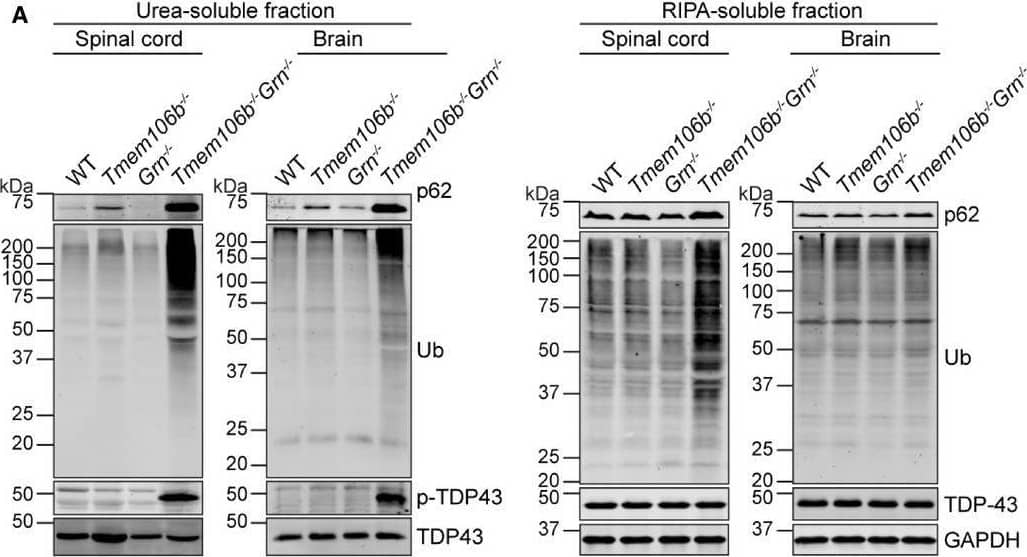
Detection of Mouse TDP-43/TARDBP by Western Blot FTLD‐related pathological changes in Tmem106b−/−Grn−/− miceA, BWestern blot analysis of p62, ubiquitin (Ub), TDP‐43 and p‐TDP-43 in RIPA‐ and urea‐soluble fractions from spinal cord (C5–C8) and brain of 5‐month‐old WT, Tmem106b−/−, Grn−/−, and Tmem106b−/−Grn−/− mice. Spinal cord: n = 3; brain: n = 4. Data presented as mean ± SEM. One‐way ANOVA tests with Bonferroni's multiple comparisons: *P < 0.05; **P < 0.01, ***P < 0.001, ****P < 0.0001.C, DImmunostaining of p62 and ubiquitin in the spinal cord sections from 5‐month‐old WT, Tmem106b−/−, Grn−/−, and Tmem106b−/−Grn−/− mice. The number of p62 or Ub positive puncta was quantified. n = 3. Data presented as mean ± SEM. One‐way ANOVA tests with Bonferroni's multiple comparisons: ***P < 0.001, ****P < 0.0001. Scale bar = 10 μm.Source data are available online for this figure. Image collected and cropped by CiteAb from the following open publication (https://pubmed.ncbi.nlm.nih.gov/32852886), licensed under a CC-BY license. Not internally tested by R&D Systems.
Reconstitution Calculator
Preparation and Storage
- 12 months from date of receipt, -20 to -70 °C as supplied.
- 1 month, 2 to 8 °C under sterile conditions after reconstitution.
- 6 months, -20 to -70 °C under sterile conditions after reconstitution.
Background: TDP-43/TARDBP
TDP-43 (TAR DNA binding protein of 43 kDa; gene name TARDBP) is a 414 amino acid (aa) nuclear RNA/DNA binding phosphoprotein that regulates transcription and splicing. TDP-43 is aberrantly expressed in most forms of amylotrophic lateral sclerosis and frontotemporal lobar degeneration. In these cases it is absent from the nucleus and accumulates, along with a truncated 20-28 kDa form, in ubiquitin-containing inclusion bodies. TDP-43 can also influence CFTR exon 9 skipping in cystic fibrosis. Within aa 1-103, human and mouse TDP-43 share 100% aa sequence identity, and 99% aa identity with rat TDP-43.
Product Datasheets
Citations for Human/Mouse/Rat TDP-43/TARDBP Antibody
R&D Systems personnel manually curate a database that contains references using R&D Systems products. The data collected includes not only links to publications in PubMed, but also provides information about sample types, species, and experimental conditions.
7
Citations: Showing 1 - 7
Filter your results:
Filter by:
-
Loss of TMEM106B and PGRN leads to severe lysosomal abnormalities and neurodegeneration in mice
Authors: Feng T, Mai S, Roscoe JM et al.
EMBO Rep.
-
TMEM106B deficiency impairs cerebellar myelination and synaptic integrity with Purkinje cell loss
Authors: T Feng, L Luan, II Katz, M Ullah, VM Van Deerli, JQ Trojanowsk, EB Lee, F Hu
Acta neuropathologica communications, 2022-03-14;10(1):33.
-
The identification of high-performing antibodies for TDP-43 for use in Western Blot, immunoprecipitation and immunofluorescence
Authors: Worrall, D;Ayoubi, R;Fotouhi, M;Southern, K;McPherson, PS;Laflamme, C;NeuroSGC/YCharOS/EDDU collaborative group, ;ABIF Consortium, ;
F1000Research
Species: Human
Sample Types: Cell Lysates
Applications: Western Blot -
Epithelial-derived factors induce muscularis mucosa of human induced pluripotent stem cell-derived gastric organoids
Authors: K Uehara, M Koyanagi-A, T Koide, T Itoh, T Aoi
Stem Cell Reports, 2022-03-03;0(0):.
Species: Mouse
Sample Types: Tissue Lysates
Applications: Western Blot -
Long non-coding RNA NEAT1_1 ameliorates TDP-43 toxicity in in vivo models of TDP-43 proteinopathy
Authors: Koji Matsukawa, Michail S. Kukharsky, Sei-Kyoung Park, Sangeun Park, Naruaki Watanabe, Takeshi Iwatsubo et al.
RNA Biology
-
Protective paraspeckle hyper-assembly downstream of TDP-43 loss of function in amyotrophic lateral sclerosis
Authors: Tatyana A. Shelkovnikova, Michail S. Kukharsky, Haiyan An, Pasquale Dimasi, Svetlana Alexeeva, Osman Shabir et al.
Molecular Neurodegeneration
Species: Human
Sample Types: Cell Lysates
Applications: Western Blot -
Generation and analysis of innovative genomically humanized knockin SOD1, TARDBP (TDP-43), and FUS mouse models
Authors: Devoy A, Price G, De Giorgio F Et al.
iScience
FAQs
No product specific FAQs exist for this product, however you may
View all Antibody FAQsReviews for Human/Mouse/Rat TDP-43/TARDBP Antibody
Average Rating: 5 (Based on 1 Review)
Have you used Human/Mouse/Rat TDP-43/TARDBP Antibody?
Submit a review and receive an Amazon gift card.
$25/€18/£15/$25CAN/¥75 Yuan/¥2500 Yen for a review with an image
$10/€7/£6/$10 CAD/¥70 Yuan/¥1110 Yen for a review without an image
Filter by:

