Human Neuropeptide Y/NPY Antibody Summary
YPSKPDNPGEDAPAEDMARYYSALRHYINLITRQRY
Accession # P01303
Applications
Please Note: Optimal dilutions should be determined by each laboratory for each application. General Protocols are available in the Technical Information section on our website.
Scientific Data
 View Larger
Neuropeptide Y/NPY in Human Brain. Neuropeptide Y/NPY was detected in immersion fixed paraffin-embedded sections of human brain (hypothalamus) using Mouse Anti-Human Neuropeptide Y/NPY Monoclonal Antibody (Catalog # MAB8517) at 15 µg/mL overnight at 4 °C. Tissue was stained using the Anti-Mouse HRP-DAB Cell & Tissue Staining Kit (brown; Catalog # CTS002) and counterstained with hematoxylin (blue). Specific staining was localized to neuronal processes. View our protocol for Chromogenic IHC Staining of Paraffin-embedded Tissue Sections.
 View Larger
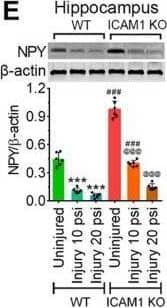
Detection of Mouse Neuropeptide Y/NPY by Western Blot ICAM-1 reduces neurotransmitters expression that reflects in sensorimotor deficits and psychological stress after TBI. A, Immunofluorescent staining of NE (red) in the hippocampus area of WT and ICAM-1−/− mice after 10 and 20 psi FPI and merged with NeuN (green) and DAPI (blue). Scale bar: 20 μm (all panels). B, Quantification of NE staining in the hippocampus area of uninjured, 10 and 20 psi FPI WT and ICAM-1−/− mice using ImageJ software (n = 6/group). C–E, Western blot analysis of 5-HT1AR (C), DAD1R (D), NPY (E) and beta -actin in the tissue lysates of hippocampus of WT and ICAM-1−/− mice 48 h after 10 and 20 psi FPI. The bar graph with dot plots shows the quantification of 5-HT1AR (C), DAD1R (D), NPY (E) versus beta -actin (n = 6/group). F, Schematic presentation of the findings. All values are expressed as mean ± SD two-way ANOVA followed by Bonferroni post hoc tests. Statistically significant ***p < 0.001 versus WT uninjured group; @@@p < 0.001 versus uninjured ICAM-1−/− group; #p < 0.05, ##p < 0.01, ###p < 0.001 versus WT corresponding injury groups; ns = non-significant. NE, norepinephrine; 5-HT1AR, 5-HT 1A receptor; DAD1R, DA D1 receptor; NPY, neuropeptide Y. Image collected and cropped by CiteAb from the following open publication (https://pubmed.ncbi.nlm.nih.gov/34135004), licensed under a CC-BY license. Not internally tested by R&D Systems.
Reconstitution Calculator
Preparation and Storage
- 12 months from date of receipt, -20 to -70 °C as supplied.
- 1 month, 2 to 8 °C under sterile conditions after reconstitution.
- 6 months, -20 to -70 °C under sterile conditions after reconstitution.
Background: Neuropeptide Y/NPY
Neuropeptide Y (NPY) is a 36 amino acid peptide that was isolated from hypothalamus in porcine brain in 1982 and lately it belongs to a family of peptides which include Pancreatic Polypeptide (PP) and Peptide YY (PYY) which exert their pharmacological action via interaction with G-protein coupled receptors Y1, Y2, Y4, Y5 and y6. NPY is the most abundant peptide in brain and in nervous system NPY functions as a neurotransmitter regulating many processes including memory and learning, pain, fat storage and blood pressure. NPY also regulates stress by stimulating secretion of corticotropin-releasing hormone in brain. It appears there is a correlation between the increased levels of NPY gene expression in hippocampus and epileptic seizures. Cocaine reduces the levels of NPY and such a decrease is thought to be related to depression and anxiety. NPY receptors are rhodopsin-like G-protein coupled receptors (GPCR) coupled to Gi or G0 proteins, which inhibit adenylate cyclase and reduce cAMP accumulation and modulate Calcium and Potassium channels.
Product Datasheets
Citation for Human Neuropeptide Y/NPY Antibody
R&D Systems personnel manually curate a database that contains references using R&D Systems products. The data collected includes not only links to publications in PubMed, but also provides information about sample types, species, and experimental conditions.
1 Citation: Showing 1 - 1
-
Intercellular Adhesion Molecule-1-Induced Posttraumatic Brain Injury Neuropathology in the Prefrontal Cortex and Hippocampus Leads to Sensorimotor Function Deficits and Psychological Stress
Authors: Bhowmick S, Malat A, Caruso D Et Al.
eNeuro
FAQs
No product specific FAQs exist for this product, however you may
View all Antibody FAQsReviews for Human Neuropeptide Y/NPY Antibody
There are currently no reviews for this product. Be the first to review Human Neuropeptide Y/NPY Antibody and earn rewards!
Have you used Human Neuropeptide Y/NPY Antibody?
Submit a review and receive an Amazon gift card.
$25/€18/£15/$25CAN/¥75 Yuan/¥2500 Yen for a review with an image
$10/€7/£6/$10 CAD/¥70 Yuan/¥1110 Yen for a review without an image
