Human Phospho-FGFR1-4 (Y653/Y654) Antibody Summary
Applications
Please Note: Optimal dilutions should be determined by each laboratory for each application. General Protocols are available in the Technical Information section on our website.
Scientific Data
 View Larger
Detection of Human Phospho- FGF R1‑4 (Y653/Y654) by Western Blot. Western blot shows lysates of KATO-III human gastric carcinoma cell line untreated (-) or treated (+) with 100 ng/mL Recom-binant Human FGF acidic (Catalog # 232-FA) for 15 minutes. PVDF membrane was probed with 0.5 µg/mL of Rabbit Anti-Human Phospho-FGF R1-4 (Y653/Y654) Antigen Affinity-purified Polyclonal Antibody (Catalog # AF3285), followed by HRP-conjugated Anti-Rabbit IgG Secondary Antibody (Catalog # HAF008). A specific band was detected for Phospho-FGF R1-4 (Y653/Y654) at approximately 120 to 145 kDa (as indicated). This experiment was conducted under reducing conditions and using Immunoblot Buffer Group 1.
 View Larger
Phospho-FGF R1-4 (Y653/Y654) in A431 Human Cell Line. FGF R1-4 phosphorylated at Y653/Y654 was detected in immersion fixed A431 human epithelial carcinoma cell line untreated (lower panel) or treated (upper panel) with pervanadate using Rabbit Anti-Human Phospho-FGF R1-4 (Y653/Y654) Antigen Affinity-purified Polyclonal Antibody (Catalog # AF3285) at 10 µg/mL for 3 hours at room temperature. Cells were stained using the NorthernLights™ 557-conjugated Anti-Rabbit IgG Secondary Antibody (red; Catalog # NL004) and counterstained with DAPI (blue). View our protocol for Fluorescent ICC Staining of Cells on Coverslips.
 View Larger
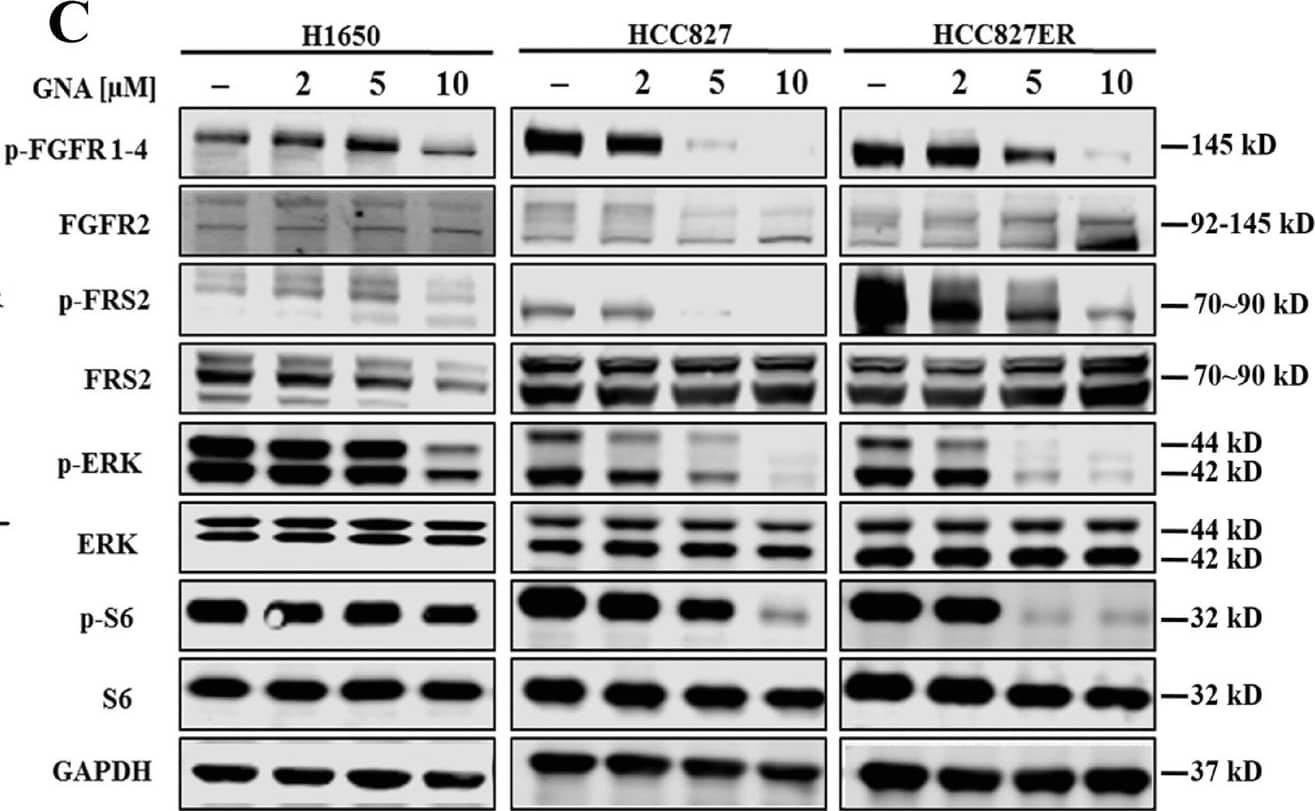
Detection of Phospho-FGFR1-4 (Y653/Y654) by Western Blot GNA inhibits cell proliferation in both NSCLC and erlotinib-resistant NSCLC by targeting FGFR and the downstream signaling pathways.a Cell viability was assessed using the CellTiter-Glo assay. After a 72 h treatment by GNA, CellTiter-Glo reagent was added directly to each well for a 10-min incubation. The plate was then read on a FlexStation 3 microplate luminometer. A dose−response curve was plotted, and the IC50 was calculated using GraphPad Prism software. Cell viability was assessed using MTT assay. After a 72 h treatment by GNA, 10 μl of 5 mg/ml 3-(4,5-dimethylthiazol-2-yl)-2,5-diphenyltetrazolium bromide (MTT) solution was added to each well and incubated for 4 h at 37 °C, then the culture medium was removed and 100 μl of DMSO was added to each well. The absorbance was measured at 570 nm on a microplate reader. A dose−response curve was plotted, and the IC50 was calculated using GraphPad Prism software. b Caspase-3/7 activity induction was evaluated after 6 h of treatment with GNA at 10, 3.33 and 1.11 μM using the Caspase-Glo 3/7 kit from Promega in the HCC827, H1650, and HCC827ER cells, respectively. The bars in the graphs represent the mean fold induction relative to the DMSO control. c H1650 cells, HCC827 cells, and HCC827ER cells were treated with GNA at various dosages for 4 h and were then probed with specified antibodies. FGFR and the downstream proteins were analyzed by western blot. d The histograms of quantitative analysis about FGFR and the downstream proteins were analyzed by western blot Image collected and cropped by CiteAb from the following open publication (https://pubmed.ncbi.nlm.nih.gov/29449529), licensed under a CC-BY license. Not internally tested by R&D Systems.
 View Larger
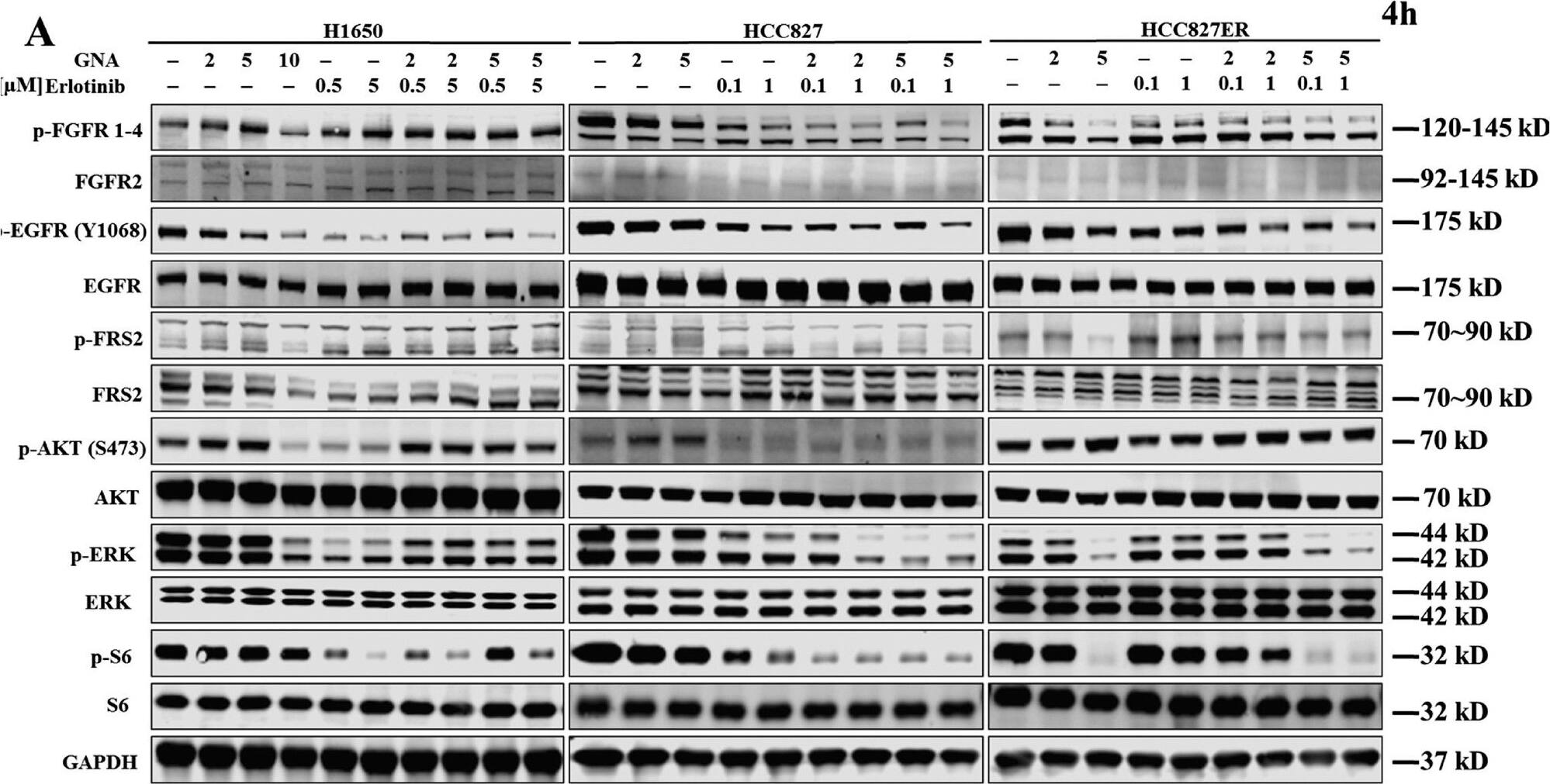
Detection of Phospho-FGFR1-4 (Y653/Y654) by Western Blot GNA enhances the anti-tumor activity of erlotinib through FGFR in vitro.a H1650 cells, HCC827 cells, and HCC827ER cells were treated with various concentrations of GNA, erlotinib, or their combination for 24 h and were then probed with specified antibodies. b−e FGFR and the downstream proteins were analyzed by a western blot. HCC827ER cells were transfected with FGFR1 and FGFR2 siRNA for 48 h, then the medium was replaced and the cells were further incubated for 24 h. After incubation, the protein expression of FGFR1 (b) and FGFR2 (c) were analyzed by western blot, the mRNA expression of FGFR1 (d) and FGFR2 (e) were analyzed by real-time PCR. (f, g) FGFR1 or FGFR2 knockdown HCC827ER cells were treated by GNA for 72 h, and the cell viability was assessed using the CellTiter-Glo assay. The data are presented as the means ± SD and were analyzed by a one-way ANOVA, **P < 0.01, ***P < 0.001 Image collected and cropped by CiteAb from the following open publication (https://pubmed.ncbi.nlm.nih.gov/29449529), licensed under a CC-BY license. Not internally tested by R&D Systems.
 View Larger
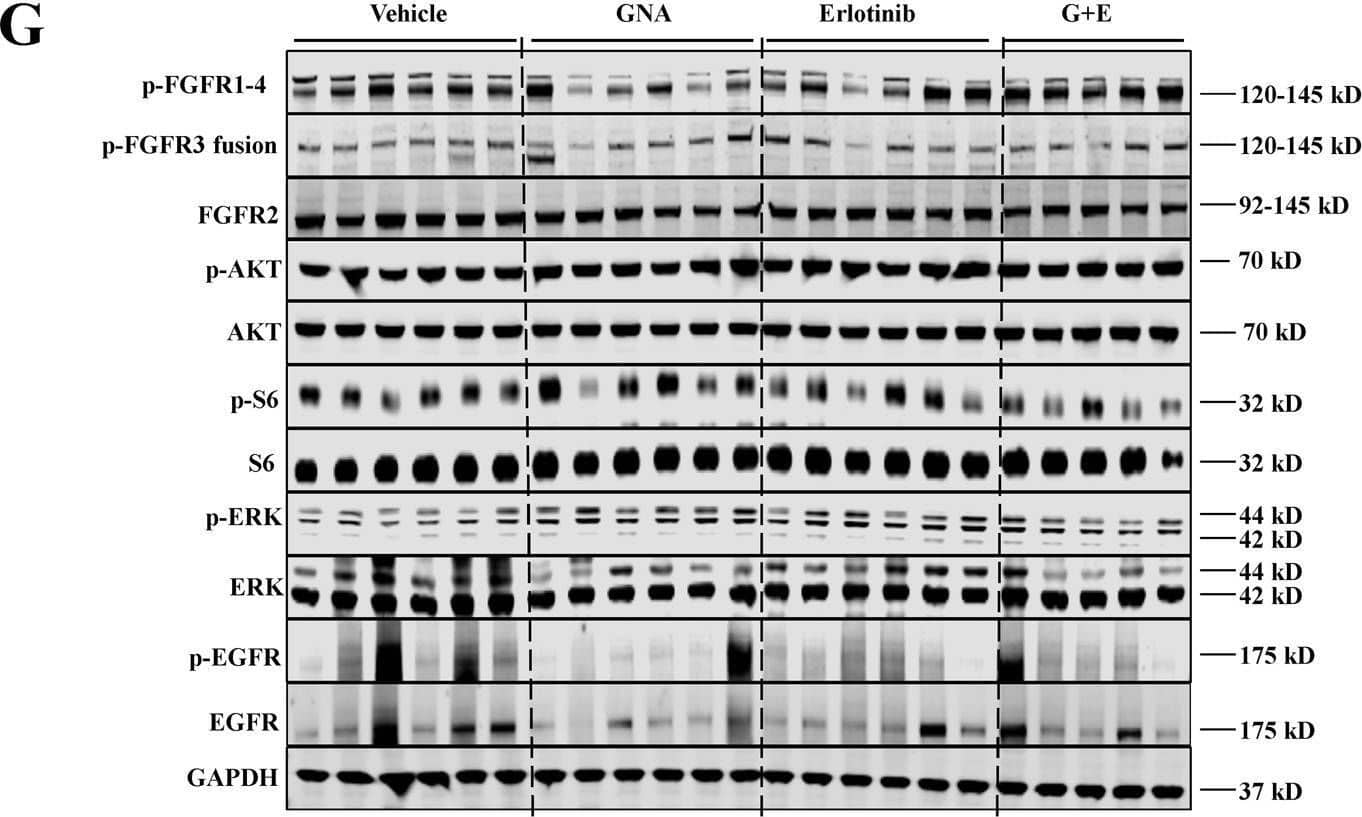
Detection of Phospho-FGFR1-4 (Y653/Y654) by Western Blot GNA increases the anti-tumor activity of erlotinib in FGFR-expressing PDX xenograft model. A The fragments from the donor mice that were implanted from patient samples were implanted subcutaneously into the right flank of nude mice. When the tumors reached 150–250 mm3, the tumor-bearing mice were then treated with vehicle, GNA (i.p., 7.5 mg/kg), erlotinib (p.o., 25 mg/kg), or their combination once daily for 22 days. The tumor volume was calculated by determining the length and width of the tumor as measured using Vernier calipers. The data are presented as the means ± SEM (n = 6) and were analyzed by a one-way ANOVA, *P < 0.05, **P < 0.01, ***P < 0.001. b The body weight of the mice from (a). c The tumor/body weight ratio of the mice from (a). d−f Representative immunohistochemical image analyses for p-FGFR (d, e) and apoptotic cells by a TUNEL assay (d, f) in the xenograft mouse model of the PDX tumors after vehicle, GNA, erlotinib, and combination treatment. The data are presented as the Histoscore and the error bars are the SEM. Statistically significant differences with P < 0.05 were considered significant compared with the vehicle control, *P < 0.05, and **P < 0.01. g Inhibition of FGFR phosphorylation in NSCLC PDX by GNA. After treatment with GNA, erlotinib, and its combination for about 3 weeks, the tumors were collected and processed. The protein samples were then probed with specified antibodies Image collected and cropped by CiteAb from the following open publication (https://pubmed.ncbi.nlm.nih.gov/29449529), licensed under a CC-BY license. Not internally tested by R&D Systems.
Reconstitution Calculator
Preparation and Storage
- 12 months from date of receipt, -20 to -70 °C as supplied.
- 1 month, 2 to 8 °C under sterile conditions after reconstitution.
- 6 months, -20 to -70 °C under sterile conditions after reconstitution.
Background: FGFR1-4
The fibroblast growth factor receptors (FGF R), including FGF R1, R2, R3, and R4, are involved in development processes, angiogenesis, wound healing, and tumorigenesis. FGF binding induces receptor dimerization and autophosphorylation on multiple tyrosine residues. Tyr653 and Tyr654 in FGF R1 and the corresponding tyrosine residues in FGF R2, R3 and R4 are important for the activation of intrinsic kinase activity.
Product Datasheets
Citations for Human Phospho-FGFR1-4 (Y653/Y654) Antibody
R&D Systems personnel manually curate a database that contains references using R&D Systems products. The data collected includes not only links to publications in PubMed, but also provides information about sample types, species, and experimental conditions.
10
Citations: Showing 1 - 10
Filter your results:
Filter by:
-
FGF11 influences 3T3‐L1 preadipocyte differentiation by modulating the expression of PPAR gamma regulators
Authors: Kyeong Won Lee, Jae‐Yeon Jeong, Young Jun An, Jung‐Hyun Lee, Hyung‐Soon Yim
FEBS Open Bio
-
Transferrin receptor 1 promotes the fibroblast growth factor receptor-mediated oncogenic potential of diffused-type gastric cancer
Authors: T Shirakihar, H Yamaguchi, T Kondo, M Yashiro, R Sakai
Oncogene, 2022-03-25;0(0):.
Species: Human
Sample Types: Cell Lysates, Whole Cells
Applications: ICC/IF, Western Blot -
FGF11 influences 3T3‐L1 preadipocyte differentiation by modulating the expression of PPAR gamma regulators
Authors: Kyeong Won Lee, Jae‐Yeon Jeong, Young Jun An, Jung‐Hyun Lee, Hyung‐Soon Yim
FEBS Open Bio
Species: Mouse
Sample Types: Cell Lysates
Applications: Western Blot -
FGFR2 amplification is predictive of sensitivity to regorafenib in gastric and colorectal cancers in vitro
Authors: Y Cha, HP Kim, Y Lim, SW Han, SH Song, TY Kim
Mol Oncol, 2018-05-29;0(0):.
Species: Human
Sample Types: Cell Lysates
Applications: Western Blot -
Gambogenic acid inhibits fibroblast growth factor receptor signaling pathway in erlotinib-resistant non-small-cell lung cancer and suppresses patient-derived xenograft growth
Authors: L Xu, X Meng, N Xu, W Fu, H Tan, L Zhang, Q Zhou, J Qian, S Tu, X Li, Y Lao, H Xu
Cell Death Dis, 2018-02-15;9(3):262.
Species: Human
Sample Types: Cell Lysates
Applications: Western Blot -
Basic Fibroblast Growth Factor Inhibits Apoptosis and Promotes Proliferation of Adipose-Derived Mesenchymal Stromal Cells Isolated from Patients with Type 2 Diabetes by Reducing Cellular Oxidative Stress
Authors: D Nawrocka, K Kornicka, J Szydlarska, K Marycz
Oxid Med Cell Longev, 2017-01-11;2017(0):3027109.
Species: Human
Sample Types: Whole Cells
Applications: ICC -
Overexpression of FGFR2 contributes to inherent resistance to MET inhibitors in MET-amplified patient-derived gastric cancer xenografts
Authors: KAI LIU, XILIN SONG, MEIRONG ZHU, HENG MA
Oncology Letters
Species: Xenograft
Sample Types: Tissue Homogenates
Applications: Western Blot -
FGFR2-amplified gastric cancer cell lines require FGFR2 and Erbb3 signaling for growth and survival.
Authors: Kunii K, Davis L, Gorenstein J, Hatch H, Yashiro M, Di Bacco A, Elbi C, Lutterbach B
Cancer Res., 2008-04-01;68(7):2340-8.
Species: Human
Sample Types: Cell Lysates
Applications: Immunoprecipitation, Western Blot -
Preclinical characterization of bemarituzumab, an anti-FGFR2b antibody for the treatment of cancer
Authors: Hong Xiang, Abigael G. Chan, Ago Ahene, David I. Bellovin, Rong Deng, Amy W. Hsu et al.
mAbs
-
Overexpression of FGFR2 contributes to inherent resistance to MET inhibitors in MET-amplified patient-derived gastric cancer xenografts
Authors: KAI LIU, XILIN SONG, MEIRONG ZHU, HENG MA
Oncology Letters
FAQs
No product specific FAQs exist for this product, however you may
View all Antibody FAQsReviews for Human Phospho-FGFR1-4 (Y653/Y654) Antibody
There are currently no reviews for this product. Be the first to review Human Phospho-FGFR1-4 (Y653/Y654) Antibody and earn rewards!
Have you used Human Phospho-FGFR1-4 (Y653/Y654) Antibody?
Submit a review and receive an Amazon gift card.
$25/€18/£15/$25CAN/¥75 Yuan/¥2500 Yen for a review with an image
$10/€7/£6/$10 CAD/¥70 Yuan/¥1110 Yen for a review without an image


