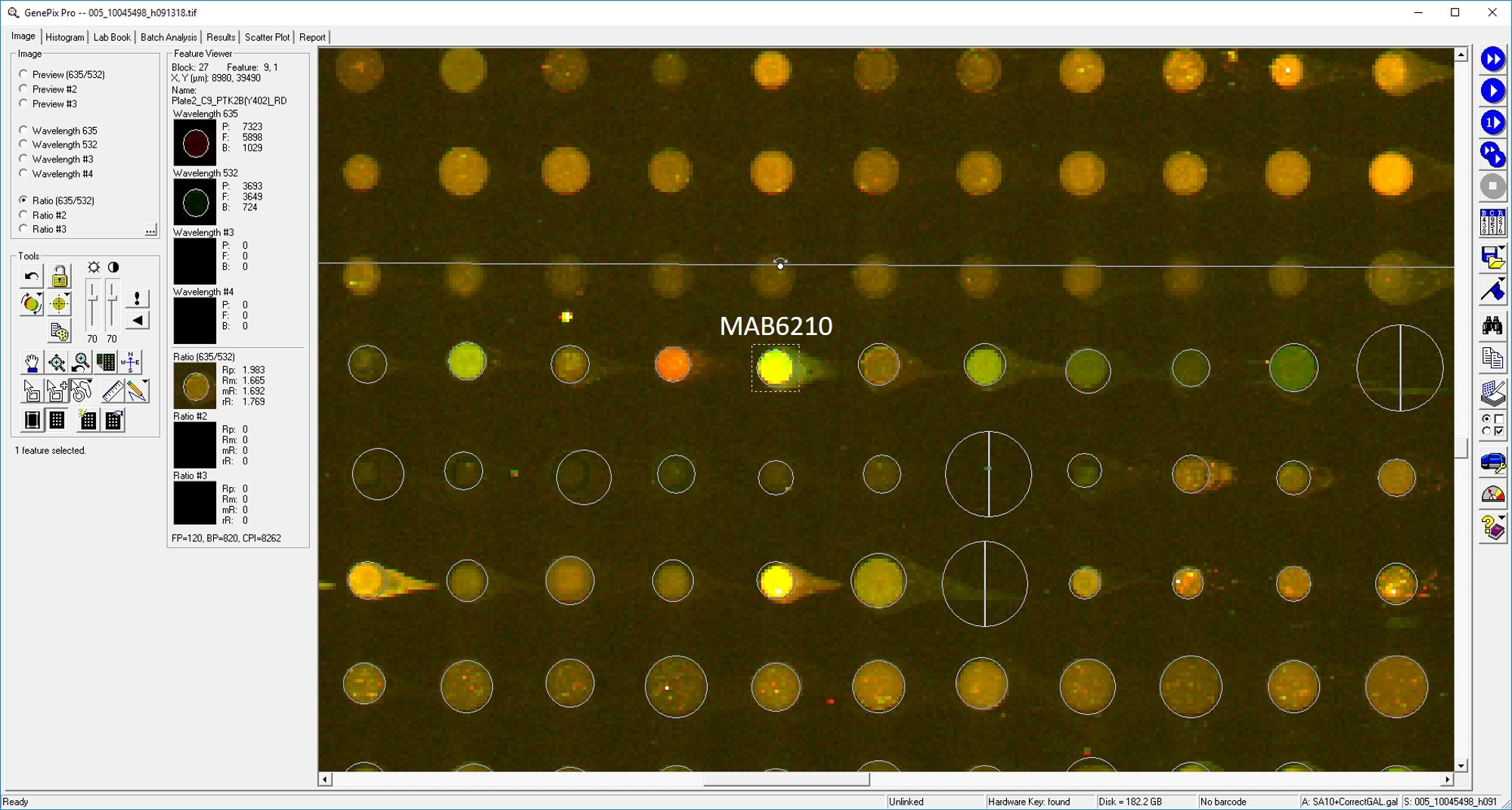
Human Phospho-PYK2/FAK2 (Y402) Antibody Summary
Accession # Q14289
Applications
Please Note: Optimal dilutions should be determined by each laboratory for each application. General Protocols are available in the Technical Information section on our website.
Scientific Data
 View Larger
Detection of HumanPhospho-PYK2/FAK2 (Y402) by Western Blot. Western blot shows lysates of Raji human Burkitt's lymphoma cell line and Jurkat human acute T cell leukemia cell line untreated (-) or treated (+) with 1 mM Pervanadate (PV) for 30 minutes and 10 µg/mL Mouse Anti-Human CD3e Monoclonal Antibody (Catalog # MAB100) for 15 minutes. PVDF membrane was probed with 0.5 µg/mL of Mouse Anti-Human Phospho-PYK2/FAK2 (Y402) Monoclonal Antibody (Catalog # MAB6210) followed by HRP-conjugated Anti-Mouse IgG Secondary Antibody (Catalog # HAF018). Specific bands were detected for Phospho-PYK2/FAK2 (Y402) at approximately 105-115 kDa (as indicated). This experiment was conducted under reducing conditions and using Immunoblot Buffer Group 1.
 View Larger
Detection of Human Phospho-PYK2/FAK2 (Y402) by Simple WesternTM. Simple Western lane view shows lysates of Raji human Burkitt's lymphoma cell line untreated (-) or treated (+) with 0.2 mg/mL Pervanadate (PV) for 30 minutes, loaded at 0.2 mg/mL. A specific band was detected for Phospho-PYK2/FAK2 (Y402) at approximately 113 kDa (as indicated) using 5 µg/mL of Mouse Anti-Human Phospho-PYK2/FAK2 (Y402) Monoclonal Antibody (Catalog # MAB6210). This experiment was conducted under reducing conditions and using the 12-230 kDa separation system.
 View Larger
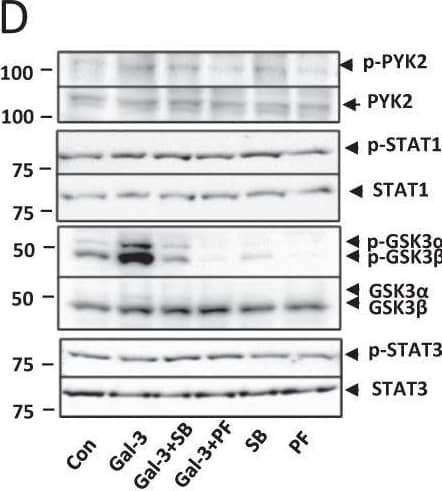
Detection of Phospho-PYK2/FAK2 (Y402) by Western Blot Galectin-3 expression induces activation of PYK2, STAT1 and GSK3 alpha / beta signalling. Expression of 37 protein kinases in SW620 cells in response to 10 µg/ml galectin-3 or BSA for 0.5 h was assessed by Proteome Profiler Human Phospho-Kinase Array (A, Percentage changes of the kinases in cell response to galectin-3 in comparison to control are shown at the bottom panel). The presence of galectin-3 increases the phosphorylation of PYK2, GSK3 alpha / beta, and STAT1 and decreases phosphorylation of STAT3. SW620 cells treated with 10 µg/ml galectin-3 for different times were assessed by immunoblotting using antibodies against p-PYK2, p-STAT-1, p-GSK3 alpha / beta or p-STAT-3 (B). The blots were striped and reprobed with antibodies against PYK2, STAT-1, GSK3 alpha / beta or STAT-3. The band density was quantified and expressed as percentages of phospho-/non-phosphorylated proteins (C). In D and E, SW620 cells were treated with 10 µg/ml galectin-3 or BSA followed by introduction of GSK3 alpha / beta inhibitor SB 216763 (SB) or PKY2 inhibitor PF-431396 (PF) for 15 min and the levels of phosphorylated PYK2, STAT-1, GSK3 alpha / beta or STAT-3 were analysed by immunoblotting. The blots were striped and reprobed with antibodies against PYK2, STAT-1, GSK3 alpha / beta or STAT-3. The densities of the blots from three independent experiments were quantified and are expressed as the percentage of phosphorylated/non-phosphorylated levels of each protein. ***P < 0.001, **P < 0.01, *P < 0.05 (ANOVA). Image collected and cropped by CiteAb from the following open publication (https://pubmed.ncbi.nlm.nih.gov/37055381), licensed under a CC-BY license. Not internally tested by R&D Systems.
 View Larger
Detection of Phospho-PYK2/FAK2 (Y402) by Western Blot Galectin-3 expression induces activation of PYK2, STAT1 and GSK3 alpha / beta signalling. Expression of 37 protein kinases in SW620 cells in response to 10 µg/ml galectin-3 or BSA for 0.5 h was assessed by Proteome Profiler Human Phospho-Kinase Array (A, Percentage changes of the kinases in cell response to galectin-3 in comparison to control are shown at the bottom panel). The presence of galectin-3 increases the phosphorylation of PYK2, GSK3 alpha / beta, and STAT1 and decreases phosphorylation of STAT3. SW620 cells treated with 10 µg/ml galectin-3 for different times were assessed by immunoblotting using antibodies against p-PYK2, p-STAT-1, p-GSK3 alpha / beta or p-STAT-3 (B). The blots were striped and reprobed with antibodies against PYK2, STAT-1, GSK3 alpha / beta or STAT-3. The band density was quantified and expressed as percentages of phospho-/non-phosphorylated proteins (C). In D and E, SW620 cells were treated with 10 µg/ml galectin-3 or BSA followed by introduction of GSK3 alpha / beta inhibitor SB 216763 (SB) or PKY2 inhibitor PF-431396 (PF) for 15 min and the levels of phosphorylated PYK2, STAT-1, GSK3 alpha / beta or STAT-3 were analysed by immunoblotting. The blots were striped and reprobed with antibodies against PYK2, STAT-1, GSK3 alpha / beta or STAT-3. The densities of the blots from three independent experiments were quantified and are expressed as the percentage of phosphorylated/non-phosphorylated levels of each protein. ***P < 0.001, **P < 0.01, *P < 0.05 (ANOVA). Image collected and cropped by CiteAb from the following open publication (https://pubmed.ncbi.nlm.nih.gov/37055381), licensed under a CC-BY license. Not internally tested by R&D Systems.
 View Larger
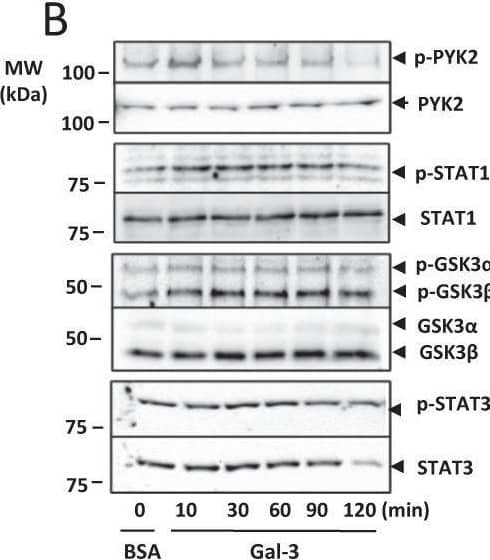
Detection of Phospho-PYK2/FAK2 (Y402) by Western Blot Galectin-3 expression induces activation of PYK2, STAT1 and GSK3 alpha / beta signalling. Expression of 37 protein kinases in SW620 cells in response to 10 µg/ml galectin-3 or BSA for 0.5 h was assessed by Proteome Profiler Human Phospho-Kinase Array (A, Percentage changes of the kinases in cell response to galectin-3 in comparison to control are shown at the bottom panel). The presence of galectin-3 increases the phosphorylation of PYK2, GSK3 alpha / beta, and STAT1 and decreases phosphorylation of STAT3. SW620 cells treated with 10 µg/ml galectin-3 for different times were assessed by immunoblotting using antibodies against p-PYK2, p-STAT-1, p-GSK3 alpha / beta or p-STAT-3 (B). The blots were striped and reprobed with antibodies against PYK2, STAT-1, GSK3 alpha / beta or STAT-3. The band density was quantified and expressed as percentages of phospho-/non-phosphorylated proteins (C). In D and E, SW620 cells were treated with 10 µg/ml galectin-3 or BSA followed by introduction of GSK3 alpha / beta inhibitor SB 216763 (SB) or PKY2 inhibitor PF-431396 (PF) for 15 min and the levels of phosphorylated PYK2, STAT-1, GSK3 alpha / beta or STAT-3 were analysed by immunoblotting. The blots were striped and reprobed with antibodies against PYK2, STAT-1, GSK3 alpha / beta or STAT-3. The densities of the blots from three independent experiments were quantified and are expressed as the percentage of phosphorylated/non-phosphorylated levels of each protein. ***P < 0.001, **P < 0.01, *P < 0.05 (ANOVA). Image collected and cropped by CiteAb from the following open publication (https://pubmed.ncbi.nlm.nih.gov/37055381), licensed under a CC-BY license. Not internally tested by R&D Systems.
 View Larger
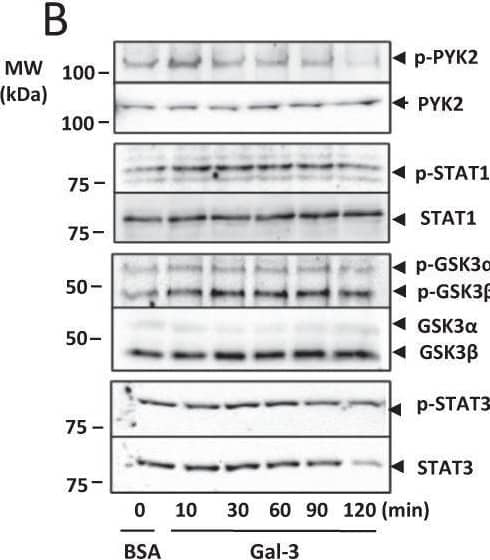
Detection of Phospho-PYK2/FAK2 (Y402) by Western Blot Galectin-3 expression induces activation of PYK2, STAT1 and GSK3 alpha / beta signalling. Expression of 37 protein kinases in SW620 cells in response to 10 µg/ml galectin-3 or BSA for 0.5 h was assessed by Proteome Profiler Human Phospho-Kinase Array (A, Percentage changes of the kinases in cell response to galectin-3 in comparison to control are shown at the bottom panel). The presence of galectin-3 increases the phosphorylation of PYK2, GSK3 alpha / beta, and STAT1 and decreases phosphorylation of STAT3. SW620 cells treated with 10 µg/ml galectin-3 for different times were assessed by immunoblotting using antibodies against p-PYK2, p-STAT-1, p-GSK3 alpha / beta or p-STAT-3 (B). The blots were striped and reprobed with antibodies against PYK2, STAT-1, GSK3 alpha / beta or STAT-3. The band density was quantified and expressed as percentages of phospho-/non-phosphorylated proteins (C). In D and E, SW620 cells were treated with 10 µg/ml galectin-3 or BSA followed by introduction of GSK3 alpha / beta inhibitor SB 216763 (SB) or PKY2 inhibitor PF-431396 (PF) for 15 min and the levels of phosphorylated PYK2, STAT-1, GSK3 alpha / beta or STAT-3 were analysed by immunoblotting. The blots were striped and reprobed with antibodies against PYK2, STAT-1, GSK3 alpha / beta or STAT-3. The densities of the blots from three independent experiments were quantified and are expressed as the percentage of phosphorylated/non-phosphorylated levels of each protein. ***P < 0.001, **P < 0.01, *P < 0.05 (ANOVA). Image collected and cropped by CiteAb from the following open publication (https://pubmed.ncbi.nlm.nih.gov/37055381), licensed under a CC-BY license. Not internally tested by R&D Systems.
Reconstitution Calculator
Preparation and Storage
- 12 months from date of receipt, -20 to -70 °C as supplied.
- 1 month, 2 to 8 °C under sterile conditions after reconstitution.
- 6 months, -20 to -70 °C under sterile conditions after reconstitution.
Background: PYK2/FAK2
PYK2 (Proline-rich kinase 2; also Ptk2b, Fak2, RAFTK and CAK beta ) is a 112‑116 kDa member of the Fak subfamily, tyrosine protein kinase family. It is expressed in multiple cell types, including endothelial cells, vascular smooth muscle cells, megakaryocytes and neurons. PYK2 is activated by elevated intracellular Ca++ and is associated with MAPK pathway activation. Human PYK2 is 1009 amino acids (aa) in length. PYK2 phosphorylation at Tyr402 is associated with enzymatic activation, intercellular localization, cell growth, cell motility, and regulating molecular associations. Over aa 390‑410, human PYK2 is 100% aa identical to mouse PYK2.
Product Datasheets
Citation for Human Phospho-PYK2/FAK2 (Y402) Antibody
R&D Systems personnel manually curate a database that contains references using R&D Systems products. The data collected includes not only links to publications in PubMed, but also provides information about sample types, species, and experimental conditions.
1 Citation: Showing 1 - 1
-
Galectin-3 promotes secretion of proteases that decrease epithelium integrity in human colon cancer cells
Authors: S Li, DM Pritchard, LG Yu
Cell Death & Disease, 2023-04-13;14(4):268.
Species: Human
Sample Types: Cell Lysates
Applications: Western Blot
FAQs
No product specific FAQs exist for this product, however you may
View all Antibody FAQsReviews for Human Phospho-PYK2/FAK2 (Y402) Antibody
Average Rating: 4 (Based on 4 Reviews)
Have you used Human Phospho-PYK2/FAK2 (Y402) Antibody?
Submit a review and receive an Amazon gift card.
$25/€18/£15/$25CAN/¥75 Yuan/¥2500 Yen for a review with an image
$10/€7/£6/$10 CAD/¥70 Yuan/¥1110 Yen for a review without an image
Filter by:
It works well