Human/Rat Brevican Antibody Summary
Asp23-Pro911
Accession # AAH27971
Applications
Please Note: Optimal dilutions should be determined by each laboratory for each application. General Protocols are available in the Technical Information section on our website.
Scientific Data
 View Larger
Detection of Human Brevican by Western Blot. Western blot shows lysates of human brain (cerebellum) tissue and human brain (motor cortex) tissue. PVDF membrane was probed with 0.1 µg/mL of Sheep Anti-Human/Rat Brevican Antigen Affinity-purified Polyclonal Antibody (Catalog # AF4009) followed by Donkey Anti-Sheep IgG HRP-conjugated Antigen Affinity-purified Polyclonal Antibody(Catalog # HAF016). Specific bands were detected for Brevican at approximately 60 and 90 kDa (as indicated). This experiment was conducted under reducing conditions and using Immunoblot Buffer Group 1.
 View Larger
Brevican in Rat Cortical Stem Cells. Brevican was detected in immersion fixed rat cortical stem cells differentiated for 7 days by growth factor withdrawal using Sheep Anti-Human/Rat Brevican Antigen Affinity-purified Polyclonal Antibody (Catalog # AF4009) at 10 µg/mL for 3 hours at room temperature. Cells were stained using the NorthernLights™ 557-conjugated Anti-Sheep IgG Secondary Antibody (red; Catalog # NL010) and counterstained with DAPI (blue). Specific staining was localized to cytoplasm. View our protocol for Fluorescent ICC Staining of Stem Cells on Coverslips.
 View Larger
Brevican in Human Brain. Brevican was detected in immersion fixed paraffin-embedded sections of human brain (cortex) using Sheep Anti-Human/Rat Brevican Antigen Affinity-purified Polyclonal Antibody (Catalog # AF4009) at 5 µg/mL overnight at 4 °C. Tissue was stained using the Anti-Sheep HRP-DAB Cell & Tissue Staining Kit (brown; Catalog # CTS019) and counterstained with hematoxylin (blue). Specific staining was localized to neuropil. View our protocol for Chromogenic IHC Staining of Paraffin-embedded Tissue Sections.
 View Larger
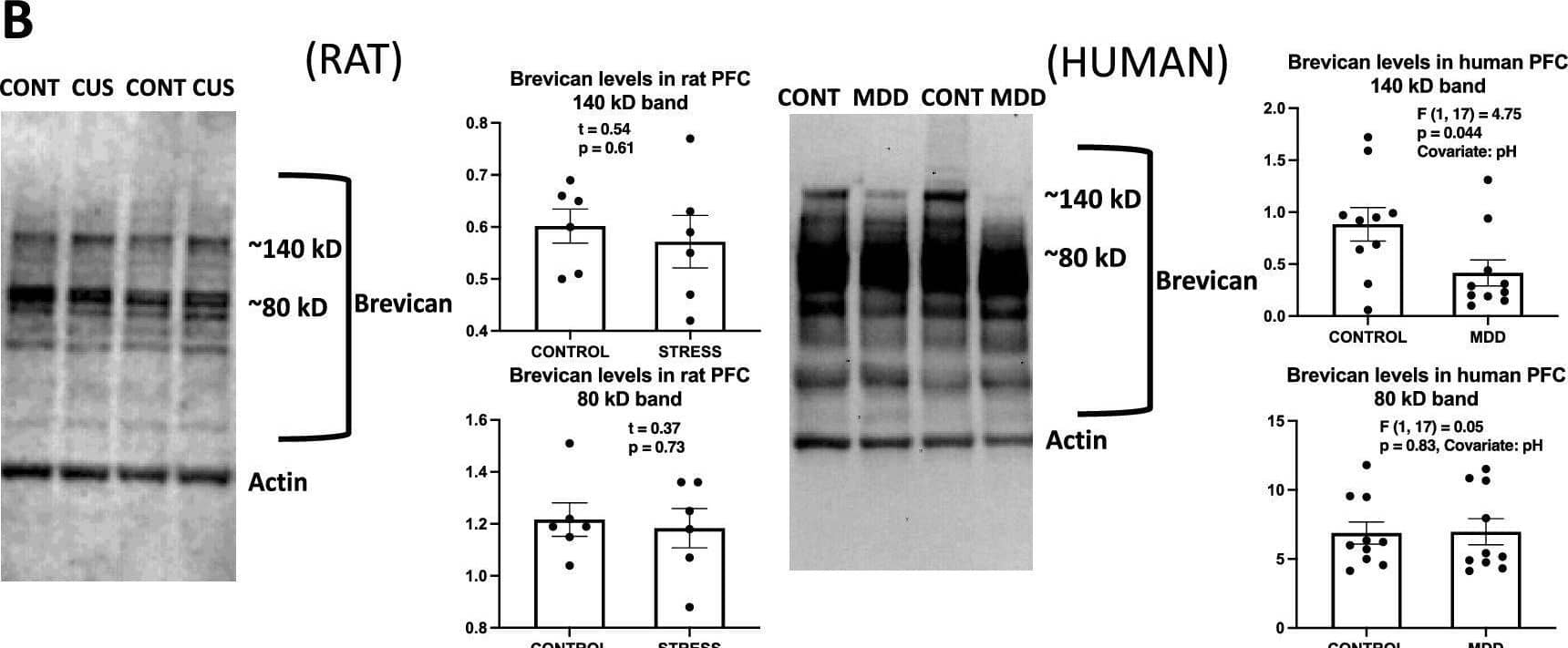
Detection of Brevican by Western Blot Brevican labeling in histological sections and western blots of human and rat prefrontal samples. (A) Micrographs and charts illustrating the average area fraction of brevican immunoreactivity in control and CUS exposed rats (four micrographs to the left and underlying charts) and in control and MDD human subjects (four micrographs to the right and underlying charts) showing no differences in overall brevican immunoreactivity and within 8 µm2 rectangles (see legends referring to rectangles in Figs. 2 And 3) around NRs both in animals with stress and in human subjects with MDD. Arrows point to nodes of Ranvier identified in the left two pictures using triple immunofluorescent staining for CASPR (labels paranodes in green) Neurofascin (red) and Brevican (blue in all the micrographs). Calibration bar is 5 µm for rat and 8 µm for human micrographs. (B) Representative western blot lanes and quantification of optical density of Brevican bands (relative to housekeeping protein actin) in the frontal pole of control and CUS rats, and in the PFC white matter of human subjects. The pictures present bands from 2 representative rats subjected to stress as compared to 2 controls (picture to the left) and two human MDD subjects against two non-psychiatric controls (picture to the right). Quantification for bands for all subjects in each group in the study at approximately 140 and 80 kD is presented in the charts. All lanes and bands in the pictures appear as they were positioned and developed in the Western blot PVDF membrane. Image collected and cropped by CiteAb from the following open publication (https://pubmed.ncbi.nlm.nih.gov/37775676), licensed under a CC-BY license. Not internally tested by R&D Systems.
Reconstitution Calculator
Preparation and Storage
- 12 months from date of receipt, -20 to -70 °C as supplied.
- 1 month, 2 to 8 °C under sterile conditions after reconstitution.
- 6 months, -20 to -70 °C under sterile conditions after reconstitution.
Background: Brevican
Brevican, also called BEHAB, is a secreted member of the the lectican family of proteoglycans that share a common domain structure (1). Brevican contains an Ig‑like V-set domain, two link domains, a Glu-rich region, a central region with glycosaminoglycan (GAG) modifications, an EGF-like domain, a C-type lectin domain, and a C-terminal Sushi/CRP-like domain (2). Brevican is restricted to the CNS and is expressed by astrocytes, oligodendrocytes, and neurons (3‑7). A GPI-anchored alternate splice form exists that is truncated following the central (GAG) region (2, 8). Brevican is cleaved by multiple proteases and exists in a number of distinct fragments (5, 9, 10). Full-length brevican consists of a 97 kDa core protein with up to approximately 100 kDa of attached chondroitin sulfate but not heparan sulfate chains (4, 7, 11, 12). Brevican associates with the extracellular matrix, perineuronal nets, and astrocyte cell surfaces by means of its chondroitin sulfate, GPI anchor, hyaluronic acid-binding link domains, and the core protein (4, 7, 8, 13). The secreted isoform is dominant during brain development and is up‑regulated in astrocytes following brain injury (2, 14). In human and rat, an under-glycosylated form of brevican is up‑regulated in highly aggressive glioma but not in low-grade glioma or other brain pathologies (15, 16). In mouse and rat, levels of an ADAMTS4-generated 55 kDa N-terminal fragment increase during remodeling after excitotoxic injury (11, 12). Human brevican shares 90%, 80%, and 80% aa sequence identity with bovine, mouse, and rat brevican, respectively. Within the Ig-like and two link domains, brevican shares 45%‑51% aa sequence identity with aggrecan, neurocan, and versican.
- Viapiano, M.S. and R.T. Matthews (2006) Trends Mol. Med. 12:488.
- Gary, S.C. et al. (2000) Gene 256:139.
- Jaworski, D.M. et al. (1994) J. Cell Biol. 125:495.
- Seidenbecher, C.I. et al. (1995) J. Biol. Chem. 270:27206.
- Hamel, M.G. et al. (2005) J. Neurochem. 93:1533.
- Ogawa, T. et al. (2001) J. Comp. Neurol. 432:285
- Yamada, H. et al. (1997) J. Neurosci. 17:7784.
- Seidenbecher, C.I. et al. (2002) J. Neurochem. 83:738.
- Matthews, R.T. et al. (2000) J. Biol. Chem. 275:22695.
- Nakamura, H. et al. (2000) J. Biol. Chem. 275:38885.
- Mayer, J. et al. (2005) BMC Neurosci. 6:52.
- Yuan, W. et al. (2002) Neuroscience 114:1091.
- Deepa, S.S. et al. (2006) J. Biol. Chem. 281:17789.
- Jaworski, D.M. et al. (1999) Exp. Neurol. 157:327.
- Viapiano, M.S. et al. (2005) Cancer Res. 65:6726.
- Viapiano, M.S. et al. (2003) J. Biol. Chem. 278:33239.
Product Datasheets
Citations for Human/Rat Brevican Antibody
R&D Systems personnel manually curate a database that contains references using R&D Systems products. The data collected includes not only links to publications in PubMed, but also provides information about sample types, species, and experimental conditions.
11
Citations: Showing 1 - 10
Filter your results:
Filter by:
-
Extracellular Matrix Changes in Subcellular Brain Fractions and Cerebrospinal Fluid of Alzheimer's Disease Patients
Authors: L Höhn, W Hu beta ler, A Richter, KH Smalla, AM Birkl-Toeg, C Birkl, S Vielhaber, SL Leber, ED Gundelfing, J Haybaeck, S Schreiber, CI Seidenbech
International Journal of Molecular Sciences, 2023-03-14;24(6):.
-
Reduced length of nodes of Ranvier and altered proteoglycan immunoreactivity in prefrontal white matter in major depressive disorder and chronically stressed rats
Authors: José Javier Miguel-Hidalgo, Erik Hearn, Mohadetheh Moulana, Khunsa Saleem, Austin Clark, Maggie Holmes et al.
Sci Rep
-
Component-specific reduction in perineuronal nets in senescence-accelerated mouse strains
Authors: Hiroshi Ueno, Yu Takahashi, Shinji Murakami, Kenta Wani, Tetsuji Miyazaki, Yosuke Matsumoto et al.
IBRO Neuroscience Reports
Species: Mouse
Sample Types: Whole Tissue
Applications: Immunohistochemistry -
Distribution and postnatal development of chondroitin sulfate proteoglycans in the perineuronal nets of cholinergic motoneurons innervating extraocular muscles
Authors: A Ritok, P Kiss, A Zaher, E Wolf, L Ducza, T Bacskai, C Matesz, B Gaal
Scientific Reports, 2022-12-14;12(1):21606.
Species: Mouse
Sample Types: Whole Tissue
Applications: IHC -
Brevican and Neurocan Cleavage Products in the Cerebrospinal Fluid - Differential Occurrence in ALS, Epilepsy and Small Vessel Disease
Authors: W Hu beta ler, L Höhn, C Stolz, S Vielhaber, C Garz, FC Schmitt, ED Gundelfing, S Schreiber, CI Seidenbech
Frontiers in Cellular Neuroscience, 2022-04-11;16(0):838432.
Species: Human
Sample Types: Serum
Applications: ELISA Development -
Cleavage of proteoglycans, plasma proteins and the platelet-derived growth factor receptor in the hemorrhagic process induced by snake venom metalloproteinases
Authors: AF Asega, MC Menezes, D Trevisan-S, D Cajado-Car, L Bertholim, AK Oliveira, A Zelanis, SMT Serrano
Sci Rep, 2020-07-31;10(1):12912.
Species: Mouse
Sample Types: Cell Lysates, Tissue Homogenates
Applications: Western Blot -
Distribution and classification of the extracellular matrix in the olfactory bulb
Authors: Andrea Hunyadi, Botond Gaál, Clara Matesz, Zoltan Meszar, Markus Morawski, Katja Reimann et al.
Brain Structure and Function
Species: Transgenic Mouse
Sample Types: Whole Tissue
Applications: Immunohistochemistry -
Spatiotemporal distribution of chondroitin sulfate proteoglycans after optic nerve injury in rodents
Authors: Craig S. Pearson, Andrea G. Solano, Sharada M. Tilve, Caitlin P. Mencio, Keith R. Martin, Herbert M. Geller
Experimental Eye Research
-
Layer-specific expression of extracellular matrix molecules in the mouse somatosensory and piriform cortices
Authors: H Ueno, S Suemitsu, S Murakami, N Kitamura, K Wani, Y Matsumoto, M Okamoto, T Ishihara
IBRO Rep, 2018-11-28;6(0):1-17.
Species: Mouse
Sample Types: Whole Tissue
Applications: IHC-Fr -
Perineuronal Nets in Spinal Motoneurones: Chondroitin Sulphate Proteoglycan around Alpha Motoneurones
Authors: SF Irvine, JCF Kwok
Int J Mol Sci, 2018-04-12;19(4):.
Species: Rat
Sample Types: Whole Tissue
Applications: IHC -
Sensory experience-dependent formation of perineuronal nets and expression of Cat-315 immunoreactive components in the mouse somatosensory cortex
Authors: H Ueno, S Suemitsu, M Okamoto, Y Matsumoto, T Ishihara
Neuroscience, 2017-05-08;0(0):.
Species: Mouse
Sample Types: Whole Tissue
Applications: IHC-Fr
FAQs
No product specific FAQs exist for this product, however you may
View all Antibody FAQsReviews for Human/Rat Brevican Antibody
Average Rating: 5 (Based on 1 Review)
Have you used Human/Rat Brevican Antibody?
Submit a review and receive an Amazon gift card.
$25/€18/£15/$25CAN/¥75 Yuan/¥2500 Yen for a review with an image
$10/€7/£6/$10 CAD/¥70 Yuan/¥1110 Yen for a review without an image
Filter by:
Used at a 1:500 but will need to increase to 1:100 for better staining

