Human/Rat PAK7 Antibody Summary
Met1-Glu134
Accession # Q9P286
Applications
Please Note: Optimal dilutions should be determined by each laboratory for each application. General Protocols are available in the Technical Information section on our website.
Scientific Data
 View Larger
Detection of Human/Rat PAK7 by Western Blot. Western blot shows lysates of human brain tissue, SH-SY5Y human neuroblastoma cell line, Raji human Burkitt's lymphoma cell line, and rat brain tissue. PVDF membrane was probed with 1 µg/mL of Mouse Anti-Human/Rat PAK7 Monoclonal Antibody (Catalog # MAB4696) followed by HRP-conjugated Anti-Mouse IgG Secondary Antibody (Catalog # HAF007). A specific band was detected for PAK7 at approximately 85 kDa (as indicated). This experiment was conducted under reducing conditions and using Immunoblot Buffer Group 3.
 View Larger
PAK7 in Human Brain. PAK7 was detected in immersion fixed paraffin-embedded sections of human brain (cerebellum) using 25 µg/mL Mouse Anti-Human/Rat PAK7 Monoclonal Antibody (Catalog # MAB4696) overnight at 4 °C. Tissue was stained with the Anti-Mouse HRP-DAB Cell & Tissue Staining Kit (brown; Catalog # CTS002) and counterstained with hematoxylin (blue). Specific labeling was localized to Purkinje cell bodies and dendrites. View our protocol for Chromogenic IHC Staining of Paraffin-embedded Tissue Sections.
 View Larger
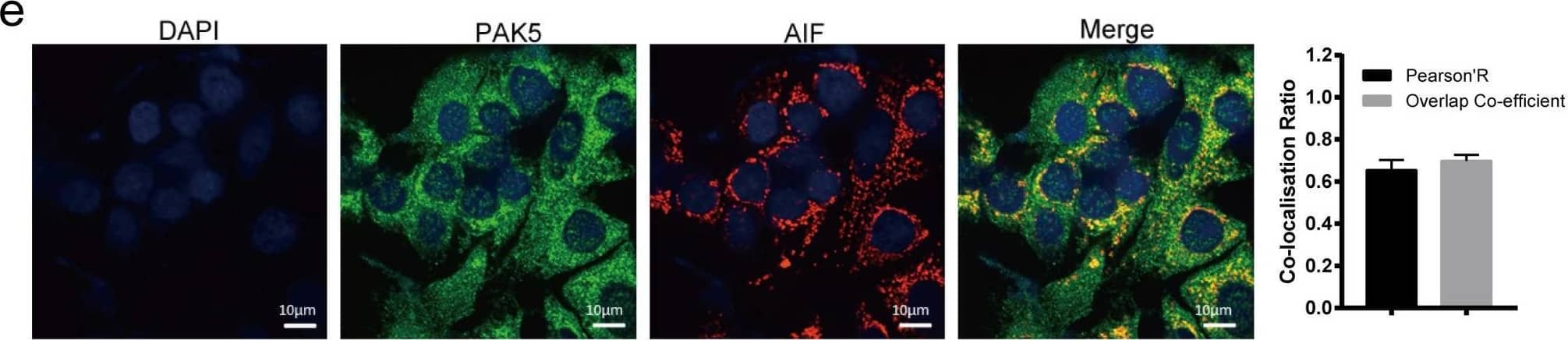
Detection of PAK7 by Immunohistochemistry PAK5 directly binds to AIF. (a,b) Endogenous AIF interacts with PAK5. BT474 cells/T47D lysates were immunoprecipitated with the anti-PAK5, anti-AIF or IgG. Precipitates were analyzed by western blot. (c) Exogenous PAK5 interacts with AIF. Total lysates were subjected to immunoprecipitation and western blot. (d) PAK5 directly binds to GST-AIF in vitro. Black stars indicate GST and GST-fusion proteins. (e) Co-localization of PAK5 and AIF. Nucleus was stained with DAPI (4', 6 diamidino-2-phenylindole). Yellow indicates co-localization. Original magnification, ×600. The Pearson's correlation and overlap co-efficient were shown in bar graph format (30 cells) from three independent experiments were analyzed (error bars, SEM). Image collected and cropped by CiteAb from the following open publication (https://pubmed.ncbi.nlm.nih.gov/33867848), licensed under a CC-BY license. Not internally tested by R&D Systems.
 View Larger
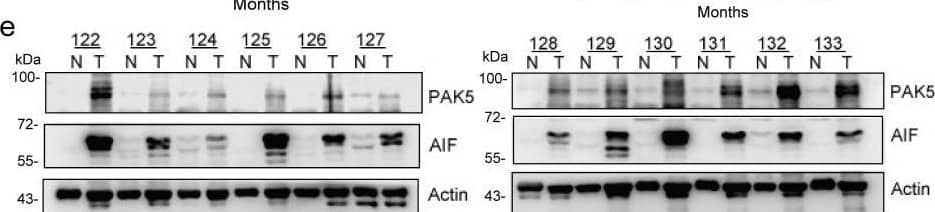
Detection of PAK7 by Western Blot PAK5 & AIF expression positively correlated with poor prognosis of breast cancer. (a) Analysis of expression differential proteins regulated by PAK5. Lysates from MDA-MB-231 overexpressing Flag-vector or Flag-tagged PAK5 & screening of differentially expressed proteins by sequencing. (b) Predict the expression of AIF in breast cancer & adjacent cancer in TCGA database. The fold-change was 0.897. (c) Predict the overall survival of AIF in GSE31519 database. (d) Predict the overall survival of AIF in TCGA database. (e) PAK5 & AIF expression in 122 clinical breast tissue pairs. Lysates of tumor tissues (T) & matched adjacent noncancerous tissues (N) were analyzed using Western blotting. Twelve representative pairs are shown. (f) The indicated protein levels in (e) were statistically analyzed (****p < 0.001). (g) Spearman's rank test was used to analyze the correlation between AIF relative expression & PAK5 relative expression in 122 subjects. (h) Representative images of immunohistochemical staining showing PAK5 & AIF protein expression in breast cancer. Original magnification, 400×. IHC staining was scored, & a Pearson correlation test was performed. Note that the scores of some samples overlap. (i-l) Kaplan-Meier survival analysis (GraphPad) of the relationship between overall survival (upper) & disease-free survival (lower) in breast cancer cases & PAK5 and/or AIF expression. The subjects were divided into different groups based on indicated PAK5 & AIF expression scores in the tumors: PAK5 low (n = 35) & PAK5 high (n = 40, i); AIF low (n = 36) & AIF high (n = 39, j). n = 15 for PAK5 low/AIF low, n=4 for PAK5 high/AIF low, n=12 for PAK5 low/AIF high, n = 44 for PAK5 high/AIF high; n = 35 for high nuclear translocation ratio of AIF, n = 40 for low nuclear translocation ratio of AIF. Image collected & cropped by CiteAb from the following open publication (https://pubmed.ncbi.nlm.nih.gov/33867848), licensed under a CC-BY license. Not internally tested by R&D Systems.
 View Larger
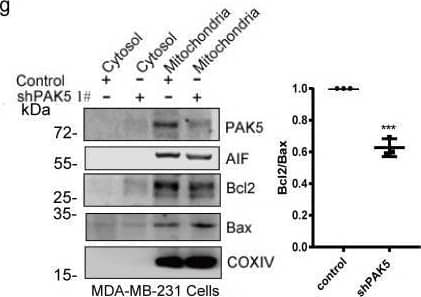
Detection of PAK7 by Western Blot PAK5 inhibits AIF release by regulating mitochondrial membrane permeability and potential. (a) PAK5 could increase the co-localization of AIF and COXIV (mitochondrial protein). Nucleus was stained with DAPI (4', 6 diamidino-2-phenylindole). Yellow indicates co-localization. Original magnification, × 600. The Pearson's correlation and overlap co-efficient were shown in bar graph format (30 cells) from three independent experiments were analyzed (error bars, SEM). (b,c) PAK5 could increase the expression of AIF in mitochondria. Cells were stably transfected with Flag-tagged PAK5 and extracted mitochondrial protein. Protein expression levels were determined by Western blotting. The data are shown as the mean _ SEM of triplicate experiments (*p < 0.05, **P < 0.01 vs. Control, n =3). (d-g) PAK5 could reduce membrane permeability of mitochondria. Cells were stably transfected with Flag-tagged PAK5 (d,e) or infected with PAK5-RNAi lentivirus (f,g) and extracted mitochondrial protein. Protein expression levels were determined by Western blotting. The data are shown as the mean _ SEM of triplicate experiments (***p < 0.001, ****p < 0.0001 vs. Control, n =3). (h-k) PAK5 can increase the membrane potential of mitochondria. Cells were stably transfected with Flag-tagged PAK5 (h,j) or infected with PAK5-RNAi lentivirus (i,k), the change in delta Ψm was examined using JC-1 staining assay. The ratio of fluorescent intensity of J-aggregates and monomers in treated cells is shown in e and f. The data are shown as the mean _ SEM of triplicate experiments (**P < 0.01, ***p < 0.001 vs. Control, n =3). Image collected and cropped by CiteAb from the following open publication (https://pubmed.ncbi.nlm.nih.gov/33867848), licensed under a CC-BY license. Not internally tested by R&D Systems.
Reconstitution Calculator
Preparation and Storage
- 12 months from date of receipt, -20 to -70 °C as supplied.
- 1 month, 2 to 8 °C under sterile conditions after reconstitution.
- 6 months, -20 to -70 °C under sterile conditions after reconstitution.
Background: PAK7
PAK7 (p21-activated kinase 7), also called PAK5, is a neuronal member of the PAK-II subfamily within the STE Ser/Thr protein kinase family. In the portion used as immunogen, human PAK7 shares 95% aa sequence identity with rat PAK7. This portion contains a CDC42/Rac1 interactive binding (CRIB) motif and potential phosphorylation sites at Ser104 and Thr107. In addition, PAK7 also interacts with RhoD and RhoH, directing its subcellular localization. PAK7 can be located in the mitochondrion, where it protects cells from apoptosis, or in the nucleus.
Product Datasheets
Citations for Human/Rat PAK7 Antibody
R&D Systems personnel manually curate a database that contains references using R&D Systems products. The data collected includes not only links to publications in PubMed, but also provides information about sample types, species, and experimental conditions.
3
Citations: Showing 1 - 3
Filter your results:
Filter by:
-
PAK5-mediated E47 phosphorylation promotes epithelial–mesenchymal transition and metastasis of colon cancer
Authors: G Zhu, X Li, B Guo, Q Ke, M Dong, F Li
Oncogene
-
PAK5-mediated AIF phosphorylation inhibits its nuclear translocation and promotes breast cancer tumorigenesis
Authors: Y Xing, Y Li, B Hu, F Han, X Zhao, H Zhang, Y Li, D Li, J Li, F Jin, F Li
International journal of biological sciences, 2021-03-27;17(5):1315-1327.
Species: Human
Sample Types: Whole Tissue
Applications: IHC -
P21-Activated Kinase Inhibitors FRAX486 and IPA3: Inhibition of Prostate Stromal Cell Growth and Effects on Smooth Muscle Contraction in the Human Prostate
Authors: Y Wang, C Gratzke, A Tamalunas, N Wiemer, A Ciotkowska, B Rutz, R Waidelich, F Strittmatt, C Liu, CG Stief, M Hennenberg
PLoS ONE, 2016-04-12;11(4):e0153312.
Species: Human
Sample Types: Tissue Homogenates
Applications: Western Blot
FAQs
No product specific FAQs exist for this product, however you may
View all Antibody FAQsReviews for Human/Rat PAK7 Antibody
Average Rating: 5 (Based on 1 Review)
Have you used Human/Rat PAK7 Antibody?
Submit a review and receive an Amazon gift card.
$25/€18/£15/$25CAN/¥75 Yuan/¥2500 Yen for a review with an image
$10/€7/£6/$10 CAD/¥70 Yuan/¥1110 Yen for a review without an image
Filter by:

