Human TRAIL/TNFSF10 Antibody Summary
Thr95-Gly281
Accession # P50591
Applications
Please Note: Optimal dilutions should be determined by each laboratory for each application. General Protocols are available in the Technical Information section on our website.
Scientific Data
 View Larger
Detection of TRAIL/TNFSF10 in Human PBMCs by Flow Cytometry. Human peripheral blood mononuclear cells (PBMCs), (A) treated with rhIFN- alpha for 48 hours (150 ng/mL), or (B) untreated, were stained with Mouse Anti-Human TRAIL/TNFSF10 Monoclonal Antibody (Catalog # MAB687) followed by PE-conjugated anti-Mouse IgG Secondary Antibody (Catalog # F0101B) and Mouse Anti-Human CD14 APC-conjugated Monoclonal Antibody (Catalog # FAB3832A). Quadrant markers were set based on control antibody staining (Catalog # MAB002). View our protocol for Staining Membrane-associated Proteins.
 View Larger
TRAIL/TNFSF10 in Human Colon. TRAIL/TNFSF10 was detected in immersion fixed paraffin-embedded sections of human colon using Human TRAIL/TNFSF10 Monoclonal Antibody (Catalog # MAB687) at 15 µg/mL overnight at 4 °C. Before incubation with the primary antibody, tissue was subjected to heat-induced epitope retrieval using Antigen Retrieval Reagent-Basic (Catalog # CTS013). Tissue was stained using the Anti-Mouse HRP-DAB Cell & Tissue Staining Kit (brown; Catalog # CTS002) and counterstained with hematoxylin (blue). Specific staining was localized to cytoplasm of lamina propria cells.. View our protocol for Chromogenic IHC Staining of Paraffin-embedded Tissue Sections.
 View Larger
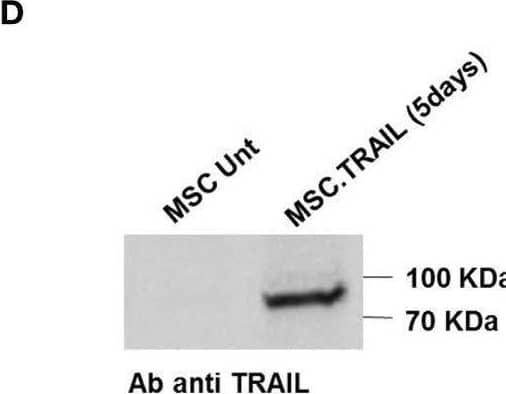
Detection of TRAIL/TNFSF10 by Western Blot Sensitivity of Colo205 and mesenchymal stem cells (MSCs) to diabody single-chain TNF-related apoptosis-inducing ligand (Db-scTRAIL) activity. (A) Colo205 cells and (B) MSCs were treated with serial dilutions (titration 1:3) of Db-scTRAIL in the absence (filled squares) or in the presence (filled triangles) of 250 ng/ml of bortezomib (BZB). After 18 h, cell viability was determined using crystal violet staining. Data were normalized using BZB-treated cells or cells treated with normal medium for Db-scTRAIL + BZB or Db-scTRAIL alone, respectively (mean ± SD, n = 3). (C) MSCs were transiently transfected (PEI), and the amount of soluble Db-scTRAIL released in cell culture medium was measured by enzyme-Linked Immunosorbent Assay, every 24 h (mean ± SD, n = 3). (D) After 5 days of transient transfection, Db-scTRAIL secreted in cell medium was purified and analyzed by western blotting using a specific antibody against TRAIL (MSC.Unt: MSC untransfected, MSC.TRAIL: MSC transfected with TRAIL). Image collected and cropped by CiteAb from the following open publication (https://pubmed.ncbi.nlm.nih.gov/28553285), licensed under a CC-BY license. Not internally tested by R&D Systems.
 View Larger
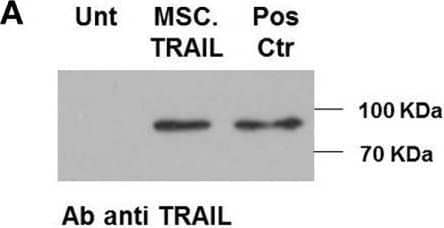
Detection of TRAIL/TNFSF10 by Western Blot Diabody single-chain TNF-related apoptosis-inducing ligand (Db-scTRAIL) released by mesenchymal stem cell (MSC).TRAIL cell line induces specific apoptotic activity in Colo205. (A) Immunoblotting of purified Db-scTRAIL from MSC untransfected (Unt) and MSC.TRAIL cell culture medium (5 days), using a specific antibody anti TRAIL. Three micrograms of purified Db-scTRAIL were used as positive control (Pos Ctr). (B) The bioactivity of the secreted Db-scTRAIL was tested after 18 h of coculture of MSC lines and Colo205 (ratios 1:5 and 1:50). The cocultures were treated in combination with bortezomib (BZB) (250 ng/ml) and/or TRAIL blocking antibody (1 μg/ml). Cell viability was analyzed using crystal violet staining and data were normalized using Colo205 cells treated with BZB as control (mean ± SD, n = 3). (C) Colo205 cells were seeded in the lower chamber of a transwell (8 × 10⁴ cells). After overnight cultivation, the stable cell lines (Mock.TRAIL and MSC.TRAIL) were seeded in the upper chamber (1.6 × 10⁴ cells) and BZB (250 ng/ml) was added to the medium. After 18 h of treatment, Colo205 were collected, stained with the specific cleaved caspase-3 antibody (Asp 175), and analyzed by flow cytometry (mean ± SD, n = 4). Image collected and cropped by CiteAb from the following open publication (https://pubmed.ncbi.nlm.nih.gov/28553285), licensed under a CC-BY license. Not internally tested by R&D Systems.
 View Larger
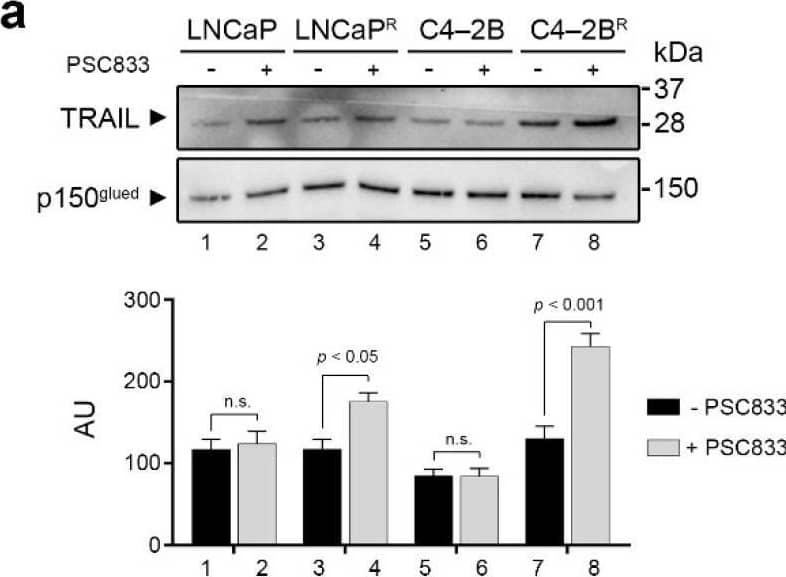
Detection of TRAIL/TNFSF10 by Western Blot TRAIL status and its role in docetaxel-resistant prostate cancer (PCa) cell lines (a) Parental and resistant cells were cultured in the presence or absence of the ABCB1 inhibitor PSC833 for 48 h and total cellular protein extracts were used to assess endogenous TRAIL expression by Western blot. Full Western blot image can be found in Figure S2. Upper panel: representative immunoblot showing levels of TRAIL protein present in whole cell extracts. P150 was used as normalizing control. Lower panel: graphs depicting pooled densitometry measurements of TRAIL levels relative to those of p150 in arbitrary units (AU). Data points are presented as mean ± SEM of triplicate measurements. (b) Cell viability was measured using MTT assay and normalized to an untreated control. LNCaP and C4-2B were treated with increasing doses of sTRAIL for 48 h. (c) LNCaPR and C4-2BR were treated for 48 h with vehicle, PSC833 alone, sTRAIL alone, or a combination of 1 μM PSC833 and increasing doses of sTRAIL. (d) Procaspase-3 and activated caspase-3 expression was assessed by Western blot after a pretreatment with PSC833 alone, sTRAIL alone, and PSC833 combined with sTRAIL. Lower panel: graphs depicting densitometry measurements of Procaspase-3 and activated caspase-3 levels relative to those of p150 in arbitrary units (AU). Full Western blot image can be found in Figure S3. Image collected and cropped by CiteAb from the following open publication (https://pubmed.ncbi.nlm.nih.gov/33799432), licensed under a CC-BY license. Not internally tested by R&D Systems.
Reconstitution Calculator
Preparation and Storage
- 12 months from date of receipt, -20 to -70 °C as supplied.
- 1 month, 2 to 8 °C under sterile conditions after reconstitution.
- 6 months, -20 to -70 °C under sterile conditions after reconstitution.
Background: TRAIL/TNFSF10
TRAIL is a type II transmembrane protein belonging to the TNF superfamily and is now designated TNFSF10. TRAIL is active as a homotrimer and is produced by a variety of cell types in both the membrane bound form and also as a soluble molecule. It binds to any of the four TRAIL receptors as well as to Osteoprotegerin.
Product Datasheets
Citations for Human TRAIL/TNFSF10 Antibody
R&D Systems personnel manually curate a database that contains references using R&D Systems products. The data collected includes not only links to publications in PubMed, but also provides information about sample types, species, and experimental conditions.
12
Citations: Showing 1 - 10
Filter your results:
Filter by:
-
Potent antitumoral activity of TRAIL through generation of tumor-targeted single-chain fusion proteins
Authors: B Schneider, S Münkel, A Krippner-Heidenreich, I Grunwald, W S Wels, H Wajant et al.
Cell Death & Disease
-
Upregulation of endogenous TRAIL-elicited apoptosis is essential for metformin-mediated antitumor activity against TNBC and NSCLC
Authors: Shuang Liu, Erik V. Polsdofer, Lukun Zhou, Sanbao Ruan, Hui Lyu, Defu Hou et al.
Molecular Therapy - Oncolytics
-
Superior antitumoral activity of dimerized targeted single-chain TRAIL fusion proteins under retention of tumor selectivity
Authors: M Siegemund, N Pollak, O Seifert, K Wahl, K Hanak, A Vogel et al.
Cell Death & Disease
-
Molecular Profiling of Docetaxel-Resistant Prostate Cancer Cells Identifies Multiple Mechanisms of Therapeutic Resistance
Authors: TS Lima, D Iglesias-G, LDO Souza, J Stenvang, DS Lima, MA Røder, K Brasso, JMA Moreira
Cancers, 2021-03-14;13(6):.
Species: Human
Sample Types: Cell Lysates
Applications: Western Blot -
TRAIL receptor gene editing unveils TRAIL-R1 as a master player of apoptosis induced by TRAIL and ER stress
Authors: F Dufour, T Rattier, AA Constantin, L Zischler, A Morl‚, H Ben Mabrou, E Humblin, G Jacquemin, E Szegezdi, F Delacote, N Marrakchi, G Guichard, C Pellat-Dec, P Vacher, P Legembre, C Garrido, M Olivier
Oncotarget, 2017-02-07;0(0):.
Species: Human
Sample Types: Cell Lysates
Applications: Western Blot -
Interferon-alpha stimulates TRAIL expression in human keratinocytes and peripheral blood mononuclear cells: implications for the pathogenesis of cutaneous lupus erythematosus.
Authors: Zahn S, Rehkamper C, Ferring-Schmitt S, Bieber T, Tuting T, Wenzel J
Br. J. Dermatol., 2011-09-15;165(5):1118-23.
Species: Human
Sample Types: Whole Tissue
Applications: IHC-P -
Plasmacytoid dendritic cells express TRAIL and induce CD4+ T-cell apoptosis in HIV-1 viremic patients.
Authors: Stary G, Klein I, Kohlhofer S, Koszik F, Scherzer T, Mullauer L, Quendler H, Kohrgruber N, Stingl G
Blood, 2009-08-18;114(18):3854-63.
Species: Human
Sample Types: Whole Cells, Whole Tissue
Applications: Flow Cytometry, IHC-P -
Conjunctival sac fluid contains elevated levels of soluble TRAIL: implications for the anti-tumoral surveillance of the anterior surface of the eye.
Authors: Secchiero P, Lamberti G, Corallini F, Melloni E, Guarnotta C, Sebastiani A, Zauli G
J. Cell. Physiol., 2009-01-01;218(1):199-204.
Species: Human
Sample Types: Whole Cells, Whole Tissue
Applications: Flow Cytometry, IHC-P -
Tumor necrosis factor-related apoptosis-inducing ligand promotes migration of human bone marrow multipotent stromal cells.
Authors: Secchiero P, Melloni E, Corallini F, Beltrami AP, Alviano F, Milani D, D'Aurizio F, di Iasio MG, Cesselli D, Bagnara GP, Zauli G
Stem Cells, 2008-09-04;26(11):2955-63.
Species: Human
Sample Types: Whole Cells
Applications: Flow Cytometry -
Insulin down-regulates TRAIL expression in vascular smooth muscle cells both in vivo and in vitro.
Authors: Corallini F, Celeghini C, Rizzardi C, Pandolfi A, Di Silvestre S, Vaccarezza M, Zauli G
J. Cell. Physiol., 2007-07-01;212(1):89-95.
Species: Human, Rat
Sample Types: Cell Lysates, Whole Cells, Whole Tissue
Applications: Flow Cytometry, IHC-P, Western Blot -
Evidence for a role of TNF-related apoptosis-inducing ligand (TRAIL) in the anemia of myelodysplastic syndromes.
Authors: Campioni D, Secchiero P, Corallini F, Melloni E, Capitani S, Lanza F, Zauli G
Am. J. Pathol., 2005-02-01;166(2):557-63.
Species: Human
Sample Types: Whole Cells
Applications: ICC -
Tumor necrosis factor-related apoptosis-inducing ligand (TRAIL) induces rheumatoid arthritis synovial fibroblast proliferation through mitogen-activated protein kinases and phosphatidylinositol 3-kinase/Akt.
Authors: Morel J, Audo R, Hahne M, Combe B
J. Biol. Chem., 2005-01-31;280(16):15709-18.
Species: Human
Sample Types: Whole Cells
Applications: Flow Cytometry
FAQs
No product specific FAQs exist for this product, however you may
View all Antibody FAQsReviews for Human TRAIL/TNFSF10 Antibody
Average Rating: 5 (Based on 1 Review)
Have you used Human TRAIL/TNFSF10 Antibody?
Submit a review and receive an Amazon gift card.
$25/€18/£15/$25CAN/¥75 Yuan/¥2500 Yen for a review with an image
$10/€7/£6/$10 CAD/¥70 Yuan/¥1110 Yen for a review without an image
Filter by:


