Mouse Caspase-11/Caspase-4 Antibody

Mouse Caspase-11/Caspase-4 Antibody Summary
Accession # P70343
Applications
Please Note: Optimal dilutions should be determined by each laboratory for each application. General Protocols are available in the Technical Information section on our website.
Scientific Data
View Larger
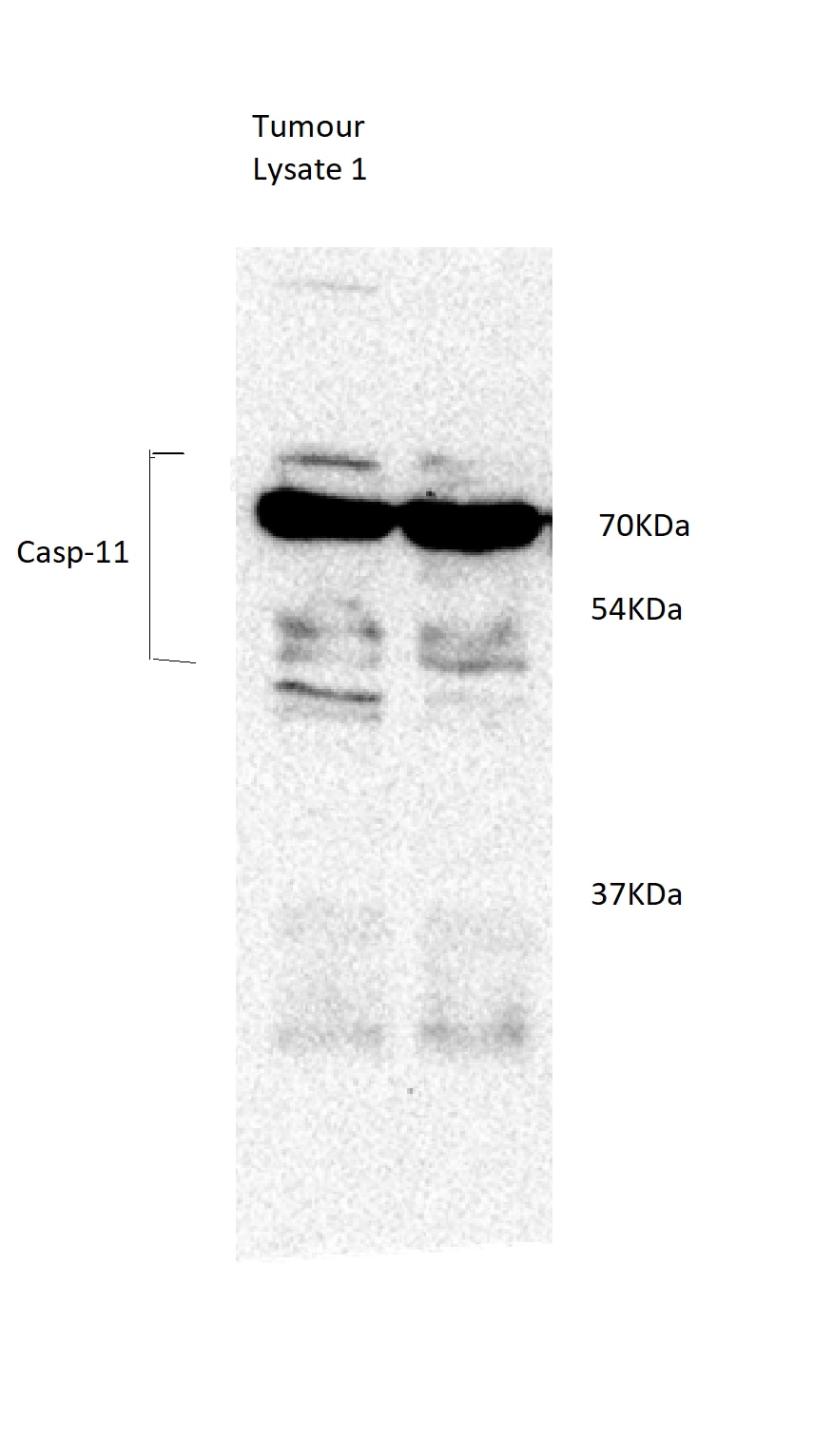
Detection of Mouse Caspase-11/Caspase-4 by Western Blot. Western blot shows lysates of mouse splenocytes untreated (-) or treated (+) with LPS. PVDF membrane was probed with 1 µg/mL of Rabbit Anti-Mouse Caspase-11/Caspase-4 Monoclonal Antibody (Catalog # MAB8648) followed by HRP-conjugated Anti-Rabbit IgG Secondary Antibody (Catalog # HAF008). Specific bands were detected for Caspase-11/Caspase-4 at approximately 36, 44, and 46 kDa (as indicated). This experiment was conducted under reducing conditions and using Immunoblot Buffer Group 1.
View Larger
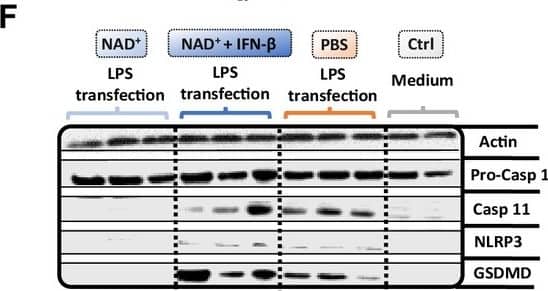
Detection of Mouse Caspase-11/Caspase-4 by Western Blot Pro-casp-1, casp-11, NLRP3, gasdermin D (GSDMD) expression were assessed by western blot. Statistical significance was determined by using Student’s t-test or one-way ANOVA. Asterisks indicate p-values *=p<0.05, **=p<0.01, and ***=p<0.001, only significant values are shown. All data depicted in this figure are provided as source data. Image collected and cropped by CiteAb from the following open publication (https://elifesciences.org/articles/88686), licensed under a CC-BY license. Not internally tested by R&D Systems.
View Larger
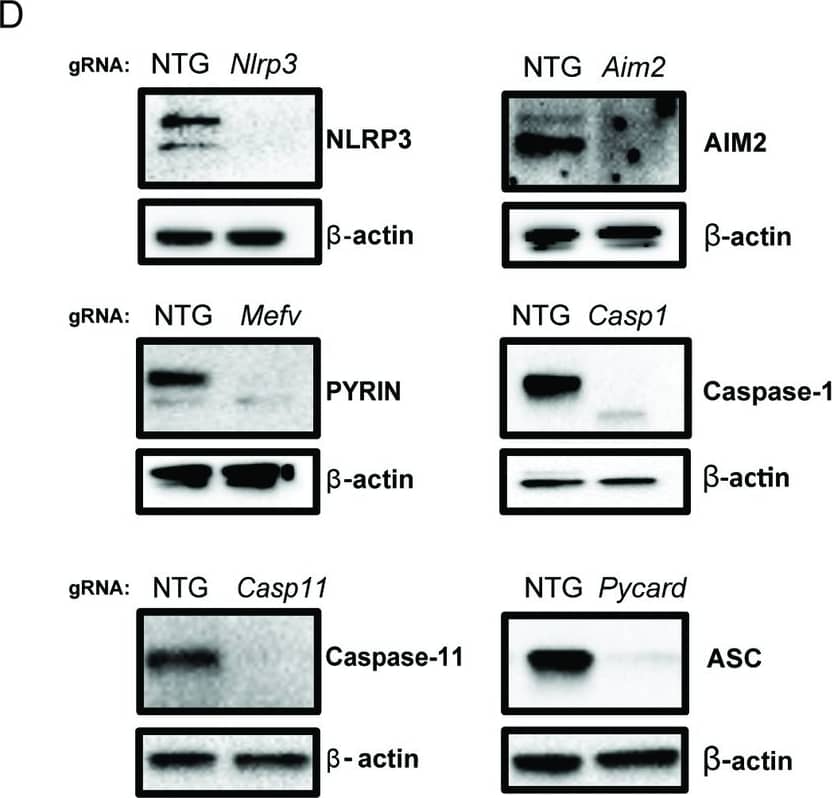
Detection of Mouse Caspase-11/Caspase-4 by Western Blot DENV NS1-induced inflammasome activation is NLPR3-independent.(A) WT and Nlrp3-/- BMDMs were primed with PAM3CSK4 (1μg/mL) for 17h and then treated with DENV2 NS1 at indicated concentrations, nigericin (5μM), or medium (PAM only). IL-1 beta levels in supernatant 2h (nigericin) or 24h (NS1 and PAM only) were measured by ELISA. Statistical significance was determined using two-way ANOVA with Holm-Sidak’s multiple comparisons test. (B) Representative Western blots of cell lysates from WT and Nlrp3-/- BMDMs after priming with PAM3CSK4 (1μg/mL) for 17h and treatment with DENV2 NS1 (10 or 5 μg/mL), treatment with nigericin (5μM), or no treatment for 24h. (C) BMDMs were primed with PAM3CSK4 (1μg/mL) for 17h and then pre-treated with MCC950 at the indicated concentrations before addition of DENV2 NS1 (10μg/mL), nigericin (5μM), or medium (Inhibitor only). IL-1 beta levels in the supernatant after 2h (Nigericin) or 24h (NS1 and PAM only) were measured by ELISA. (D) Representative Western blots of cell lysates from BMDMs nucleofected with Cas9-gRNA ribonuclear protein complexes to knock out the indicated genes. Two gRNAs per gene were used per nucleofection. NTG = non-targeting guide. (E) Knockout BMDMs from (D) were primed with PAM3CSK4 (1μg/mL) for 17h and treated with DENV2 NS1 (10μg/mL) or left untreated for 48h. Statistical significance was determined using two-way ANOVA followed by with Holm-Sidak’s multiple comparisons test. The data are shown as the mean ± SD of 3 biological replicates (A,C), a representative image taken from 2 biological replicates (B,D), or data pooled from 8 independent experiments with at least 3 biological replicates per guide (E). *p<0.05, **p<0.01, *** p< 0.001, ****p<0.0001, ns (not significant), p> 0.05. Image collected and cropped by CiteAb from the following open publication (https://dx.plos.org/10.1371/journal.ppat.1012167), licensed under a CC-BY license. Not internally tested by R&D Systems.
View Larger
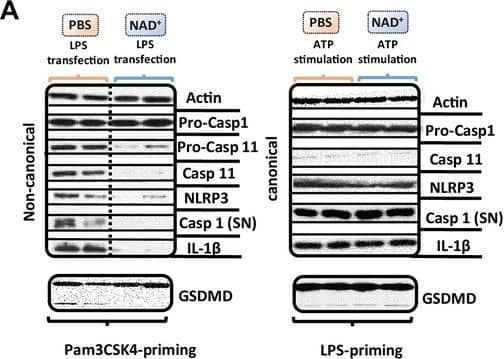
Detection of Mouse Caspase-11/Caspase-4 by Western Blot NAD+ specifically inhibits the non-canonical inflammasome by targeting caspase-11.Bone marrow was isolated from mice and bone marrow-derived macrophages (BMDMs) were differentiated in vitro. Subsequently, BMDMs were cultured in the presence of NAD+ or PBS. BMDMs were then primed with either Pam3CSK4 or lipopolysaccharide (LPS) O111:B4. Next primed BMDMs were stimulated with ATP or LPS and cholera toxin B (CTB). (A) Pro-casp-1, pro-casp-11, casp-11, NLRP3, casp-1, IL1 beta, and gasdermin D (GSDMD) expression were determined using western blot and (B) IL-1 beta secretion and LDH release were assessed in the supernatant. Column plots display mean with standard deviation (n=5-8). Image collected and cropped by CiteAb from the following open publication (https://elifesciences.org/articles/88686), licensed under a CC-BY license. Not internally tested by R&D Systems.
Reconstitution Calculator
Preparation and Storage
- 12 months from date of receipt, -20 to -70 °C as supplied.
- 1 month, 2 to 8 °C under sterile conditions after reconstitution.
- 6 months, -20 to -70 °C under sterile conditions after reconstitution.
Background: Caspase-11/Caspase-4
Mouse Caspase-11 (commonly referred as Caspase-4) is a member of the cysteine-aspartic acid protease family known as caspases that function in initiating apoptosis or activating proinflammitory cytokines. Mouse Caspase-11 is expressed as a 343 amino acid latent zymogen. The active caspase-11 is cleaved into two subunits, p20 (aa 81-266) and p10 (aa 286-373). Caspase-11 is one of several caspases associated with the inflammasome and plays an important role in the activation of proinflammatory cytokines. Caspase-11 is activated by an autocatalytic mechanism or by cleavage by Caspase-8 in response to ER stress or bacterial infection, and its expression and activation can be induced by exposure to LPS. The active enzyme can cleave and activate Caspase-1 which in turn activates IL-1 beta. Mouse Caspase-11 has a 59 and 89% homology to human and rat Caspase-4, respectively.
Product Datasheets
Citation for Mouse Caspase-11/Caspase-4 Antibody
R&D Systems personnel manually curate a database that contains references using R&D Systems products. The data collected includes not only links to publications in PubMed, but also provides information about sample types, species, and experimental conditions.
1 Citation: Showing 1 - 1
-
Contribution of the inflammasome to inflammaging.
Authors: Mejias NH, Martinez CC, Stephens ME, de Rivero Vaccari JP.
J Inflamm (Lond).
FAQs
No product specific FAQs exist for this product, however you may
View all Antibody FAQsReviews for Mouse Caspase-11/Caspase-4 Antibody
Average Rating: 4 (Based on 1 Review)
Have you used Mouse Caspase-11/Caspase-4 Antibody?
Submit a review and receive an Amazon gift card.
$25/€18/£15/$25CAN/¥75 Yuan/¥2500 Yen for a review with an image
$10/€7/£6/$10 CAD/¥70 Yuan/¥1110 Yen for a review without an image
Filter by:
50ug protein