Mouse CCL7/MCP-3/MARC Antibody Summary
Gln24-Pro97
Accession # Q03366
Applications
Please Note: Optimal dilutions should be determined by each laboratory for each application. General Protocols are available in the Technical Information section on our website.
Scientific Data
 View Larger
Chemotaxis Induced by CCL7/MARC and Neutralization by Mouse CCL7/MARC Antibody. Recombinant Mouse CCL7/ MARC (Catalog # 456-MC) chemoattracts the BaF3 mouse pro-B cell line transfected with human CCR2A in a dose-dependent manner (orange line). The amount of cells that migrated through to the lower chemotaxis chamber was measured by Resazurin (Catalog # AR002). Chemotaxis elicited by Recombinant Mouse CCL7/ MARC (2 µg/mL) is neutralized (green line) by increasing concentrations of Mouse CCL7/MARC Antigen Affinity-purified Polyclonal Antibody (Catalog # AF-456-NA). The ND50 is typically 7.5-45 µg/mL.
 View Larger
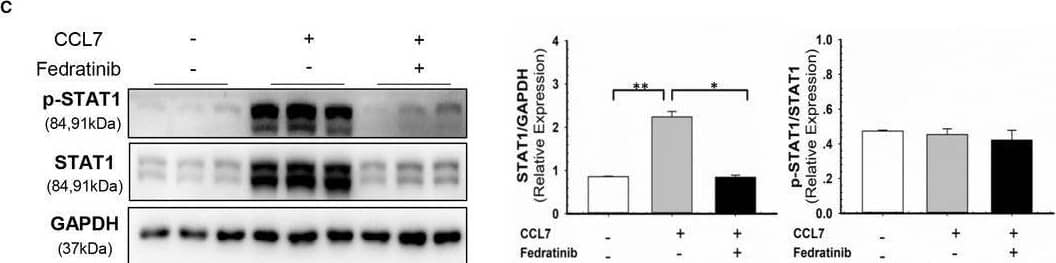
Detection of CCL7/MCP-3/MARC by Western Blot CCL7‐activated JAK2/STAT1 signal in macrophages. (A) Protein abundance of JAK2 and STAT1 in abdominal aortas of saline (n = 4) and Ang II‐infused (n = 4) mice. (B) Protein abundance of JAK2, p‐JAK2, STAT1, p‐STAT1 and p‐JAK2/JAK2, p‐STAT1/STAT1 ratio in BMDMs incubated with rmCCL7 (100 ng/ml). (C) Protein abundance of STAT1, p‐STAT1 and p‐STAT1/STAT1 ratio in BMDM incubated with rmCCL7(100 ng/ml) and pre‐treated 1 hour with JAK2 inhibitor Fedratinib (1 μM). Values were represented as mean ± SEM; Student's t test was used for data analysis in (A, B). One Way ANOVA was used for data analysis in(C). *P < .05; **P < .01; ***P < .001, respectively Image collected and cropped by CiteAb from the following open publication (https://pubmed.ncbi.nlm.nih.gov/34189838), licensed under a CC-BY license. Not internally tested by R&D Systems.
 View Larger
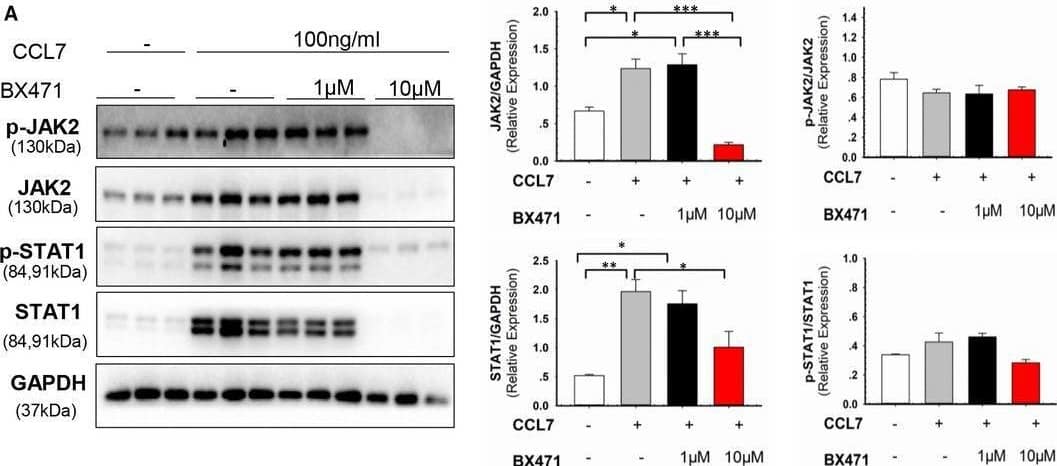
Detection of CCL7/MCP-3/MARC by Western Blot CCL7‐CCR1 interaction regulated macrophage phenotype through JAK2 /STAT1 pathway. (A) Protein abundance of JAK2, p‐JAK2, STAT1, p‐STAT1 and p‐JAK2/JAK2, p‐STAT1/STAT1 ratio in BMDMs incubated with rmCCL7 (100 ng/ml) and pre‐treated 1 hour with CCR1 antagonist‐BX471(1 μM and 10 μM). (B) M1 markers (iNOS, IL‐6, IL‐12A, IL‐12B, TNF‐ alpha ) mRNA level in BMDMs incubated with rmCCL7 alone or in combination with JAK2 inhibitor‐Fedratinib (1 μM) and STAT1 inhibitor‐Fludarabine (1 μM). (C) Pathological mechanism diagram of CCL7 in Ang II‐induced AAA. Values were represented as mean ± SEM; One Way ANOVA was used for data analysis in (A‐B) *P < .05; **P < .01; ***P < .001, respectively Image collected and cropped by CiteAb from the following open publication (https://pubmed.ncbi.nlm.nih.gov/34189838), licensed under a CC-BY license. Not internally tested by R&D Systems.
 View Larger
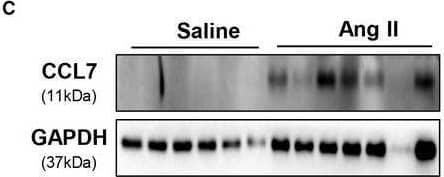
Detection of CCL7/MCP-3/MARC by Western Blot CCL7 expression and macrophages infiltration increased in Ang II‐infused abdominal aortas. (A) Representative abdominal aorta images with ultrasound examination, the maximum abdominal aorta diameter (luminal diameter) and the maximum abdominal aorta area (luminal area). A grid on the scale represented 0.5 mm. (B) qRT‐PCR for CCL7 mRNA expression in saline (n = 6) and Ang II (n = 7) infused mice. (C) Protein levels of CCL7 in saline (n = 6) and Ang II (n = 7) infused abdominal aortas. (D) Plasma concentrations of CCL7 in saline (n = 6) and Ang II (n = 9) infused mice. (E) Representative images of macrophage infiltration in aneurysmal lesions as revealed by CD68 immunostaining. Black arrows indicated CD68‐positive location, scale bars represented 200 μm (left) and 50 μm (right images). Values were represented as mean ± SEM; Student's t test was used for data analysis in (A‐E). *P < .05; **P < .01; ***P < .001, respectively Image collected and cropped by CiteAb from the following open publication (https://pubmed.ncbi.nlm.nih.gov/34189838), licensed under a CC-BY license. Not internally tested by R&D Systems.
Reconstitution Calculator
Preparation and Storage
- 12 months from date of receipt, -20 to -70 °C as supplied.
- 1 month, 2 to 8 °C under sterile conditions after reconstitution.
- 6 months, -20 to -70 °C under sterile conditions after reconstitution.
Background: CCL7/MCP-3/MARC
Mouse MARC, a member of the beta subfamily of chemokines, was initially identified as a transcript that is induced in a mouse mast cell line after Fc epsilon RI triggering by IgE plus antigen. Sequence comparisons suggest that MARC may be the mouse homologue of the human MCP-3 gene. Mouse MARC/MCP-3 expression has also been detected during murine experimental allergic encephalomyelitis in the spinal cord, and in LPS-stimulated murine WEHI -3 cells and Swiss 3T3 cells where MARC expression is glucocorticoid-attenuated. Except for one amino acid subsititution, mouse MARC is identical to mouse FIC, the product of a growth factor‑activated gene. The mouse MARC cDNA encodes a 97 amino acid residue precursor protein with a 23 amino acid residue signal peptide that is cleaved to yield a 74 amino acid residue mature protein. Mouse CCR2, a mouse chemokine receptor, has been shown to bind JE/MCP-1 with high affinity and MARC/MCP-3 with lower affinity. The E. coli-expressed mouse MARC/MCP-3 produced at R&D Systems has been shown to be a monocyte and T-lymphocyte chemoattractant.
- Kulmburg, P.A. et al. (1992) J. Exp. Med. 176:1773.
- Thirion, S. et al. (1994) Biochem. Biophys. Res. Commun. 201:493.
- Smith, J.B. and H.R. Herschman (1995) J. Biol. Chem. 270:16756.
- Kurihara, T. and R. Bravo (1996) J. Biol. Chem. 271:11603.
Product Datasheets
Citations for Mouse CCL7/MCP-3/MARC Antibody
R&D Systems personnel manually curate a database that contains references using R&D Systems products. The data collected includes not only links to publications in PubMed, but also provides information about sample types, species, and experimental conditions.
15
Citations: Showing 1 - 10
Filter your results:
Filter by:
-
Hypoxia inducible factor 1 alpha in vascular smooth muscle cells promotes angiotensin II-induced vascular remodeling via activation of CCL7-mediated macrophage recruitment
Authors: Qi D, Wei M, Jiao S et al.
Cell Death Dis
-
Glioma-derived CCL2 and CCL7 mediate migration of immune suppressive CCR2+/CX3CR1+ M-MDSCs into the tumor microenvironment in a redundant manner
Authors: Gregory P. Takacs, Christian J. Kreiger, Defang Luo, Guimei Tian, Julia S. Garcia, Loic P. Deleyrolle et al.
Frontiers in Immunology
-
Essential roles of the cytokine oncostatin M in crosstalk between muscle fibers and immune cells in skeletal muscle after aerobic exercise
Authors: T Komori, Y Morikawa
The Journal of Biological Chemistry, 2022-11-09;0(0):102686.
Species: Mouse
Sample Types: Tissue Homogenates
Applications: Western Blot -
ROS-induced PADI2 downregulation accelerates cellular senescence via the stimulation of SASP production and NF kappa B activation
Authors: Hyun-Jung Kim, Woo-Jin Kim, Hye-Rim Shin, Hee-In Yoon, Jae-I Moon, Eunji Lee et al.
Cellular and Molecular Life Sciences
-
CCL7 contributes to angiotensin II-induced abdominal aortic aneurysm by promoting macrophage infiltration and pro-inflammatory phenotype
Authors: C Xie, F Ye, N Zhang, Y Huang, Y Pan, X Xie
Journal of Cellular and Molecular Medicine, 2021-06-29;0(0):.
Species: Mouse
Sample Types: In Vivo
Applications: Neutralization -
Deficiency in CCR2 increases susceptibility of mice to infection with an intracellular pathogen, Francisella tularensis LVS, but does not impair development of protective immunity
Authors: SL Kurtz, R De Pascali, AI Meierovics, KL Elkins
PLoS ONE, 2021-03-24;16(3):e0249142.
Species: Mouse
Sample Types: In Vivo
Applications: Neutralization -
Reticular Fibroblasts Expressing the Transcription Factor WT1 Define a Stromal Niche that Maintains and Replenishes Splenic Red Pulp Macrophages
Authors: Alicia Bellomo, Isabelle Mondor, Lionel Spinelli, Marine Lagueyrie, Benjamin J. Stewart, Nicolas Brouilly et al.
Immunity
-
Fbxw7 increases CCL2/7 in CX3CR1hi macrophages to promote intestinal inflammation
Authors: J He, Y Song, G Li, P Xiao, Y Liu, Y Xue, Q Cao, X Tu, T Pan, Z Jiang, X Cao, L Lai, Q Wang
J. Clin. Invest., 2019-06-27;130(0):.
Species: Mouse
Sample Types: Whole Cells
Applications: Bioassay -
Chemokines CCL2 and CCL7, but not CCL12, play a significant role in the development of pain-related behavior and opioid-induced analgesia
Authors: K Kwiatkowsk, K Popiolek-B, A Piotrowska, E Rojewska, K Ciapa?a, W Makuch, J Mika
Cytokine, 2019-04-16;119(0):202-213.
Species: Mouse
Sample Types: In Vivo
Applications: In Vivo -
CCL7 and IRF-7 Mediate Hallmark Inflammatory and IFN Responses following Rhinovirus 1B Infection.
Authors: Girkin J, Hatchwell L, Foster P, Johnston S, Bartlett N, Collison A, Mattes J
J Immunol, 2015-04-06;194(10):4924-30.
Species: Mouse
Sample Types: In Vivo
Applications: Neutralization -
The expression of Fn14 via mechanical stress-activated JNK contributes to apoptosis induction in osteoblasts.
Authors: Matsui H, Fukuno N, Kanda Y, Kantoh Y, Chida T, Nagaura Y, Suzuki O, Nishitoh H, Takeda K, Ichijo H, Sawada Y, Sasaki K, Kobayashi T, Tamura S
2014-01-20;0(0):.
Species: Mouse
Sample Types: Cell Lysates
Applications: Western Blot -
B lymphocytes trigger monocyte mobilization and impair heart function after acute myocardial infarction
Authors: Yasmine Zouggari, Hafid Ait-Oufella, Philippe Bonnin, Tabassome Simon, Andrew P Sage, Coralie Guérin et al.
Nature Medicine
-
Identification of Chemoattractive Factors Involved in the Migration of Bone Marrow-Derived Mesenchymal Stem Cells to Brain Lesions Caused by Prions
Authors: Chang-Hyun Song, Osamu Honmou, Hidefumi Furuoka, Motohiro Horiuchi
Journal of Virology
Species: Human
Sample Types: Whole Cells
Applications: Neutralization -
Comprehensive assessment of chemokine expression profiles by flow cytometry.
Authors: Eberlein J, Nguyen TT, Victorino F, Golden-Mason L, Rosen HR, Homann D
J. Clin. Invest., 2010-02-08;120(3):907-23.
Species: Mouse
Sample Types: Whole Cells
Applications: Flow Cytometry -
The CCL7-CCL2-CCR2 axis regulates IL-4 production in lungs and fungal immunity.
Authors: Szymczak WA, Deepe GS
J. Immunol., 2009-07-08;183(3):1964-74.
Species: Mouse
Sample Types: In Vivo
Applications: Neutralization
FAQs
No product specific FAQs exist for this product, however you may
View all Antibody FAQsReviews for Mouse CCL7/MCP-3/MARC Antibody
There are currently no reviews for this product. Be the first to review Mouse CCL7/MCP-3/MARC Antibody and earn rewards!
Have you used Mouse CCL7/MCP-3/MARC Antibody?
Submit a review and receive an Amazon gift card.
$25/€18/£15/$25CAN/¥75 Yuan/¥2500 Yen for a review with an image
$10/€7/£6/$10 CAD/¥70 Yuan/¥1110 Yen for a review without an image

