Mouse CD27/TNFRSF7 Antibody Summary
Thr21-Arg182
Accession # P41272
Applications
Please Note: Optimal dilutions should be determined by each laboratory for each application. General Protocols are available in the Technical Information section on our website.
Scientific Data
 View Larger
Detection of Mouse CD27/TNFRSF7 by Western Blot. Western blot shows lysates of mouse spleen tissue. PVDF Membrane was probed with 2 µg/mL of Mouse CD27/TNFRSF7 Monoclonal Antibody (Catalog # MAB574) followed by HRP-conjugated Anti-Rat IgG Secondary Antibody (Catalog # HAF005). A specific band was detected for CD27/TNFRSF7 at approximately 45 kDa (as indicated). This experiment was conducted under reducing conditions and using Immunoblot Buffer Group 7.
 View Larger
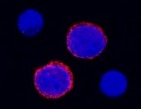
CD27/TNFRSF7 in Mouse Splenocytes. CD27/TNFRSF7 was detected in immersion fixed mouse splenocytes using Rat Anti-Mouse CD27/TNFRSF7 Monoclonal Antibody (Catalog # MAB574) at 8 µg/mL for 3 hours at room temperature. Cells were stained using the NorthernLights™ 557-conjugated Anti-Rat IgG Secondary Antibody (red; Catalog # NL013) and counterstained with DAPI (blue). Specific staining was localized to plasma membrane. View our protocol for Fluorescent ICC Staining of Non-adherent Cells.
 View Larger
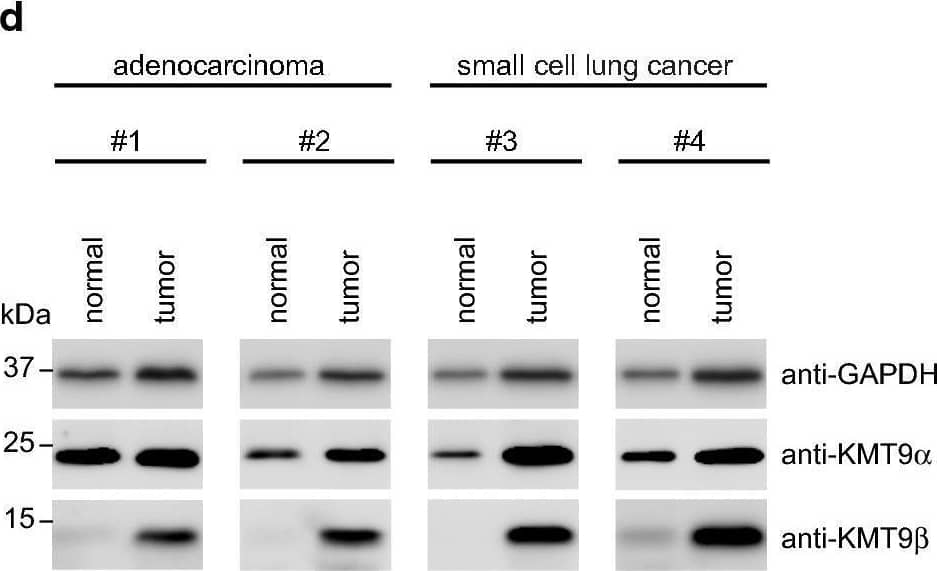
Detection of CD27/TNFRSF7 by Western Blot KMT9 is expressed in lung cancer tissue and cell lines. a Dynamics of KMT9 alpha expression in matched normal and stage 1a lung adenocarcinoma tissue from eleven patients that underwent curative lobectomy. Normal samples were taken at 6 cm distance from macroscopic tumor sites. Data were extracted from (GSE83213). Red lines indicate increased expression of KMT9 alpha in tumor (n = 8), green lines indicate decreased expression of KMT9 alpha in tumor (n = 3). b TCGA data comparing KMT9 alpha expression in n = 515 lung adenocarcinoma with non-matched normal lung tissue (n = 59). Data represent interquartile range including minimum, 25th percentile, median, 75th percentile and maximum values. Significance was accessed by t test. c Kaplan–Meier survival analysis of patients with adenocarcinoma expressing high (n = 58) and low (n = 57) KMT9 alpha. Data were extracted from GSE26939. HR = hazard ratio. d Western blots of matched tissue from normal and tumor samples from patients with adenocarcinoma (#1 and #2) or SCLC (#3 and #4). Western blots were performed with the indicated antibodies. e Expression levels of KMT9 alpha and KMT9 beta in human cell lines from SCLC (GLC-2 and NCI-H82), adenocarcinoma (A549, PC-9 and NCI-H2087) and human immortalized normal lung fibroblasts (CRL-7000 and IMR-90) were analyzed by western blot using the indicated antibodies. f In A549 cells, KMT9 alpha and KMT9 beta are present in both nuclear and cytoplasmic compartments. Western blots were performed with the indicated antibodies. g Levels of H4K12me1 in SCLC (GLC-2 and NCI-H82) and adenocarcinoma (A549, PC-9 and NCI-H2087) cells were analyzed by western blotting using the indicated antibodies Image collected and cropped by CiteAb from the following open publication (https://pubmed.ncbi.nlm.nih.gov/32095117), licensed under a CC-BY license. Not internally tested by R&D Systems.
 View Larger
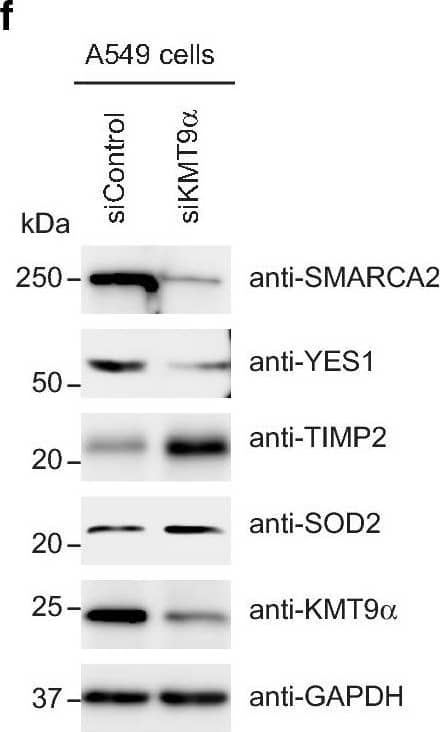
Detection of CD27/TNFRSF7 by Western Blot KMT9 controls expression of genes involved in the organization of organelles, cells death and cell proliferation. a Venn diagram showing overlap and number of genes/proteins in A549 cells that are differentially expressed upon RNAi mediated knock-down of KMT9 alpha (log2(fold-change) > ± 0.26). In total, 460 targets are concomitantly up- or down-regulated on RNA and protein level upon knock-down of KMT9 alpha. Enriched GO_cellular components b and GO_biological processes c gene sets obtained for the indicated 460 KMT9 alpha -regulated target genes. d Heat map displaying mRNA levels of the 460 KMT9 alpha -regulated genes involved in cell proliferation (GO:0042127) in A549 cells treated with siControl or siKMT9 alpha #1. e RNA sequencing reads (left panel) and mass spectrometry volcano plot (right panel) for the indicated genes and proteins are represented exemplarily. f Western blot displaying expression of the target proteins indicated in e upon knock-down of KMT9 alpha in A549 cells. The indicated antibodies were used. g Quantitative real-time PCR analysis of the mRNA expression of the target genes displayed in e after knock-down of KMT9 alpha. Data represent means + standard deviation. Significance was accessed by two-tailed t test, n = 3 (TIMP2 n = 6) Image collected and cropped by CiteAb from the following open publication (https://pubmed.ncbi.nlm.nih.gov/32095117), licensed under a CC-BY license. Not internally tested by R&D Systems.
Reconstitution Calculator
Preparation and Storage
- 12 months from date of receipt, -20 to -70 °C as supplied.
- 1 month, 2 to 8 °C under sterile conditions after reconstitution.
- 6 months, -20 to -70 °C under sterile conditions after reconstitution.
Background: CD27/TNFRSF7
CD27 is a lymphocyte-specific member of the tumor necrosis factor receptor superfamily (TNFRSF) and is designated TNFRSF7 (1, 2). Mouse CD27 cDNA encodes a 250 amino acid (aa) residue type I transmembrane protein with a 20 aa putative signal peptide, a 162 aa extracellular region containing three TNFR cysteine-rich repeats, a 21 aa transmembrane domain and a 47 aa cytoplasmic region (3). Mouse and human CD27 share approximately 65% amino acid identity. CD27 exists as homodimers on the cell surface via an extracellular disulfide bond in the membrane-proximal region. A soluble form of CD27 is also produced during the immune response and is found in various body fluids (4). CD27 is expressed on subsets of T and B cells. The expression of CD27 is upregulated upon T-cell activation. Although CD27 appears to be a marker for human memory B cells, it is only expressed in a small population of mouse B cells in germinal centers and at sites of B cell stimulation, suggesting that mouse CD27 may be a marker for activated B cells (5). CD27 interacts with CD27 ligand (also named CD70 and TNFSF7), which is a member of the TNF ligand superfamily. Ligation of CD27 on T cells provides costimulatory signals that are required for T cell proliferation, clonal expansion and the promotion of effector T cell formation (1, 2). Ligation of CD27 on B cells has been shown to inhibit terminal differentiation of activated mouse B cells into plasma cells and enhances commitment to memory B cell responses (5).
- Croft, M. (2003) Nature Reviews Immunol. 3:609.
- Croft, M. (2003) Cytokine and Growth Factor Reviews 14:265.
- Gravestein, L.A. et al. (1993) Eur. J. Immunol. 23:943.
- Lens, S.M. et al. (1998) Semin. Immunol. 10:491.
- Raman, V.S. et al. (2003) J. Immunol. 171:5876.
Product Datasheets
Citation for Mouse CD27/TNFRSF7 Antibody
R&D Systems personnel manually curate a database that contains references using R&D Systems products. The data collected includes not only links to publications in PubMed, but also provides information about sample types, species, and experimental conditions.
1 Citation: Showing 1 - 1
-
Depletion of histone methyltransferase KMT9 inhibits lung cancer cell proliferation by inducing non-apoptotic cell death
Authors: HM Baumert, E Metzger, M Fahrner, J George, RK Thomas, O Schilling, R Schüle
Cancer Cell Int., 2020-02-17;20(0):52.
Species: Human
Sample Types: Cell Culture Lysates
Applications: Western Blot
FAQs
No product specific FAQs exist for this product, however you may
View all Antibody FAQsReviews for Mouse CD27/TNFRSF7 Antibody
Average Rating: 5 (Based on 1 Review)
Have you used Mouse CD27/TNFRSF7 Antibody?
Submit a review and receive an Amazon gift card.
$25/€18/£15/$25CAN/¥75 Yuan/¥2500 Yen for a review with an image
$10/€7/£6/$10 CAD/¥70 Yuan/¥1110 Yen for a review without an image
Filter by: