Mouse IL-18 R alpha /IL-1 R5 Antibody Summary
Ser19-Gly326
Accession # Q61098
Applications
Please Note: Optimal dilutions should be determined by each laboratory for each application. General Protocols are available in the Technical Information section on our website.
Scientific Data
 View Larger
Detection of IL‑18 R alpha /IL‑1 R5 in Mouse Splenocytes by Flow Cytometry. Mouse splenocytes were stained with Rat Anti-Mouse IL‑18 Ra/IL‑1 R5 Monoclonal Antibody (Catalog # MAB1216, filled histogram) or isotype control antibody (Catalog # MAB005, open histogram), followed by Phycoerythrin-conjugated Anti-Rat IgG F(ab')2Secondary Antibody (Catalog # F0105B).
 View Larger
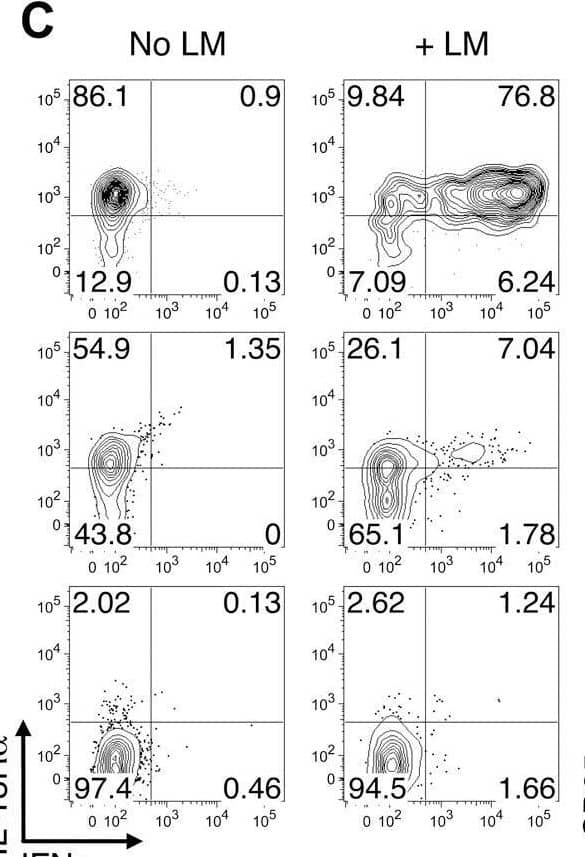
Detection of IL-18 R alpha /IL-1 R5 by Flow Cytometry Memory but not exhausted T cells express IFN-gamma and CD25 in response to LM infection. Cohorts of mice were challenged with wild-type LM 59-81 days following acute (LCMV-Arm), protracted (LCMV-cl13 infected B6 mice) and chronic (LCMV-cl13 infected CD4-/- mice) infections. Splenocytes were prepared 20 hr after the bacterial infection and cultured in the presence of BFA for 3hr prior to surface MHC tetramer staining and intracellular staining for IFN-gamma accumulation. (A) Overview of the experimental design. (B) Representative flow cytometry plots show IL-18R alpha expression and IFN-gamma production by gated CD8 T cells are shown with and without LM infection. (C) IL-18R alpha and (D) CD25 expression in conjunction with IFN-gamma production are shown for gated LCMV DbGP33+ CD8 T cells. The percentages of (E) IFN-gamma -producing and (F) CD25-expressing IFN-gamma + LCMV Db(GP33) and Db(GP276) epitope-specific CD8 T cells are shown for individual mice, and mean values are indicated by the horizontal bars. (G) and (H) Bacterial titers in the spleens and livers, respectively, following LM challenge of the cohorts of mice that were previously infected with LCMV. Flow cytometry plots show representative data from either (B, C) three or (D) two independent experiments analyzing a total of 11-12 LM challenged mice per group. Graphs show results from (E) 4–5 experiments with 15-18 mice per group, from (F) two experiments with 6-8 mice per group, from (G) four experiments with 14-15 mice per group, and from (H) three experiments with 10–12 mice per group. *** p<0.001, ** p<0.01, * p<0.05. Image collected and cropped by CiteAb from the following open publication (https://pubmed.ncbi.nlm.nih.gov/21980291), licensed under a CC-BY license. Not internally tested by R&D Systems.
 View Larger
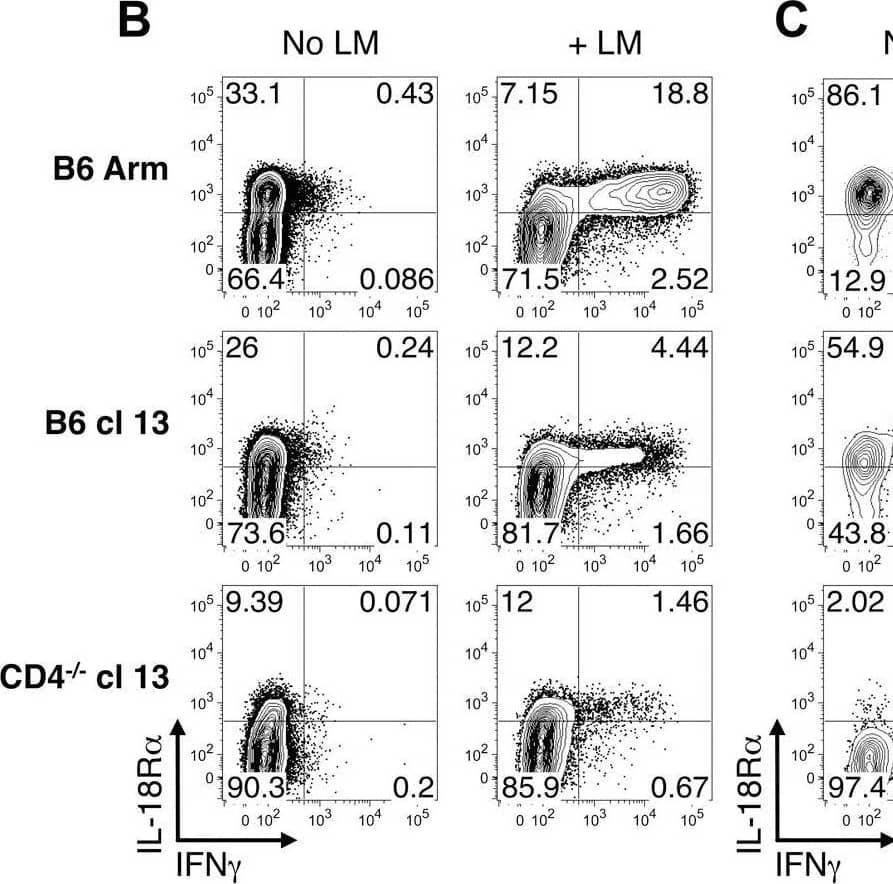
Detection of IL-18 R alpha /IL-1 R5 by Flow Cytometry Memory but not exhausted T cells express IFN-gamma and CD25 in response to LM infection. Cohorts of mice were challenged with wild-type LM 59-81 days following acute (LCMV-Arm), protracted (LCMV-cl13 infected B6 mice) and chronic (LCMV-cl13 infected CD4-/- mice) infections. Splenocytes were prepared 20 hr after the bacterial infection and cultured in the presence of BFA for 3hr prior to surface MHC tetramer staining and intracellular staining for IFN-gamma accumulation. (A) Overview of the experimental design. (B) Representative flow cytometry plots show IL-18R alpha expression and IFN-gamma production by gated CD8 T cells are shown with and without LM infection. (C) IL-18R alpha and (D) CD25 expression in conjunction with IFN-gamma production are shown for gated LCMV DbGP33+ CD8 T cells. The percentages of (E) IFN-gamma -producing and (F) CD25-expressing IFN-gamma + LCMV Db(GP33) and Db(GP276) epitope-specific CD8 T cells are shown for individual mice, and mean values are indicated by the horizontal bars. (G) and (H) Bacterial titers in the spleens and livers, respectively, following LM challenge of the cohorts of mice that were previously infected with LCMV. Flow cytometry plots show representative data from either (B, C) three or (D) two independent experiments analyzing a total of 11-12 LM challenged mice per group. Graphs show results from (E) 4–5 experiments with 15-18 mice per group, from (F) two experiments with 6-8 mice per group, from (G) four experiments with 14-15 mice per group, and from (H) three experiments with 10–12 mice per group. *** p<0.001, ** p<0.01, * p<0.05. Image collected and cropped by CiteAb from the following open publication (https://pubmed.ncbi.nlm.nih.gov/21980291), licensed under a CC-BY license. Not internally tested by R&D Systems.
Reconstitution Calculator
Preparation and Storage
- 12 months from date of receipt, -20 to -70 °C as supplied.
- 1 month, 2 to 8 °C under sterile conditions after reconstitution.
- 6 months, -20 to -70 °C under sterile conditions after reconstitution.
Background: IL-18 R alpha/IL-1 R5
IL-18 R, also known as IL-18 R alpha, is a member of the IL-1 receptor family and has been designated IL-1 R5.
Product Datasheets
Citation for Mouse IL-18 R alpha /IL-1 R5 Antibody
R&D Systems personnel manually curate a database that contains references using R&D Systems products. The data collected includes not only links to publications in PubMed, but also provides information about sample types, species, and experimental conditions.
1 Citation: Showing 1 - 1
-
Mapping of the full length and the truncated interleukin-18 receptor alpha in the mouse brain.
Authors: Alboni S, Cervia D, Ross B, Montanari C, Gonzalez AS, Sanchez-Alavez M, Marcondes MC, De Vries D, Sugama S, Brunello N, Blom J, Tascedda F, Conti B
J. Neuroimmunol., 2009-07-28;214(1):43-54.
Species: Mouse
Sample Types: Whole Tissue
Applications: IHC-P
FAQs
No product specific FAQs exist for this product, however you may
View all Antibody FAQsReviews for Mouse IL-18 R alpha /IL-1 R5 Antibody
There are currently no reviews for this product. Be the first to review Mouse IL-18 R alpha /IL-1 R5 Antibody and earn rewards!
Have you used Mouse IL-18 R alpha /IL-1 R5 Antibody?
Submit a review and receive an Amazon gift card.
$25/€18/£15/$25CAN/¥75 Yuan/¥2500 Yen for a review with an image
$10/€7/£6/$10 CAD/¥70 Yuan/¥1110 Yen for a review without an image


