Mouse Intelectin-1/Omentin Antibody Summary
Ala20-Ser298
Accession # O88310
Applications
Please Note: Optimal dilutions should be determined by each laboratory for each application. General Protocols are available in the Technical Information section on our website.
Scientific Data
 View Larger
Detection of Mouse Intelectin‑1/Omentin by Western Blot. Western blot shows lysates of mouse small intestine tissue. PVDF membrane was probed with 2 µg/mL of Rat Anti-Mouse Intelectin-1/Omentin Monoclonal Antibody (Catalog # MAB8074) followed by HRP-conjugated Anti-Rat IgG Secondary Antibody (Catalog # HAF005). A specific band was detected for Intelectin-1/Omentin at approximately 35 kDa (as indicated). This experiment was conducted under reducing conditions and using Immunoblot Buffer Group 1.
 View Larger
Intelectin‑1/Omentin in Mouse Intestine. Intelectin-1/Omentin was detected in perfusion fixed frozen sections of mouse intestine using Rat Anti-Mouse Intelectin-1/Omentin Monoclonal Antibody (Catalog # MAB8074) at 25 µg/mL overnight at 4 °C. Tissue was stained using the NorthernLights™ 557-conjugated Anti-Rat IgG Secondary Antibody (red; Catalog # NL013) and counterstained with DAPI (blue). Specific staining was localized to Paneth cells in intestinal glands. View our protocol for Fluorescent IHC Staining of Frozen Tissue Sections.
 View Larger
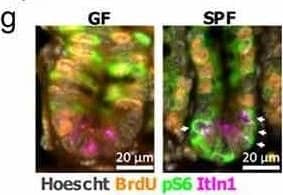
Detection of Intelectin-1/Omentin by Immunohistochemistry Microbiota suppresses transcriptional nutrient stress response and activates mTOR signaling. A) Overlay of nutrient starvation stress response transcription factor genes upon gene expression volcano plot of all GF and SPF epithelial cells. B) Violin plot of Atf3 and Jun expression across GF and SPF epithelial cells. C) Violin plot of Fos expression across GF and SPF epithelial cells and quantification and representative image of Fos in situ hybridization within GF and SPF jejunal/ileal small intestinal crypts. D) Violin plots and E) UMAP visualization of Rps6kb1 and Rps6 epithelial subsets in GF and SPF epithelial cells. *, p < .01 comparing GF and SPF clusters by Wilcoxon rank sum test and >0.75 Log2 fold change. F) pS6 staining and quantification of jejunal/ileal small intestinal crypts from GF and SPF mice. G) Immunofluorescence co-staining of BrdU, pS6, and Itln1 in GF and SPF jejunal/ileal small intestinal crypts. Arrows indicate co-expression of Itln1 and pS6. Representative images shown (n = 4–6). Each point represents the mean quantification 20 crypts from one mouse (n = 4–6). Stains were quantified using CellProfiler. Bars represent mean ± SEM. **, p < .005 by two-tailed Student’s t-test. Image collected and cropped by CiteAb from the following open publication (https://pubmed.ncbi.nlm.nih.gov/35939622), licensed under a CC-BY license. Not internally tested by R&D Systems.
 View Larger
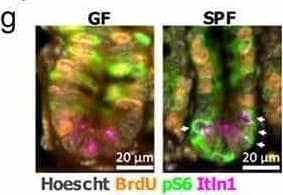
Detection of Intelectin-1/Omentin by Immunohistochemistry Microbiota suppresses transcriptional nutrient stress response and activates mTOR signaling. A) Overlay of nutrient starvation stress response transcription factor genes upon gene expression volcano plot of all GF and SPF epithelial cells. B) Violin plot of Atf3 and Jun expression across GF and SPF epithelial cells. C) Violin plot of Fos expression across GF and SPF epithelial cells and quantification and representative image of Fos in situ hybridization within GF and SPF jejunal/ileal small intestinal crypts. D) Violin plots and E) UMAP visualization of Rps6kb1 and Rps6 epithelial subsets in GF and SPF epithelial cells. *, p < .01 comparing GF and SPF clusters by Wilcoxon rank sum test and >0.75 Log2 fold change. F) pS6 staining and quantification of jejunal/ileal small intestinal crypts from GF and SPF mice. G) Immunofluorescence co-staining of BrdU, pS6, and Itln1 in GF and SPF jejunal/ileal small intestinal crypts. Arrows indicate co-expression of Itln1 and pS6. Representative images shown (n = 4–6). Each point represents the mean quantification 20 crypts from one mouse (n = 4–6). Stains were quantified using CellProfiler. Bars represent mean ± SEM. **, p < .005 by two-tailed Student’s t-test. Image collected and cropped by CiteAb from the following open publication (https://pubmed.ncbi.nlm.nih.gov/35939622), licensed under a CC-BY license. Not internally tested by R&D Systems.
Reconstitution Calculator
Preparation and Storage
- 12 months from date of receipt, -20 to -70 °C as supplied.
- 1 month, 2 to 8 °C under sterile conditions after reconstitution.
- 6 months, -20 to -70 °C under sterile conditions after reconstitution.
Background: Intelectin-1/Omentin
Intelectin (endothelial lectin; also ITLN-1 and omentin) is a 34 kDa Ca-dependent galactofuranose-binding lectin that is not a C-type lectin. It is expressed in intestinal and airway epithelium and appears to participate in insulin signaling and microbe recognition. Intelectin-1 is upregulated in asthma and contributes to allergic airway inflammation. The mouse Intelectin-1 preproprecursor is 313 amino acids (aa) in length. It contains a 19 aa signal sequence, a 279 aa mature segment (aa 20-298), and a 15 aa C-terminal proregion that is cleaved to generate a GPI-linkage. Soluble Intelectin-1 can be released from omental adipose tissue and malignant pleural mesothelioma. One fibrinogen-related domain exists in the mature molecule (aa 32-251). Human Intelectin-1 exists as a disulfide-linked glycosylated homotrimer; mouse is unglycosylated and a monomer. Mature mouse Intelectin-1 is 82% aa identical to human Intelectin-1.
Product Datasheets
Citations for Mouse Intelectin-1/Omentin Antibody
R&D Systems personnel manually curate a database that contains references using R&D Systems products. The data collected includes not only links to publications in PubMed, but also provides information about sample types, species, and experimental conditions.
3
Citations: Showing 1 - 3
Filter your results:
Filter by:
-
R-spondin-3 induces secretory, antimicrobial Lgr5+ cells in the stomach
Authors: M Sigal, MDM Reinés, S Müllerke, C Fischer, M Kapalczyns, H Berger, ERM Bakker, HJ Mollenkopf, ME Rothenberg, B Wiedenmann, S Sauer, TF Meyer
Nat. Cell Biol., 2019-06-24;21(7):812-823.
Species: Bacteria - Helicobacter pylori, Mouse, Transgenic Mouse
Sample Types: Cell Culture Supernates, Whole Tissue
Applications: Immunohistochemistry, Western Blot -
Perivascular Adipose Tissue-Enhanced Vasodilation in Metabolic Syndrome Rats by Apelin and N-Acetyl–l-Cysteine-Sensitive Factor(s)
Authors: Satomi Kagota, Kana Maruyama-Fumoto, Saki Iwata, Miho Shimari, Shiori Koyanagi, Yayoi Shiokawa et al.
International Journal of Molecular Sciences
-
Omentin-1 prevents inflammation-induced osteoporosis by downregulating the pro-inflammatory cytokines
Authors: SS Rao, Y Hu, PL Xie, J Cao, ZX Wang, JH Liu, H Yin, J Huang, YJ Tan, J Luo, MJ Luo, SY Tang, TH Chen, LQ Yuan, EY Liao, R Xu, ZZ Liu, CY Chen, H Xie
Bone Res, 2018-03-30;6(0):9.
Species: Mouse
Sample Types: Tissue Homogenates
Applications: Western Blot
FAQs
No product specific FAQs exist for this product, however you may
View all Antibody FAQsReviews for Mouse Intelectin-1/Omentin Antibody
There are currently no reviews for this product. Be the first to review Mouse Intelectin-1/Omentin Antibody and earn rewards!
Have you used Mouse Intelectin-1/Omentin Antibody?
Submit a review and receive an Amazon gift card.
$25/€18/£15/$25CAN/¥75 Yuan/¥2500 Yen for a review with an image
$10/€7/£6/$10 CAD/¥70 Yuan/¥1110 Yen for a review without an image

