Mouse Pref-1/DLK1/FA1 Antibody Summary
Ala24-Gln305
Accession # Q09163
Applications
Please Note: Optimal dilutions should be determined by each laboratory for each application. General Protocols are available in the Technical Information section on our website.
Scientific Data
 View Larger
Detection of Mouse Pref‑1/DLK1/FA1 by Western Blot. Western blot shows lysates of 3T3-L1 mouse embryonic fibroblast adipose-like cell line. PVDF membrane was probed with 1 µg/mL of Goat Anti-Mouse Pref-1/DLK1/FA1 Antigen Affinity-purified Polyclonal Antibody (Catalog # AF8277) followed by HRP-conjugated Anti-Goat IgG Secondary Antibody (Catalog # HAF017). A specific band was detected for Pref-1/DLK1/FA1 at approximately 45-60 kDa (as indicated). This experiment was conducted under reducing conditions and using Immunoblot Buffer Group 1.
 View Larger
Detection of Pref‑1/DLK1/FA1 in 3T3‑L1 Mouse Cell Line by Flow Cytometry. 3T3-L1 mouse embryonic fibroblast adipose-like cell line was stained with Goat Anti-Mouse Pref-1/DLK1/FA1 Antigen Affinity-purified Polyclonal Antibody (Catalog # AF8277, filled histogram) or control antibody (Catalog # AB-108-C, open histogram), followed by Phycoerythrin-conjugated Anti-Goat IgG Secondary Antibody (Catalog # F0107).
 View Larger
Pref‑1/DLK1/FA1 in Mouse Embryo. Pref-1/DLK1/FA1 was detected in immersion fixed frozen sections of mouse embryonic lung using Goat Anti-Mouse Pref-1/DLK1/FA1 Antigen Affinity-purified Polyclonal Antibody (Catalog # AF8277) at 1 µg/mL overnight at 4 °C. Tissue was stained using the Anti-Goat HRP-DAB Cell & Tissue Staining Kit (brown; Catalog # CTS008) and counterstained with hematoxylin (blue). Specific staining was localized to cytoplasm. View our protocol for Chromogenic IHC Staining of Frozen Tissue Sections.
 View Larger
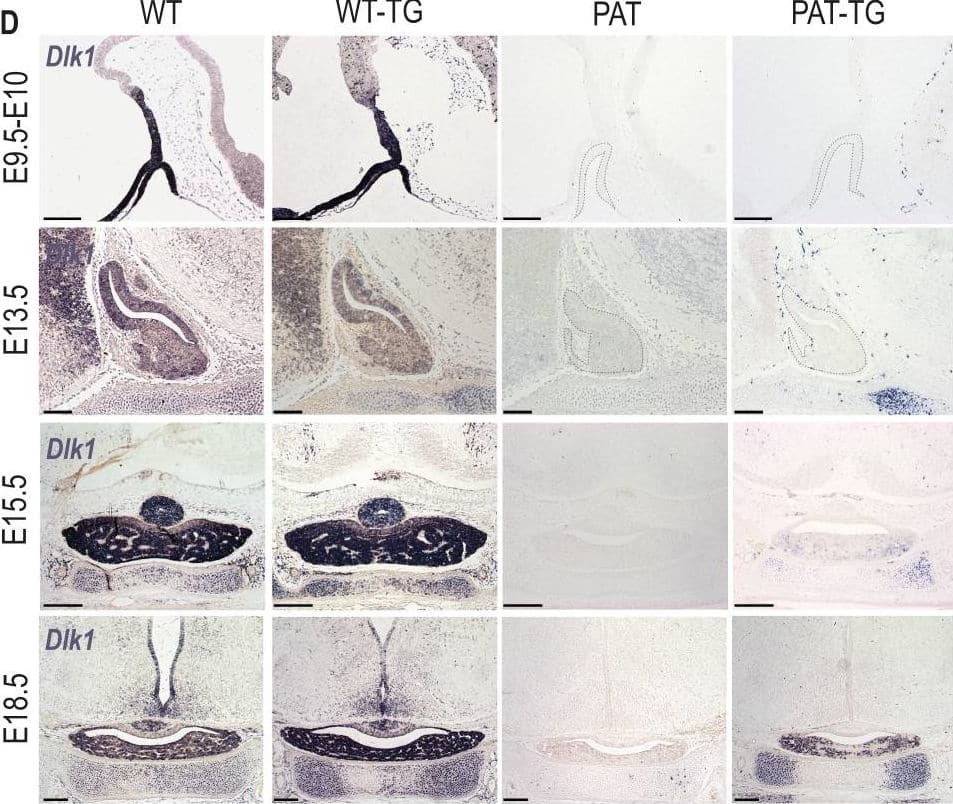
Detection of Mouse Pref-1/DLK1/FA1 by Immunohistochemistry Dlk1 imprinting & expression in the developing pituitary gland from the endogenous locus & TGDlk1-70C transgene.(A) Cross used to generate embryos & postnatal animals in the study. Males inheriting the deleted allele from the mother (maternal Dlk1tm1Srbpa/+ heterozygotes or MATs) were crossed to females hemizygous for the TGDlk1-70C transgene (WT-TG), generating 4 genotypes, WT, WT-TG, paternal Dlk1+/tm1Srbpa heterozygotes (PATs) & mice inheriting a deleted paternal allele & the transgene (PAT-TG). (B) Schematic showing the known splice variants of Dlk1, A-D. Splicing occurs internally in exon 5 of the Dlk1 gene. Dlk1-A & B retain an extracellular cleavage domain (TACE), in Dlk1-C & D this region is spliced out. All versions contain a single pass transmembrane domain (TM). Red arrows indicate location of primers used in (C). (C) Semi-quantitative PCR on embryonic day (E) 18.5 whole pituitary glands from the 4 genotypes shown in (A). Top – primers amplify the exon 4–5 region of Dlk1 & can distinguish splice variants based on size. Bottom – alpha-tubulin (Tuba1a) was amplified as a loading control on each sample. (D) In-situ hybridisation for Dlk1 in the developing pituitary gland from E9.5 to E18.5 in the 4 genotypes shown in (A). Dlk1 expression is indicated by purple staining. Scale bars show 100 µm (E9.5 & E13.5, sagittal sections) & 200 µm (E15.5 & E18.5, frontal sections). (E) Immunohistochemistry (IHC) for DLK1 on frontal sections at E18.5 & postnatal day 21 (P21), counterstained with DAPI. Scale bars = 50 µm.Figure 2—source data 1.Zipped file containing the source data for Figure 2D -gels with cropped areas highlighted & original gel images. Zipped file containing the source data for Figure 2D -gels with cropped areas highlighted & original gel images. Image collected & cropped by CiteAb from the following open publication (https://pubmed.ncbi.nlm.nih.gov/37589451), licensed under a CC-BY license. Not internally tested by R&D Systems.
 View Larger
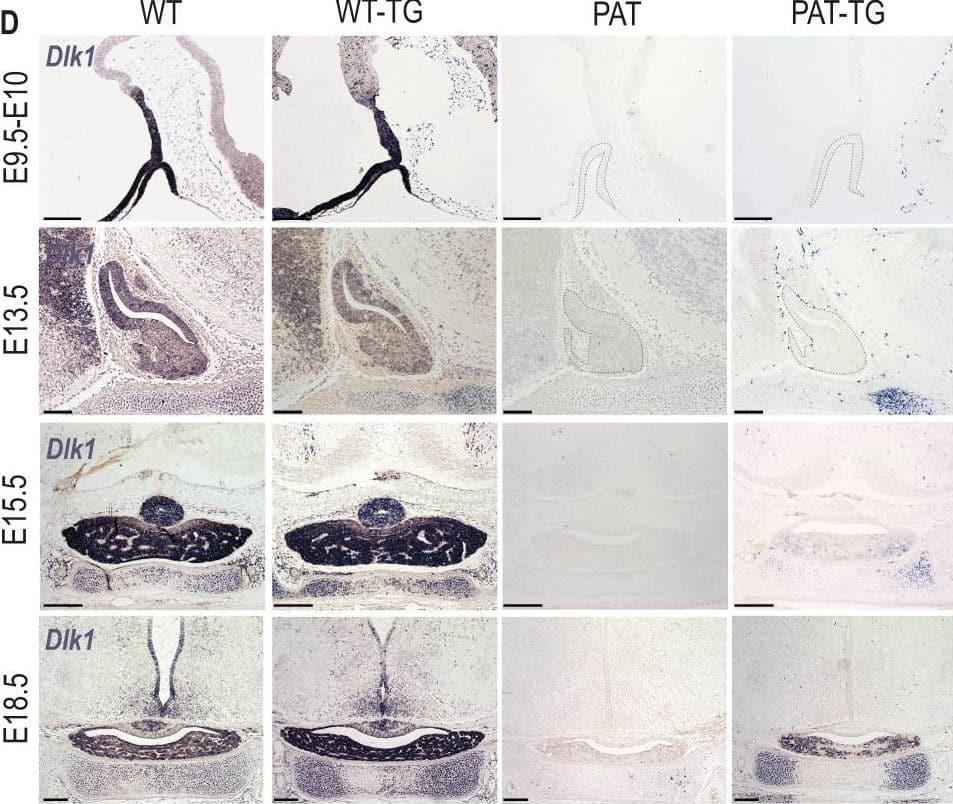
Detection of Mouse Pref-1/DLK1/FA1 by Immunohistochemistry Dlk1 imprinting & expression in the developing pituitary gland from the endogenous locus & TGDlk1-70C transgene.(A) Cross used to generate embryos & postnatal animals in the study. Males inheriting the deleted allele from the mother (maternal Dlk1tm1Srbpa/+ heterozygotes or MATs) were crossed to females hemizygous for the TGDlk1-70C transgene (WT-TG), generating 4 genotypes, WT, WT-TG, paternal Dlk1+/tm1Srbpa heterozygotes (PATs) & mice inheriting a deleted paternal allele & the transgene (PAT-TG). (B) Schematic showing the known splice variants of Dlk1, A-D. Splicing occurs internally in exon 5 of the Dlk1 gene. Dlk1-A & B retain an extracellular cleavage domain (TACE), in Dlk1-C & D this region is spliced out. All versions contain a single pass transmembrane domain (TM). Red arrows indicate location of primers used in (C). (C) Semi-quantitative PCR on embryonic day (E) 18.5 whole pituitary glands from the 4 genotypes shown in (A). Top – primers amplify the exon 4–5 region of Dlk1 & can distinguish splice variants based on size. Bottom – alpha-tubulin (Tuba1a) was amplified as a loading control on each sample. (D) In-situ hybridisation for Dlk1 in the developing pituitary gland from E9.5 to E18.5 in the 4 genotypes shown in (A). Dlk1 expression is indicated by purple staining. Scale bars show 100 µm (E9.5 & E13.5, sagittal sections) & 200 µm (E15.5 & E18.5, frontal sections). (E) Immunohistochemistry (IHC) for DLK1 on frontal sections at E18.5 & postnatal day 21 (P21), counterstained with DAPI. Scale bars = 50 µm.Figure 2—source data 1.Zipped file containing the source data for Figure 2D -gels with cropped areas highlighted & original gel images. Zipped file containing the source data for Figure 2D -gels with cropped areas highlighted & original gel images. Image collected & cropped by CiteAb from the following open publication (https://pubmed.ncbi.nlm.nih.gov/37589451), licensed under a CC-BY license. Not internally tested by R&D Systems.
Reconstitution Calculator
Preparation and Storage
- 12 months from date of receipt, -20 to -70 °C as supplied.
- 1 month, 2 to 8 °C under sterile conditions after reconstitution.
- 6 months, -20 to -70 °C under sterile conditions after reconstitution.
Background: Pref-1/DLK1/FA1
Pref-1 (Preadipocyte factor 1, Protein delta homolog 1, DLK1, FA1 and Fetal antigen 1) is a 45-60 kDa transmembrane glycoprotein that is highly expressed in fetal liver, placenta, adult adrenal gland, brain, testis and ovary. Expression of Pref-1 is elevated in liver after birth but starts to decline around postnatal day 16. It contains 6 EGF-like domains and is involved in embryonic skeletal system development. Pref-1 inhibits preadipocyte proliferation by regulating their entry into G1/S-phase and represses preadipocyte differentiation. It is a master regulator of preadipocyte homeostasis and adipose tissue expansion. Pref-1 manipulation may, therefore, be utilized in obesity treatments. Mouse Pref-1 shares 81% aa identity with human Pref-1.
Product Datasheets
Citations for Mouse Pref-1/DLK1/FA1 Antibody
R&D Systems personnel manually curate a database that contains references using R&D Systems products. The data collected includes not only links to publications in PubMed, but also provides information about sample types, species, and experimental conditions.
7
Citations: Showing 1 - 7
Filter your results:
Filter by:
-
Lef1 expression in fibroblasts maintains developmental potential in adult skin to regenerate wounds
Authors: Quan M Phan, Gracelyn M Fine, Lucia Salz, Gerardo G Herrera, Ben Wildman, Iwona M Driskell et al.
eLife
-
A pref-1-controlled non-inflammatory mechanism of insulin resistance
Authors: Yiheng Huang, Donghong Cui, Liujun Chen, Haibin Tong, Hong Wu, Grace K. Muller et al.
iScience
-
Dynamic interplay between IL-1 and WNT pathways in regulating dermal adipocyte lineage cells during skin development and wound regeneration
Authors: Sun, L;Zhang, X;Wu, S;Liu, Y;Guerrero-Juarez, CF;Liu, W;Huang, J;Yao, Q;Yin, M;Li, J;Ramos, R;Liao, Y;Wu, R;Xia, T;Zhang, X;Yang, Y;Li, F;Heng, S;Zhang, W;Yang, M;Tzeng, CM;Ji, C;Plikus, MV;Gallo, RL;Zhang, LJ;
Cell reports
Species: Mouse
Sample Types: Whole Tissue
Applications: Immunohistochemistry -
Increased prostaglandin-D2 in male STAT3-deficient hearts shifts cardiac progenitor cells from endothelial to white adipocyte differentiation
Authors: E Stelling, M Ricke-Hoch, S Erschow, S Hoffmann, AK Bergmann, M Heimerl, S Pietzsch, K Battmer, A Haase, B Stapel, M Scherr, JL Balligand, O Binah, D Hilfiker-K
PloS Biology, 2020-12-28;18(12):e3000739.
Species: Mouse
Sample Types: Whole Cells
Applications: Flow Cytometry -
Obesity induces preadipocyte CD36 expression promoting inflammation via the disruption of lysosomal calcium homeostasis and lysosome function
Authors: X Luo, Y Li, P Yang, Y Chen, L Wei, T Yu, J Xia, XZ Ruan, L Zhao, Y Chen
EBioMedicine, 2020-06-06;56(0):102797.
Species: Mouse
Sample Types: Whole Tissue
Applications: IHC -
Mesenchymal Precursor Cells in Adult Nerves Contribute to Mammalian Tissue Repair and Regeneration
Authors: MJ Carr, JS Toma, APW Johnston, PE Steadman, SA Yuzwa, N Mahmud, PW Frankland, DR Kaplan, FD Miller
Cell Stem Cell, 2018-11-29;0(0):.
Species: Mouse
Sample Types:
-
Niche-derived soluble DLK1 promotes glioma growth
Authors: Grassi E, Jeannot P, Pantazopoulou V et al.
Neoplasia
FAQs
No product specific FAQs exist for this product, however you may
View all Antibody FAQsReviews for Mouse Pref-1/DLK1/FA1 Antibody
There are currently no reviews for this product. Be the first to review Mouse Pref-1/DLK1/FA1 Antibody and earn rewards!
Have you used Mouse Pref-1/DLK1/FA1 Antibody?
Submit a review and receive an Amazon gift card.
$25/€18/£15/$25CAN/¥75 Yuan/¥2500 Yen for a review with an image
$10/€7/£6/$10 CAD/¥70 Yuan/¥1110 Yen for a review without an image


