Recombinant B. Thetaiotaomicron Arylsulfatase Protein, CF
Recombinant B. Thetaiotaomicron Arylsulfatase Protein, CF Summary
- R&D Systems E. coli-derived Recombinant B. Thetaiotaomicron Arylsulfatase Protein (11383-SU)
- Quality control testing to verify active proteins with lot specific assays by in-house scientists
- All R&D Systems proteins are covered with a 100% guarantee
Product Specifications
Met1-Lys509 (S77C) with a C-terminal 6-His tag
Analysis
Product Datasheets
Carrier Free
CF stands for Carrier Free (CF). We typically add Bovine Serum Albumin (BSA) as a carrier protein to our recombinant proteins. Adding a carrier protein enhances protein stability, increases shelf-life, and allows the recombinant protein to be stored at a more dilute concentration. The carrier free version does not contain BSA.
In general, we advise purchasing the recombinant protein with BSA for use in cell or tissue culture, or as an ELISA standard. In contrast, the carrier free protein is recommended for applications, in which the presence of BSA could interfere.
11383-SU
| Formulation | Supplied as a 0.2 μm filtered solution in Tris and NaCl. |
| Shipping | The product is shipped with polar packs. Upon receipt, store it immediately at the temperature recommended below. |
| Stability & Storage: | Use a manual defrost freezer and avoid repeated freeze-thaw cycles.
|
Assay Procedure
- Assay Buffer: 50 mM MES, 10 mM CaCl2, pH 5.5
- Recombinant Bt.1636 arylsulfatase (rBt. 1636 arylsulfatase) (Catalog # 11383-SU)
- Cy5-Fuc labeled sulfo-G2 (Cy5-sulfoG2) (Catalog # GL305)
- 15% SDS-PAGE gel
- Gel loading dye
- Gel Imager with Cy5 fluorescent dye detection capability
- Dilute rBt. 1636 arylsulfatase to 0.05 µg/µL with Assay Buffer.
- Dilute Cy5-sulfoG2 to 0.02 uM with Assay Buffer.
- For reaction, combine 10 µL of rBt. 1636 arylsulfatase and 10 µL of Cy5-sulfoG2. For a control, combine 10 µL of Assay Buffer and 10 µL Cy5-sulfoG2.
- Incubate reaction and control at 37 °C for 1 hour.
- Add Gel loading dye to each tube.
- Load half the volume of each reaction and control onto a 15% SDS-PAGE gel. Let samples migrate at least 80% down the gel before stopping.
- Acquire gel image with a gel imager.
- Determine intensities of each band. Calculate percent cleavage of Cy5-sulfoG2:
| % Cleavage = [ 1 - ( | Intensity of uncleaved Cy5-sulfoG2 | ) ] x 100 |
| Intensity of cleaved and uncleaved bands |
- rBt. 1636 arylsulfatase: 0.5 µg
- Cy5-sulfoG2: 0.2 pmol
Scientific Data
View Larger
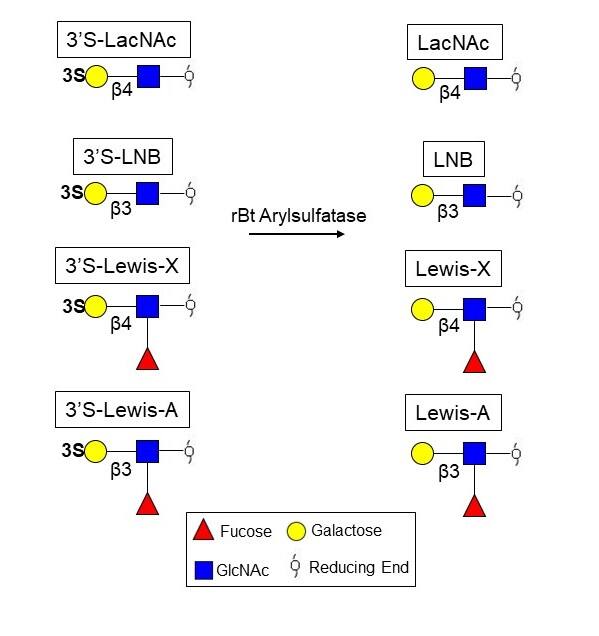
Recombinant B. Thetaiotaomicron Arylsulfatase Protein, CF (Catalog # 11383-SU) has specificity for 3S-Galactose. It has been shown to remove 3’-sulfate (3S) from various glycan structures including LacNAc, LNB, Lewis-X and Lewis-A.
View Larger
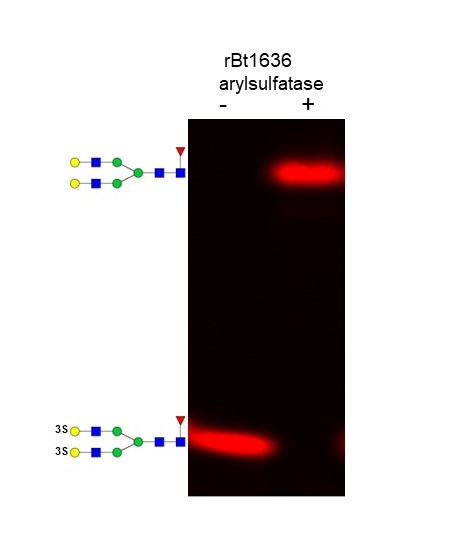
Lane 1 contained fluorescent substrate glycan Cy5-Fuc labeled sulfo-G2. Following treatment with Recombinant B. Thetaiotaomicron Arylsulfatase Protein, CF (Catalog # 11383-SU) 3’-sulfate (3S) from galactose was removed and a mobility shift was observed. SDS-PAGE gel was imaged using the red fluorescent channel.
View Larger
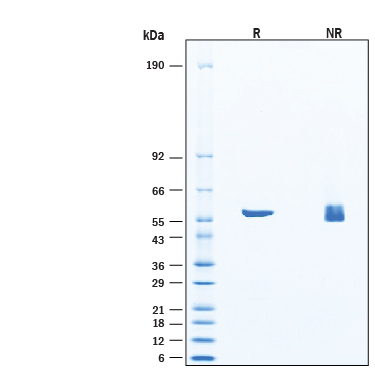
2 μg/lane of Recombinant Bacteroides Thetaiotaomicron Arylsulfatase His-tag Protein (Catalog # 11383-SU) was resolved with SDS-PAGE under reducing (R) and non-reducing (NR) conditions and visualized by Coomassie® Blue staining, showing bands at 54-60 kDa under reducing condition.
Reconstitution Calculator
Background: Bacteroides Thetaiotaomicron Arylsulfatase
Recombinant Bacteroides thetaiotaomicron Arylsulfatase His-tag, known in the literature as BT1636, is a cell surface-localized member of a diverse sulfatase family involved in mucin degradation (1). BT1636 is active on 3'S-Gal-beta 1,3-GalNAc (core 1) as well as more complex sulfated glycans built around other core structures (1). This broader specificity suggests the enzyme evolved to recognize various linkages and substitutions found in O-glycans. BT1636 displays an alpha / beta / alpha topology with a C-terminal sub-domain, a coordinated calcium ion, a deep pocket for substrates, and an active site with highly conserved residues that interact with the sulfate group (1-3). Bacteroides thetaiotaomicron (Bt) is one of the major bacteria of the human gut microbiome that can utilize O-glycans as a sole source of nutrients and has a requirement for active sulfatases for competitive colonization (4, 5). Although the Bt genome encodes 28 different S1 sulfatases (1), investigation suggests BT1636 is critical as an early enzyme in O-glycan cleavage that allows import and further degradation of O-glycans in the periplasmic space. Bt mutants lacking only sulfatase BT1636 displayed a large defect in colonization competition experiments versus wild-type Bt (1). Given BT1636 is critical to initiation of the complex pathway of mucin degradation, target and inhibition of this enzyme may lead to the ability to inhibit pathways that enable and contribute to disease such as IBD (1). The activity of recombinant BT1636 is demonstrated in an electrophoretic gel mobility shift assay using a fluorophore-labeled glycan as the substrate (6).
- Luis, A.S. et al. (2021) Nature. 598:332.
- Cartmell, A. et al. (2017) Proc. Natl. Acad. Sci. U.S.A. 27:7037.
- Ulmer, J.E. et al. (2014) J. Biol. Chem. 289:24289.
- Martens, E.C. et al. (2008) Cell Host Microbe 4:447.
- Benjdia, A. et al. (2011) J. Biol. Chem. 286:25973.
- Wu, Z.L. et al. (2020) Glycobiology 30:970.
FAQs
No product specific FAQs exist for this product, however you may
View all Proteins and Enzyme FAQsReviews for Recombinant B. Thetaiotaomicron Arylsulfatase Protein, CF
There are currently no reviews for this product. Be the first to review Recombinant B. Thetaiotaomicron Arylsulfatase Protein, CF and earn rewards!
Have you used Recombinant B. Thetaiotaomicron Arylsulfatase Protein, CF?
Submit a review and receive an Amazon gift card.
$25/€18/£15/$25CAN/¥75 Yuan/¥2500 Yen for a review with an image
$10/€7/£6/$10 CAD/¥70 Yuan/¥1110 Yen for a review without an image
