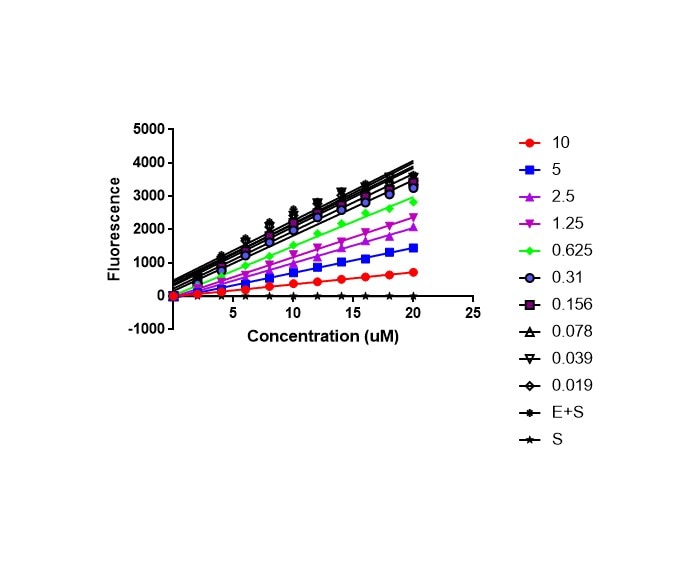
Recombinant Human UCH-L1/PGP9.5 Protein, CF
Recombinant Human UCH-L1/PGP9.5 Protein, CF Summary
Product Specifications
25 kDa
Product Datasheets
Carrier Free
CF stands for Carrier Free (CF). We typically add Bovine Serum Albumin (BSA) as a carrier protein to our recombinant proteins. Adding a carrier protein enhances protein stability, increases shelf-life, and allows the recombinant protein to be stored at a more dilute concentration. The carrier free version does not contain BSA.
In general, we advise purchasing the recombinant protein with BSA for use in cell or tissue culture, or as an ELISA standard. In contrast, the carrier free protein is recommended for applications, in which the presence of BSA could interfere.
E-340
| Formulation | X mg/ml (X μM) in 50 mM HEPES pH 8.0, 100 mM NaCl, 1 mM EDTA, 2 mM DTT |
| Shipping | The product is shipped with dry ice or equivalent. Upon receipt, store it immediately at the temperature recommended below. |
| Stability & Storage: | Use a manual defrost freezer and avoid repeated freeze-thaw cycles.
|
Reconstitution Calculator
Background: UCH-L1/PGP9.5
Ubiquitin Carboxyl-terminal Esterase L1 (UCH-L1), also known as PGP 9.5, is a deubiquitinating enzyme with a predicted molecular weight of 25 kDa (1). The human protein shares 95% amino acid sequence identity with its mouse and rat orthologs. UCH-L1 is expressed abundantly in neurons, accounting for 1-2% of total soluble proteins in the brain (2). It localizes primarily to the cytoplasm, but a subpopulation has been shown to be transiently nuclear (3,4). UCH-L1 contains two catalytic residues, Cys90 and His161, which are required for isopeptide bond cleavage at the C-terminal glycine residue of Ubiquitin (5). The levels of free Ubiquitin appear to be partially regulated by UCH-L1 through the hydrolysis of small Ubiquitin chains and the stabilization of monomeric Ubiquitin (6). Mice lacking functional UCH-L1 show neuronal dysfunction and neurodegeneration, and mutations in this enzyme have been linked to Parkinson's disease, suggesting that it is important for proper central nervous system function (7,8). UCH-L1 also likely plays a complex role in cancer. It has been reported to function as an oncogene in lymphoma, colorectal cancer, and nonsmall cell lung carcinoma (9-11). In contrast, it is thought to function as a tumor suppressor protein in nasopharyngeal and breast cancers (12,13).
- Wilkinson, K.D. et al. (1989) Science 246:670.
- Solano, S.M. et al. (2000) Ann. Neurol. 47:201.
- Henderson, M.J. et al. (2010) J. Biol. Chem. 285:11314.
- Bheda, A. et al. (2010) Cell Cycle 9:980.
- Larsen, C.N. et al. (1996) Biochemistry 35:6735.
- Walters, B.J. et al. (2008) Mol. Cell. Neurosci. 39:539.
- Sakurai, M. et al. (2008) Eur. J. Neurosci. 27:691.
- Andersson, F.I. et al. (2011) J. Mol. Biol. 407:261.
- Hussain, S. et al. (2010) Leukemia 24:1641.
- Akishima-Fukasawa, Y. et al. (2010) Am. J. Clin. Pathol. 134:71.
- Kim, H.J. et al. (2009) Oncogene 28:117.
- Li, L. et al. (2010) Clin. Cancer Res. 16:2949.
- Xiang, T. et al. (2012) PLoS One 7:e29783.
Citations for Recombinant Human UCH-L1/PGP9.5 Protein, CF
R&D Systems personnel manually curate a database that contains references using R&D Systems products. The data collected includes not only links to publications in PubMed, but also provides information about sample types, species, and experimental conditions.
5
Citations: Showing 1 - 5
Filter your results:
Filter by:
-
Reactive-site-centric chemoproteomics identifies a distinct class of deubiquitinase enzymes
Authors: DS Hewings, J Heideker, TP Ma, AP AhYoung, F El Oualid, A Amore, GT Costakes, D Kirchhofer, B Brasher, T Pillow, N Popovych, T Maurer, C Schwerdtfe, WF Forrest, K Yu, J Flygare, M Bogyo, IE Wertz
Nat Commun, 2018-03-21;9(1):1162.
Species: Human
Sample Types: Protein
Applications: Bioassay -
Overexpression of ubiquitin carboxyl-terminal hydrolase 1 (UCHL1) in boys with cryptorchidism
Authors: D Toliczenko, E Matuszczak, M Tylicka, B Szyma?ska, M Komarowska, E Gorodkiewi, W Debek, A Hermanowic
PLoS ONE, 2018-02-05;13(2):e0191806.
Species: Human
Sample Types: Complex Sample Type
Applications: Bioassay -
Overexpression of ubiquitin carboxyl-terminal hydrolase L1 (UCHL1) in serum of children after thermal injury
Authors: E Matuszczak, M Tylicka, W D?bek, A Sankiewicz, E Gorodkiewi, A Hermanowic
Adv Med Sci, 2017-02-11;62(1):83-86.
Applications: Bioassay -
Proteasome addiction defined in Ewing's sarcoma is effectively targeted by a novel class of 19S proteasome inhibitors
Authors: Neerav N Shukla
Cancer Res, 2016-06-02;0(0):.
Species: Human
Sample Types: Protein
Applications: Bioassay -
A selective USP1-UAF1 inhibitor links deubiquitination to DNA damage responses.
Authors: Liang, Qin, Dexheimer, Thomas S, Zhang, Ping, Rosenthal, Andrew S, Villamil, Mark A, You, Changjun, Zhang, Qiuting, Chen, Junjun, Ott, Christin, Sun, Hongmao, Luci, Diane K, Yuan, Bifeng, Simeonov, Anton, Jadhav, Ajit, Xiao, Hui, Wang, Yinsheng, Maloney, David J, Zhuang, Zhihao
Nat Chem Biol, 2014-02-16;10(4):298-304.
Applications: Bioassay
FAQs
No product specific FAQs exist for this product, however you may
View all Proteins and Enzyme FAQsReviews for Recombinant Human UCH-L1/PGP9.5 Protein, CF
Average Rating: 5 (Based on 1 Review)
Have you used Recombinant Human UCH-L1/PGP9.5 Protein, CF?
Submit a review and receive an Amazon gift card.
$25/€18/£15/$25CAN/¥75 Yuan/¥2500 Yen for a review with an image
$10/€7/£6/$10 CAD/¥70 Yuan/¥1110 Yen for a review without an image
Filter by: