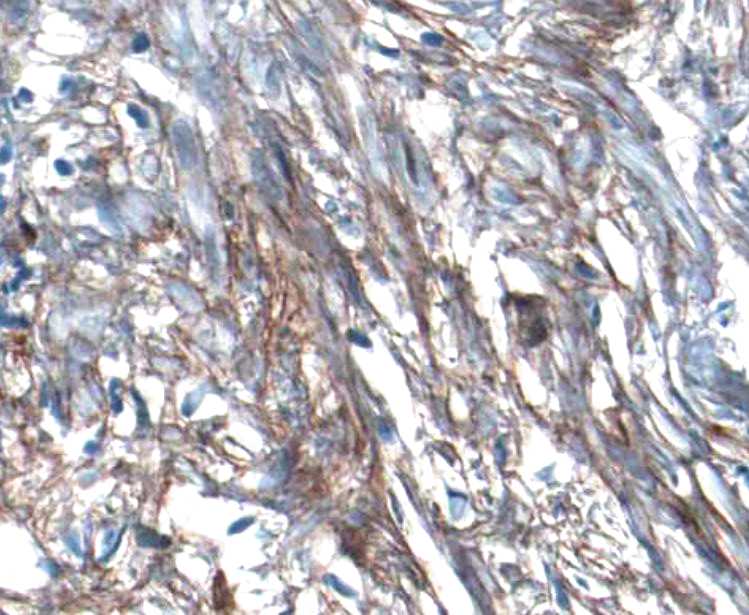
Human/Mouse LRRN1/NLRR-1 Antibody Summary
Ser26-Ala631
Accession # AAH34947
Applications
Please Note: Optimal dilutions should be determined by each laboratory for each application. General Protocols are available in the Technical Information section on our website.
Scientific Data
 View Larger
LRRN1/NLRR‑1 in Embryonic Mouse Somites. LRRN1/NLRR-1 was detected in immersion fixed frozen sections of embryonic mouse somites (E9.5) using 10 µg/mL Sheep Anti-Human LRRN1/NLRR-1 Antigen Affinity-purified Polyclonal Antibody (Catalog # AF4990) overnight at 4 °C. Tissue was stained with the NorthernLights™ 557-conjugated Anti-Sheep IgG Secondary Antibody (red; Catalog # NL010) and counterstained with DAPI (blue). View our protocol for Fluorescent IHC Staining of Frozen Tissue Sections.
 View Larger
Detection of LRRN1/NLRR-1 by Western Blot N1mAbs potentiates EGFR inhibitor-induced growth suppression. (A) NLRR1-stably expressing SH-SY5Y cells were treated with N1mAb 281 (25 μg/ml) and different concentrations of AG1478 (AG) for 72 h Data are represented as mean ± SD. Quantification of cell proliferation was performed by WST-8 assays. Data were normalized to the results for untreated cells and represented as percentage of control (mean ± SD). (B) AG1478-resistant A549 cells were treated with N1mAb 281 and different concentrations of AG1478 for 72 h (C) NLRR1-stably expressing SH-SY5Y cells were starved and treated with N1mAb 240 or 281 at 25 μg/ml for 3 h, followed by EGF treatment at the indicated concentration for 10 min. Cell lysates were subjected to western blot analyses. Arrowheads, glycosylated NLRR1. (D) MCF7 cells overexpressing NLRR1 were starved and treated with N1mAb 281 at 25 μg/ml for 3 h, followed by EGF treatment (1 ng/ml) for 10 min. The cell lysates were subjected to western blot analyses. (E) To check the effect of the long-term treatment of N1mAbs, SK-N-BE cells were incubated with N1mAbs (30 μg/ml) for 7 days with medium change every 2 days, and the cell lysates were subjected to western blot analyses. Image collected and cropped by CiteAb from the following open publication (https://pubmed.ncbi.nlm.nih.gov/34277416), licensed under a CC-BY license. Not internally tested by R&D Systems.
Reconstitution Calculator
Preparation and Storage
- 12 months from date of receipt, -20 to -70 °C as supplied.
- 1 month, 2 to 8 °C under sterile conditions after reconstitution.
- 6 months, -20 to -70 °C under sterile conditions after reconstitution.
Background: LRRN1/NLRR-1
LRRN1 (Leucine-rich repeat neuronal protein 1; NLRR1) is a 95 kDa member of the neuronal LRR family of proteins. It is a cell-surface glycoprotein that is expressed on embryonic motor neurons and somatic myoblasts. Human LRRN1 is 716 amino acids (aa) in length. It is a type I transmembrane protein that contains a 606 aa extracellular region (aa 26-631) and a short 64 aa cytoplasmic tail. The extracellular region shows eleven LRRs (aa 94-384) that mediate protein-protein interactions, one C2-type Ig-like domain and one fibronectin type III domain. There is one potential alternate start site at Met286. Over aa 26-631, human LRRN1 shares 96% aa sequence identity with mouse LRRN1.
Product Datasheets
Citations for Human/Mouse LRRN1/NLRR-1 Antibody
R&D Systems personnel manually curate a database that contains references using R&D Systems products. The data collected includes not only links to publications in PubMed, but also provides information about sample types, species, and experimental conditions.
4
Citations: Showing 1 - 4
Filter your results:
Filter by:
-
NLRR1 Is a Potential Therapeutic Target in Neuroblastoma and MYCN-Driven Malignant Cancers
Authors: Atsushi Takatori, MD. Shamim Hossain, Atsushi Ogura, Jesmin Akter, Yohko Nakamura, Akira Nakagawara
Frontiers in Oncology
Species: Human
Sample Types: Whole Tissue
Applications: Immunohistochemistry -
Leucine-rich repeat neuronal protein-1 suppresses apoptosis of gastric cancer cells through regulation of Fas/FasL
Authors: B Liu, Y Zhang, Y Fan, S Wang, Z Li, M Deng, C Li, J Wang, R Ma, X Wang, Y Wang, L Xu, K Hou, X Che, Y Liu, X Qu
Cancer Sci., 2019-06-10;110(7):2145-2155.
Species: Human, Xenograft
Sample Types: Cell Lysates, Whole Tissue
Applications: IHC, Western Blot -
Molecular Logic of Spinocerebellar Tract Neuron Diversity and Connectivity
Authors: M Baek, V Menon, TM Jessell, AW Hantman, JS Dasen
Cell Rep, 2019-05-28;27(9):2620-2635.e4.
Species: Mouse
Sample Types: Whole Tissue
Applications: IHC -
Neuronal leucine-rich repeat 1 negatively regulates anaplastic lymphoma kinase in neuroblastoma
Sci Rep, 2016-09-08;6(0):32682.
Species: Human
Sample Types: Whole Tissue
Applications: IHC-P, Immunoprecipitation
FAQs
No product specific FAQs exist for this product, however you may
View all Antibody FAQsReviews for Human/Mouse LRRN1/NLRR-1 Antibody
Average Rating: 5 (Based on 1 Review)
Have you used Human/Mouse LRRN1/NLRR-1 Antibody?
Submit a review and receive an Amazon gift card.
$25/€18/£15/$25CAN/¥75 Yuan/¥2500 Yen for a review with an image
$10/€7/£6/$10 CAD/¥70 Yuan/¥1110 Yen for a review without an image
Filter by: