Human VAP-1/AOC3 Antibody Summary
VAP‑1/AOC3 is observed.
Gly27-Asn763
Accession # Q16853
Applications
Please Note: Optimal dilutions should be determined by each laboratory for each application. General Protocols are available in the Technical Information section on our website.
Scientific Data
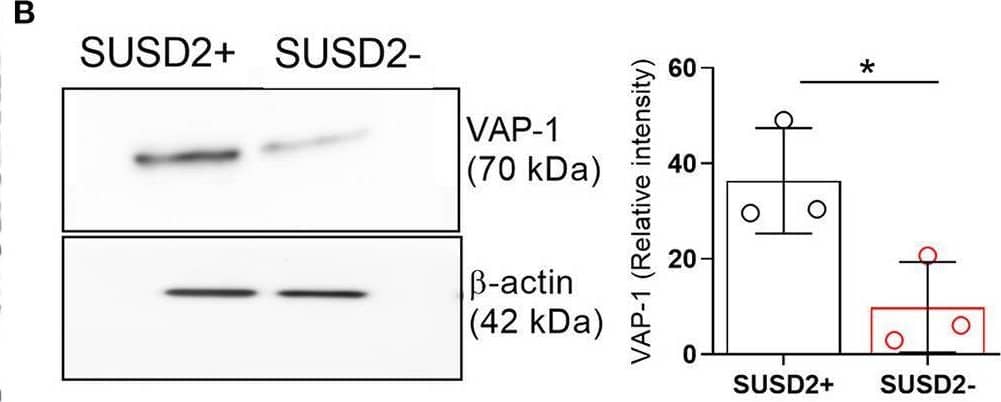 View Larger
Detection of VAP-1/AOC3 by Western Blot Biophysical and functional characterization of endometrial pericytes and EnSCs. (A) Immunohistochemistry showing VAP-1 expression in luteal-phase human endometrium, hematoxylin was used to stain the nuclei. Staining indicates VAP-1 reactivity in the vasculature and spiral arteries, arrow pointing to spiral artery. Scale bar: 200 μm. (B) VAP-1 expression was determined at protein level in freshly isolated SUSD2+ pericytes and SUSD2− EnSCs from three independent endometrial biopsies by Western blot analysis and normalized to beta -actin and relative intensity determined by densitometry; Student's t-test; *P < 0.05. (C) Expression of ELN (left panel), CNN1 (middle panel) and MYH11 (right panel) transcripts was determined by RT-qPCR in freshly isolated SUSD2+ pericytes and SUSD2− EnSCs from four independent endometrial biopsies; Student's t-test; *P < 0.05; **P < 0.01. (D) Representative graphs showing proliferation and migration SUSD2+ pericytes and SUSD2− EnSCs monitored in real-time using the xCELLigence system for the indicated time-points. (E) freshly isolated SUSD2+ pericytes and SUSD2− EnSCs were embedded into collagen at a density of 1 × 10⁶ cells per gel. Single cell contraction force was measured using the depth-sensing nanoindentation system. Data represent mean ± SEM of four biological repeat experiments. Student's t-test; **P < 0.01; ****P < 0.0001. Image collected and cropped by CiteAb from the following open publication (https://pubmed.ncbi.nlm.nih.gov/33537312), licensed under a CC-BY license. Not internally tested by R&D Systems.
Reconstitution Calculator
Preparation and Storage
- 12 months from date of receipt, -20 to -70 °C as supplied.
- 1 month, 2 to 8 °C under sterile conditions after reconstitution.
- 6 months, -20 to -70 °C under sterile conditions after reconstitution.
Background: VAP-1/AOC3
Vascular adhesion protein-1 (VAP-1), also called AOC3 (amine oxidase copper-containing 3) or SSAO (semicarbazide-sensitive amine oxidase), is a copper amine oxidase with a topaquinone cofactor. VAP-1 is a Type II integral membrane protein, but a soluble form of the enzyme is present in human serum, and its level increases in diabetes and some inflammatory liver diseases (1, 2). Human and mouse VAP-1 share 83% amino acid sequence identity. VAP-1 catalyzes the oxidative deamination of small primary amines such as methylamine, benzylamine, and aminoacetone in a reaction that produces an aldehyde, ammonia, and H2O2 (3). The enzyme is sensitive to inhibition by semicarbazide. VAP-1 expression is highest in the endothelium of lung, heart, and intestine, but low in tissues such as brain, spleen, kidney, and liver (4). VAP-1 vascular expression is regulated at sites of inflammation through its release from intracellular granules in which the protein is stored (5). The adhesive function of VAP-1 has been demonstrated in studies showing that the protein is important for the adherence of certain lymphocyte subtypes to inflamed endothelial tissues (6). VAP-1 mediated adhesion is involved in the process of leukocyte extravasation, an important feature of inflammatory responses. The role of VAP-1 amine oxidase activity in this process is not fully defined, but it appears to be carbohydrate-dependent (7). VAP-1 is considered to be a therapeutic target for diabetes, oxidative stress, and inflammatory diseases (8).
- Kurkijärvi, R. et al. (1998) J. Immunol. 161:1549.
- Gearing, A.J.H. and W. Newman (1993) Immunol. Today 14:506.
- Lizcano, J.M. et al. (1998) Biochem. J. 331:69.
- Smith, D.J. et al. (1998) J. Exp. Med. 188:17.
- Jaakkala K. et al. (2000) Am. J. Pathol. 157:463.
- Salmi, M. and J. Jalkanen (2001) Trends Immunol. 22:211.
- Salmi, M. and J. Jalkanen (1996) J. Exp. Med. 183:569.
- Dunkel, P. et al. (2008) Curr. Med. Chem. 15:1827.
Product Datasheets
Citations for Human VAP-1/AOC3 Antibody
R&D Systems personnel manually curate a database that contains references using R&D Systems products. The data collected includes not only links to publications in PubMed, but also provides information about sample types, species, and experimental conditions.
4
Citations: Showing 1 - 4
Filter your results:
Filter by:
-
NG2/CSPG4, CD146/MCAM and VAP1/AOC3 are regulated by myocardin-related transcription factors in smooth muscle cells
Authors: C Rippe, B Morén, L Liu, KG Stenkula, J Mustaniemi, M Wennström, K Swärd
Scientific Reports, 2021-03-16;11(1):5955.
Species: Human
Sample Types: Cell Lysates
Applications: Western Blot -
Myofibroblasts are distinguished from activated skin fibroblasts by the expression of AOC3 and other associated markers
Proc. Natl. Acad. Sci. U.S.A., 2016-03-28;113(15):E2162-71.
Species: Human
Sample Types: Whole Tissue
Applications: IHC-P -
Single-cell analysis reveals prognostic fibroblast subpopulations linked to molecular and immunological subtypes of lung cancer
Authors: Christopher J. Hanley, Sara Waise, Matthew J. Ellis, Maria A. Lopez, Wai Y. Pun, Julian Taylor et al.
Nature Communications
-
Vascular Adhesion Protein-1 Determines the Cellular Properties of Endometrial Pericytes
Authors: Seley Gharanei, Katherine Fishwick, Ruban Peter Durairaj, Tianrong Jin, Eleftherios Siamantouras, Kuo-Kang Liu et al.
Frontiers in Cell and Developmental Biology
FAQs
No product specific FAQs exist for this product, however you may
View all Antibody FAQsReviews for Human VAP-1/AOC3 Antibody
Average Rating: 3 (Based on 1 Review)
Have you used Human VAP-1/AOC3 Antibody?
Submit a review and receive an Amazon gift card.
$25/€18/£15/$25CAN/¥75 Yuan/¥2500 Yen for a review with an image
$10/€7/£6/$10 CAD/¥70 Yuan/¥1110 Yen for a review without an image
Filter by:
The Antibody worked great in a Positive control (Human Lung) but no reactivity to the equine protein was possible.

