Mouse CD8 alpha Antibody Summary
Applications
Please Note: Optimal dilutions should be determined by each laboratory for each application. General Protocols are available in the Technical Information section on our website.
Scientific Data
 View Larger
CD8 alpha in Mouse Splenocytes. CD8a was detected in immersion fixed mouse splenocytes using 10 µg/mL Rat Anti-Mouse CD8a Monoclonal Antibody (Catalog # MAB116) for 3 hours at room temperature. Cells were stained with the NorthernLights™ 557-conjugated Anti-Rat IgG Secondary Antibody (red; Catalog # NL013) and counter-stained with DAPI (blue). View our protocol for Fluorescent ICC Staining of Non-adherent Cells.
 View Larger
CD8 alpha in Mouse Splenocytes. CD8a was detected in mouse splenocytes using Rat Anti-Mouse CD8a Monoclonal Antibody (Catalog # MAB116) at 10 µg/mL for 3 hours at room temperature. Cells were stained using the NorthernLights™ 557-conjugated Anti-Rat IgG Secondary Antibody (yellow; Catalog # NL013) and counterstained with DAPI (blue). View our protocol for Fluorescent ICC Staining of Non-adherent Cells.
 View Larger
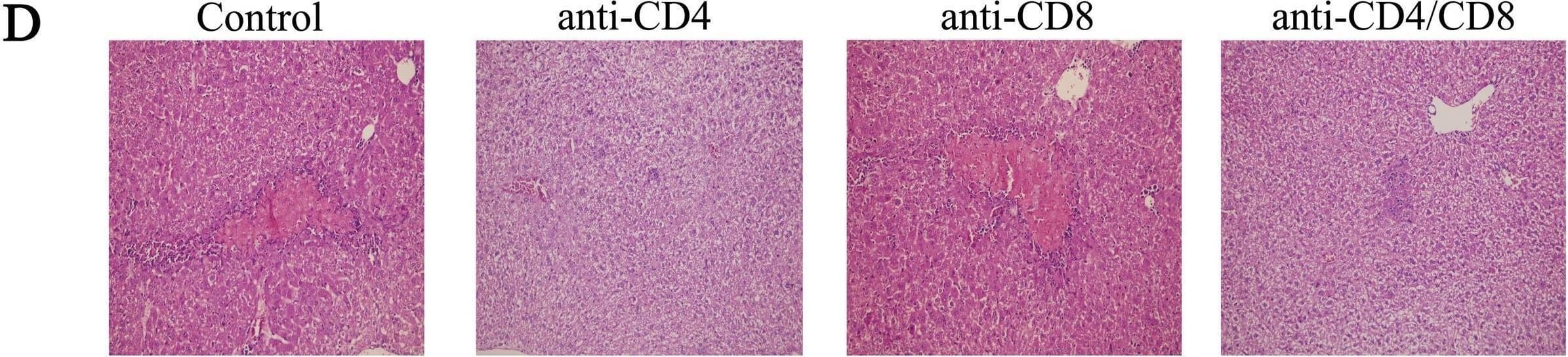
Detection of CD8 alpha by Immunohistochemistry T cells and Con A-induced hepatitis. Isotype, CD4 and/or CD8 mAbs (100 µg per mouse) was administrated i.p. to Balb/c mice (n = 8 per group) 24h before Con A injection (20 mg kg–1). The effect of anti-CD4 orCD-8 antibodies administration on depleting these cells in the liver of mice prior injecting Con A was determined by FACS. Representative results were shown in (A). Sera were collected 24 h after Con A injection. Serum ALT (B) and AST (C) levels were measured. The results were presented as the mean ± SD of three separate experiments. ***, p<0.001 vs control. (D) The livers were removed 24 h later. Paraffin sections were stained with hematoxylin and eosin (H&E) staining. Representative liver sections were shown for each group, original magnification: ×200. Image collected and cropped by CiteAb from the following open publication (https://pubmed.ncbi.nlm.nih.gov/23118999), licensed under a CC-BY license. Not internally tested by R&D Systems.
 View Larger
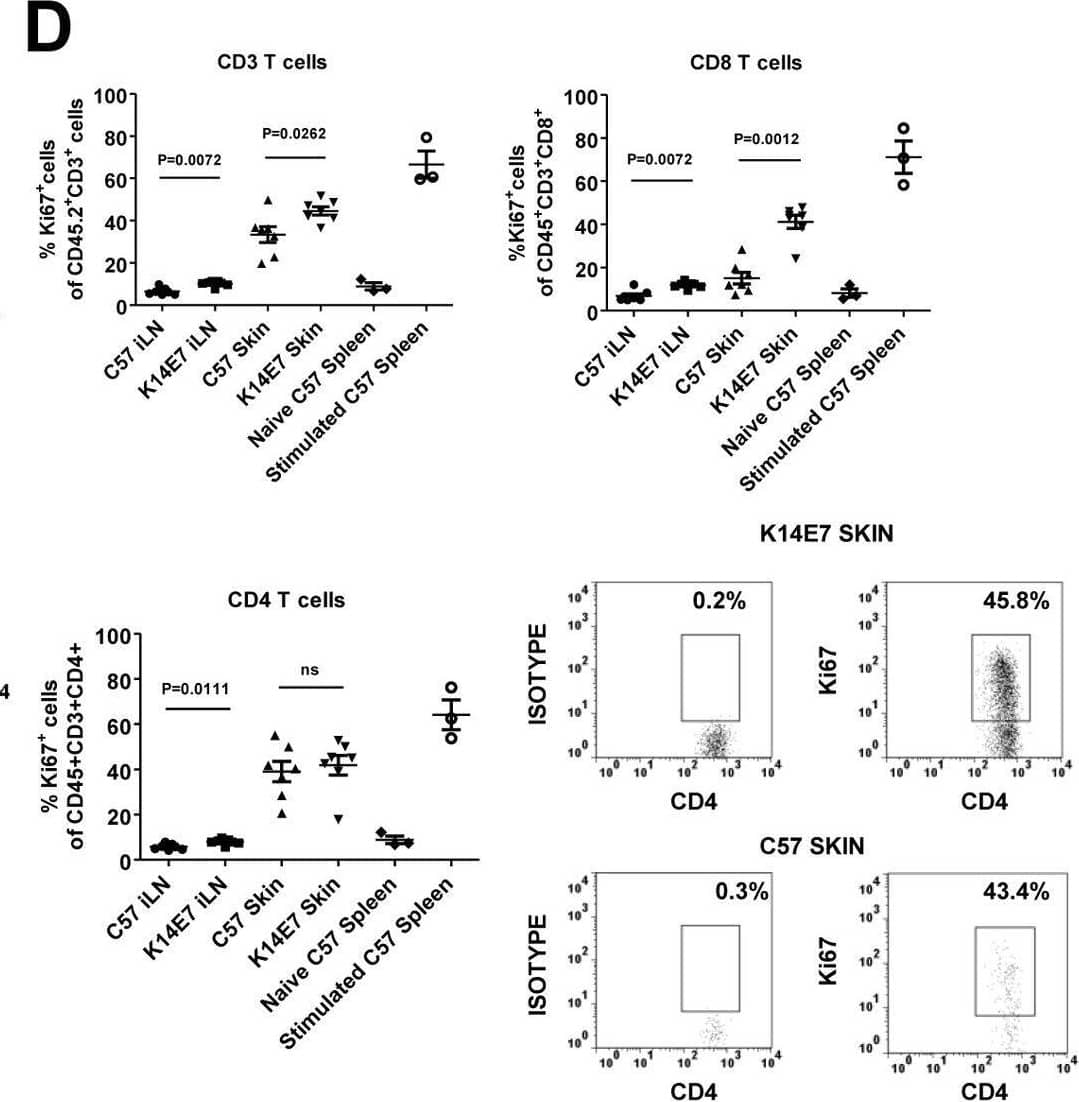
Detection of CD8 alpha by Flow Cytometry Endogenous T cells accumulate in K14E7 skin with an enrichment for CCR6-expressing CD4 T cells.(A) Ear skin tissue was taken from K14E7 mice in addition to control mice expressing the SIY epitope under the K14 promoter. CD4 and CD8 expression was measured on gated CD45+CD3+ cells. Data is representative of at least 4 mice/group (B) The numbers of CD4+ and CD8+ T cells in K14E7 skin or control C57 skin were enumerated per square centimetre of ear skin using flow count beads in flow cytometry. Data represents pooled mice from at least two independent experiments. (C) Gated CD3+ CD4+ T cells from the lymph node or skin of K14E7 mice were analysed for expression of the chemokine receptors, CCR6 and CCR4. The left hand panels show representative plots of isotype and CCR6 antibody staining for CD4+ T cells while the graph summarises chemokine receptor staining representative of 6 mice/group from 3 independent experiments. (D) Both K14E7 mice and C57 mice were analysed for the proliferative marker, Ki67, using intracellular staining of lymphocytes derived from the skin and inguinal lymph nodes (iLN). Naive C57 spleen cells (negative control) or C57 spleen cells treated for 3 days with PMA/Ionomycin (positive control) were also analysed. The K14E7 and C57 data represent 7 mice/group derived from 3 independent experiments while controls are spleen cells from a single mouse in 3 independent experiments. The lower right hand panels are representative plots showing isotype and Ki67 staining in K14E7 or C57 mouse skin. Image collected and cropped by CiteAb from the following open publication (https://pubmed.ncbi.nlm.nih.gov/23469070), licensed under a CC0-1.0 license. Not internally tested by R&D Systems.
 View Larger
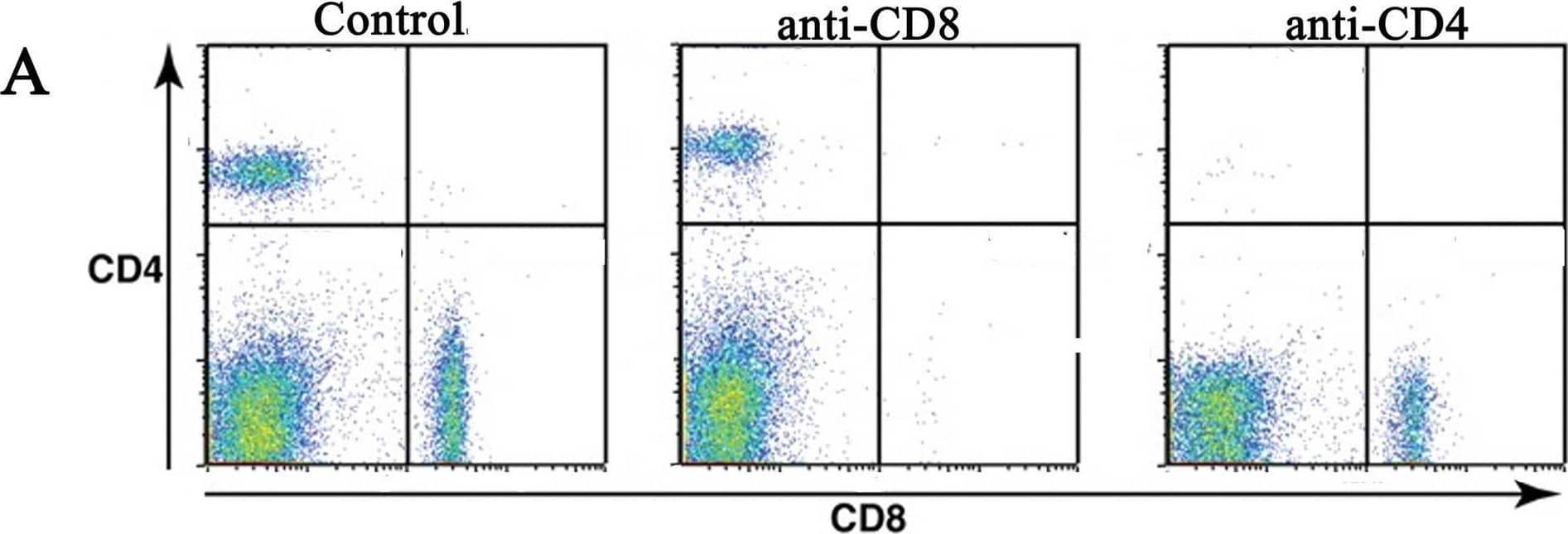
Detection of CD8 alpha by Flow Cytometry T cells and Con A-induced hepatitis. Isotype, CD4 and/or CD8 mAbs (100 µg per mouse) was administrated i.p. to Balb/c mice (n = 8 per group) 24h before Con A injection (20 mg kg–1). The effect of anti-CD4 orCD-8 antibodies administration on depleting these cells in the liver of mice prior injecting Con A was determined by FACS. Representative results were shown in (A). Sera were collected 24 h after Con A injection. Serum ALT (B) and AST (C) levels were measured. The results were presented as the mean ± SD of three separate experiments. ***, p<0.001 vs control. (D) The livers were removed 24 h later. Paraffin sections were stained with hematoxylin and eosin (H&E) staining. Representative liver sections were shown for each group, original magnification: ×200. Image collected and cropped by CiteAb from the following open publication (https://pubmed.ncbi.nlm.nih.gov/23118999), licensed under a CC-BY license. Not internally tested by R&D Systems.
Reconstitution Calculator
Preparation and Storage
- 12 months from date of receipt, -20 to -70 °C as supplied.
- 1 month, 2 to 8 °C under sterile conditions after reconstitution.
- 6 months, -20 to -70 °C under sterile conditions after reconstitution.
Background: CD8
CD8, also known as Ly-2, is a heterodimeric glycoprotein consisting of an alpha and beta chain. It is expressed on cytolytic T cells and functions in conjunction with the T cell receptor in the recognition of MHC/peptide complexes. Mouse CD8 (containing an alpha /Ly-2 or alpha ′/Lyt-2 chain) is an antigen co‑receptor on the T cell surface which interacts with MHC I molecules on antigen presenting cells (1). CD8 alpha beta heterodimer is expressed on a subpopulation of mature T cells (2, 3). CD8 alpha, without CD8 beta, has been detected on subsets of gamma δ TCR-bearing T cells (4), intestinal intrathymic lymphocytes (5, 6) and dendritic cells (7, 8).
- Bierer, B.E. et al. (1989) Annu. Rev. Immunol. 7:579.
- Ledbetter, J.A. et al. (1980) J. Exp. Med. 152:280.
- Hayakawa, K. et al. (1994) Science 263:1131.
- MacDonald, H.R. et al. (1990) Eur. J. Immunol. 20:927.
- Rocha, B. et al. (1992) Immunol. Today 13:449.
- Wang, J. and J.R. Klein (1994) Science 265:1860.
- Vermec, D. et al. (1992) J. Exp. Med. 176:47.
- Suss, G. and K. Shortman (1996) J. Exp. Med. 183:1789.
Product Datasheets
Citations for Mouse CD8 alpha Antibody
R&D Systems personnel manually curate a database that contains references using R&D Systems products. The data collected includes not only links to publications in PubMed, but also provides information about sample types, species, and experimental conditions.
13
Citations: Showing 1 - 10
Filter your results:
Filter by:
-
Non-thermal Nanoelectroablation of UV-induced Murine Melanomas Stimulates an Immune Response
Authors: Richard Nuccitelli, Kevin Tran, Kaying Lui, Joanne Huynh, Brian Athos, Mark Kreis et al.
Pigment Cell & Melanoma Research
-
Monoacylglycerol lipase regulates cannabinoid receptor 2-dependent macrophage activation and cancer progression.
Authors: Xiang W, Shi R et al.
Nat Commun
-
Functionalized nanowires for miRNA-mediated therapeutic programming of naïve T cells
Authors: Yee Mon, KJ;Kim, S;Dai, Z;West, JD;Zhu, H;Jain, R;Grimson, A;Rudd, BD;Singh, A;
Nature nanotechnology
Species: Transgenic Mouse
Sample Types: Whole Cells
Applications: Flow Cytometry -
Eggerthella lenta augments preclinical autoantibody production and metabolic shift mimicking senescence in arthritis
Authors: Balakrishnan, B;Luckey, D;Wright, K;Davis, JM;Chen, J;Taneja, V;
Science advances
Species: Transgenic Mouse
Sample Types: Whole Cells
Applications: Flow Cytometry -
Tumor suppressor TET2 promotes cancer immunity and immunotherapy efficacy
Authors: YP Xu, L Lv, Y Liu, MD Smith, WC Li, XM Tan, M Cheng, Z Li, M Bovino, J Aubé, Y Xiong
J. Clin. Invest., 2019-07-16;130(0):.
Species: Mouse
Sample Types: Whole Tissue
Applications: IHC-P -
CCL5-deficiency enhances intratumoral infiltration of CD8+ T cells in colorectal cancer
Authors: S Zhang, M Zhong, C Wang, Y Xu, WQ Gao, Y Zhang
Cell Death Dis, 2018-07-10;9(7):766.
Species: Mouse
Sample Types: Whole Tissue
Applications: IHC -
Combination of CD40 agonism and CSF-1R blockade reconditions tumor-associated macrophages and drives potent antitumor immunity
Authors: KR Wiehagen, NM Girgis, DH Yamada, AA Smith, SR Chan, IS Grewal, M Quigley, RI Verona
Cancer Immunol Res, 2017-11-02;0(0):.
Species: Mouse
Sample Types: Whole Cells
Applications: Flow Cytometry -
The efficacy of combination therapy with oncolytic herpes simplex virus HF10 and dacarbazine in a mouse melanoma model
Authors: R Tanaka, F Goshima, S Esaki, Y Sato, T Murata, Y Nishiyama, D Watanabe, H Kimura
Am J Cancer Res, 2017-08-01;7(8):1693-1703.
Species: Mouse
Sample Types: Whole Cells
Applications: Cell Selection -
Deficiency of the immunostimulatory cytokine IL-21 promotes intestinal neoplasia via dysregulation of the Th1/Th17 axis
Authors: M Shapiro, B Nandi, G Gonzalez, RH Prabhala, H Mashimo, Q Huang, NY Frank, NC Munshi, JS Gold
Oncoimmunology, 2016-12-07;6(1):e1261776.
Species: Mouse
Sample Types: Whole Tissue
Applications: IHC -
Role of Rip2 in development of tumor-infiltrating MDSCs and bladder cancer metastasis.
Authors: Zhang, Hanwei, Chin, Arnold I
PLoS ONE, 2014-04-14;9(4):e94793.
Species: Mouse
Sample Types: Whole Cells, Whole Tissue
Applications: Flow Cytometry, IHC-P -
CXCR3-dependent recruitment of antigen-specific T lymphocytes to the liver during murine cytomegalovirus infection.
Authors: Hokeness KL, Deweerd ES, Munks MW, Lewis CA, Gladue RP, Salazar-Mather TP
J. Virol., 2006-11-15;81(3):1241-50.
Species: Mouse
Sample Types: Whole Tissue
Applications: IHC-Fr -
RNU (Foxn1 RNU-Nude) Rats Demonstrate an Improved Ability to Regenerate Muscle in a Volumetric Muscle Injury Compared to Sprague Dawley Rats
Authors: Michael J. McClure, Lucas C. Olson, David J. Cohen, Yen Chen Huang, Shirley Zhang, Tri Nguyen et al.
Bioengineering (Basel)
-
Alteration of Adaptive Immunity in a Colorectal Peritoneal Carcinomatosis Model
Authors: Rongchen Shi, Wei Xiang, Xia Kang, Lili Zhang, Jinping Wang, Hongming Miao et al.
Journal of Cancer
FAQs
-
Is Mouse CD8 alpha Antibody, Catalog # MAB116, suitable for IHC with paraffin-embedded tissue?
We test this antibody agasint cells and do not have data to show its use against paraffin-embedded tissue. We have citations where customers have used the clone in paraffin-embedded tissue; please see the citation link on the webpage. We are also aware the literature suggests this clone works best with acetone-fixed frozen sections or zinc-fixed paraffin sections. https://www.ncbi.nlm.nih.gov/pmc/articles/PMC4539256/
Reviews for Mouse CD8 alpha Antibody
Average Rating: 4 (Based on 2 Reviews)
Have you used Mouse CD8 alpha Antibody?
Submit a review and receive an Amazon gift card.
$25/€18/£15/$25CAN/¥75 Yuan/¥2500 Yen for a review with an image
$10/€7/£6/$10 CAD/¥70 Yuan/¥1110 Yen for a review without an image
Filter by:

1:100 coccentration