Simple Plex Human IL-6 (2nd Gen) Assay Cartridge
Discontinued Product
SPCKB-PS-003028 has been discontinued and is replaced by SPCKB-PS-009384.


Simple Plex Human IL-6 (2nd Gen) Assay Cartridge Summary
*The Sample Volume represented is based on the amount of sample incorporated into the reaction after taking into account the assay’s minimum required dilution for a given matrix. Serial dilution may be necessary to achieve some of the final sample volumes represented.
Product Summary
Precision
Bronchoalveolar Lavage Fluid, Cell Culture Supernates, Serum, EDTA Plasma, Heparin Plasma, Cerebrospinal Fluid
| Intra-Assay Precision | Inter-Assay Precision | |||
|---|---|---|---|---|
| Sample | 1 | 2 | 1 | 2 |
| n | 16 | 16 | 50 | 50 |
| Mean (pg/mL) | 37.9 | 1763 | 38.7 | 1709 |
| Standard Deviation | 0.804 | 108 | 3.95 | 163 |
| CV% | 2.1 | 6.1 | 10.2 | 9.6 |
Recovery
Recovery at three different spiked concentrations within the range of the assay was evaluated.
| Sample Type | Average % Recovery | Range % |
|---|---|---|
| EDTA Plasma (n=6) | 95 | 92-98 |
| Heparin Plasma (n=6) | 93 | 91-94 |
| Serum (n=6) | 94 | 86-98 |
Linearity
Scientific Data
Product Datasheets
Preparation and Storage
Background: IL-6
Interleukin 6 (IL-6) is a pleiotropic, a-helical, 22-28 kDa phosphorylated and variably glycosylated cytokine that plays important roles in the acute phase reaction, inflammation, hematopoiesis, bone metabolism, and cancer progression. Mature human IL-6 is 183 amino acids (aa) in length and shares 39% aa sequence identity with mouse and rat IL-6. Alternative splicing generates several isoforms with internal deletions, some of which exhibit antagonistic properties. Cells known to express IL-6 include CD8+ T cells, fibroblasts, synoviocytes, adipocytes, osteoblasts, megakaryocytes, endothelial cells (under the influence of endothelins), sympathetic neurons, cerebral cortex neurons, adrenal medulla chromaffin cells, retinal pigment cells, mast cells, keratinocytes, Langerhans cells, fetal and adult astrocytes, neutrophils, monocytes, eosinophils, colonic epithelial cells, B1 B cells and pancreatic islet beta cells. IL-6 production is generally correlated with cell activation and is normally kept in control by glucocorticoids, catecholamines, and secondary sex steroids. Normal human circulating IL-6 is in the 1 pg/mL range, with slight elevations during the menstrual cycle, modest elevations in certain cancers, and large elevations after surgery.
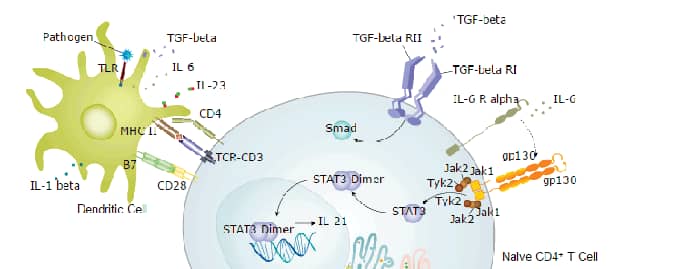
IL-6 induces signaling through a cell surface heterodimeric receptor complex composed of a ligand binding subunit (IL-6 R alpha) and a signal transducing subunit (gp130). IL-6 binds to IL-6 Ra, triggering IL-6 Ra association with gp130 and gp130 dimerization. gp130 is also a component of the receptors for CLC, CNTF, CT-1, IL-11, IL-27, LIF, and OSM. Soluble forms of IL-6 Ra are generated by both alternative splicing and proteolytic cleavage. In a mechanism known as trans-signaling, complexes of soluble IL-6 and IL-6 Ra elicit responses from gp130-expressing cells that lack cell surface IL-6 Ra. Trans-signaling enables a wider range of cell types to respond to IL-6, as the expression of gp130 is ubiquitous, while that of IL-6 Ra is predominantly restricted to hepatocytes, monocytes, and resting lymphocytes. Soluble splice forms of gp130 block trans-signaling from IL-6/IL-6 Ra but not from other cytokines that use gp130 as a co-receptor.
IL-6, along with TNF-a and IL-1, drives the acute inflammatory response. IL-6 is almost solely responsible for fever and the acute phase response in the liver, and it is important in the transition from acute inflammation to either acquired immunity or chronic inflammatory disease. When dysregulated, it contributes to chronic inflammation in conditions such as obesity, insulin resistance, inflammatory bowel disease, arthritis, and sepsis. IL-6 modulates bone resorption and is a major effector of inflammatory joint destruction in rheumatoid arthritis through its promotion of Th17 cell development and activity. It contributes to atherosclerotic plaque development and destabilization as well as the development of inflammation-associated carcinogenesis.
Citation for Simple Plex Human IL-6 (2nd Gen) Assay Cartridge
R&D Systems personnel manually curate a database that contains references using R&D Systems products. The data collected includes not only links to publications in PubMed, but also provides information about sample types, species, and experimental conditions.
1 Citation: Showing 1 - 1
-
Torquetenovirus in pregnancy: Correlation with vaginal microbiome, metabolome and pro-inflammatory cytokines
Authors: S Morselli, C Foschi, L Laghi, S Zagonari, G Patuelli, T Camboni, C Ceccarani, C Consolandi, ME Djusse, MF Pedna, A Marangoni, M Severgnini, V Sambri
Frontiers in Microbiology, 2022;13(0):998849.
Species: Human
Sample Types: Cell Culture Supernatants
FAQs
No product specific FAQs exist for this product, however you may
View all Simple Plex Assays FAQsReviews for Simple Plex Human IL-6 (2nd Gen) Assay Cartridge
There are currently no reviews for this product. Be the first to review Simple Plex Human IL-6 (2nd Gen) Assay Cartridge and earn rewards!
Have you used Simple Plex Human IL-6 (2nd Gen) Assay Cartridge?
Submit a review and receive an Amazon gift card.
$25/€18/£15/$25CAN/¥75 Yuan/¥2500 Yen for a review with an image
$10/€7/£6/$10 CAD/¥70 Yuan/¥1110 Yen for a review without an image