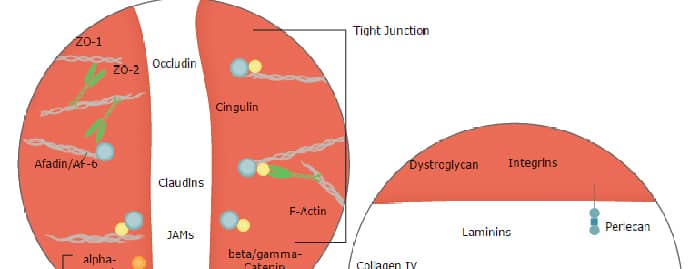
Integrin alpha V beta 3 together with alpha IIb beta 3, constitutes the only known beta 3 Integrins (1‑3). The non-covalent heterodimer of 170 kDa alpha V/CD51 and 93 kDa beta 3/CD61 subunits shows wide expression, notably by endothelial cells and osteoclasts (2‑4). Each subunit has a transmembrane sequence and a short cytoplasmic tail connected to the cytoskeleton. Active cell surface alpha V beta 3 adheres to matrix proteins including vitronectin, fibronectin, fibrinogen and thrombospondin (2, 3). The ligand binding site of alpha V beta 3 is in the N-terminal head region, formed by interaction of the beta 3 vWFA domain with the alpha V beta-propeller structure (4). The alpha V subunit contributes a thigh and a calf region, while the beta 3 subunit contains a PSI domain and four cysteine-rich I-EGF folds. The alpha V subunit domains termed thigh, calf-1 and calf-2 generate a “knee” region that is bent when the alpha V beta 3 is in its constitutively inactive state. Activation, either by “inside out” signaling or by Mg2+ or Mn2+ binding, extends the Integrin to expose its ligand binding site (1, 4). Two splice variants of beta 3 (b and c) diverge over the last 21 amino acids (aa) and lack cytoplasmic phosphorylation sites (5, 6). Another beta 3 splice variant diverges after the vWFA domain, producing a soluble 60 kDa form in platelets and endothelial cells (7). alpha V beta 3 is essential for the maturation of osteoclasts and their binding and resorption of bone; it also, however, promotes their apoptosis (8, 9). M-CSF R and alpha V beta 3 share signaling pathways during osteoclastogenesis, and deletion of either molecule causes osteopetrosis (8, 9). Also cell entry of several viruses is mediated by alpha V beta 3 (4, 10). The 962 aa human alpha V ECD (11) shares 92‑95% aa sequence identity with mouse, rat and cow alpha V while the 685 aa human beta 3 ECD (12) shares 95% aa identity with horse and dog, and 89‑92% aa identity with mouse, rat and pig beta 3.
Human Integrin alpha V beta 3 Antibody
R&D Systems | Catalog # MAB3050


Key Product Details
Species Reactivity
Validated:
Human
Cited:
Human, Xenograft
Applications
Validated:
Adhesion Blockade, Flow Cytometry, Immunoprecipitation, CyTOF-ready
Cited:
Immunohistochemistry, Immunohistochemistry-Paraffin, Western Blot, Neutralization, Flow Cytometry, Immunocytochemistry, Bioassay, Functional Assay
Label
Unconjugated
Antibody Source
Monoclonal Mouse IgG1 Clone # 23C6
Loading...
Product Specifications
Immunogen
Human osteoclasts
Specificity
Detects human Integrin alpha V beta 3.
Clonality
Monoclonal
Host
Mouse
Isotype
IgG1
Endotoxin Level
<0.10 EU per 1 μg of the antibody by the LAL method.
Scientific Data Images for Human Integrin alpha V beta 3 Antibody
Detection of Human Integrin alpha V beta 3 by Immunocytochemistry/Immunofluorescence
Effects of AA and DHA on actin ring formation and VNR expression.Osteoclast differentiation was stimulated in CD14+ monocytes by the addition of 25 ng ml-1 M-CSF and 30 ng ml-1 RANKL as described in Materials and Methods. Vehicle (0.08% ethanol) or LCPUFAs (40 μorption (day 12–14) in mature osteoclasts. After 3 weeks of culture, cells were fixed and stained with Hoechst (blue) for nuclei, phalloidin (red) for actin rings, and anti-VNR antibody (green). The results are representative of three independent experiments conducted in triplicate. Scale bar = 200 μm. Diff Ocl—differentiating osteoclasts. Mat Ocl—mature osteoclasts. Image collected and cropped by CiteAb from the following publication (https://pubmed.ncbi.nlm.nih.gov/25867515), licensed under a CC-BY license. Not internally tested by R&D Systems.
Detection of Human Human Integrin alpha V beta 3 Antibody by Immunocytochemistry/ Immunofluorescence
Effects of AA and DHA on actin ring formation and VNR expression.Osteoclast differentiation was stimulated in CD14+ monocytes by the addition of 25 ng ml-1 M-CSF and 30 ng ml-1 RANKL as described in Materials and Methods. Vehicle (0.08% ethanol) or LCPUFAs (40 μorption (day 12–14) in mature osteoclasts. After 3 weeks of culture, cells were fixed and stained with Hoechst (blue) for nuclei, phalloidin (red) for actin rings, and anti-VNR antibody (green). The results are representative of three independent experiments conducted in triplicate. Scale bar = 200 μm. Diff Ocl—differentiating osteoclasts. Mat Ocl—mature osteoclasts. Image collected and cropped by CiteAb from the following publication (https://pubmed.ncbi.nlm.nih.gov/25867515), licensed under a CC-BY license. Not internally tested by R&D Systems.
Detection of Human Integrin alpha V beta 3 by Immunocytochemistry/ Immunofluorescence
Effects of AA and DHA on actin ring formation and VNR expression.Osteoclast differentiation was stimulated in CD14+ monocytes by the addition of 25 ng ml-1 M-CSF and 30 ng ml-1 RANKL as described in Materials and Methods. Vehicle (0.08% ethanol) or LCPUFAs (40 μorption (day 12–14) in mature osteoclasts. After 3 weeks of culture, cells were fixed and stained with Hoechst (blue) for nuclei, phalloidin (red) for actin rings, and anti-VNR antibody (green). The results are representative of three independent experiments conducted in triplicate. Scale bar = 200 μm. Diff Ocl—differentiating osteoclasts. Mat Ocl—mature osteoclasts. Image collected and cropped by CiteAb from the following open publication (https://pubmed.ncbi.nlm.nih.gov/25867515), licensed under a CC-BY license. Not internally tested by R&D Systems.Applications for Human Integrin alpha V beta 3 Antibody
Application
Recommended Usage
Adhesion Blockade
Horton, M.A. et al. (1991) Exp. Cell Res. 195:368. Bates, R.C. et al. (1998) Cell Adhes. Commun. 6:21.
CyTOF-ready
Ready to be labeled using established conjugation methods. No BSA or other carrier proteins that could interfere with conjugation.
Flow Cytometry
2.5 µg/106 cells
Sample: HUVEC human umbilical vein endothelial cells
Sample: HUVEC human umbilical vein endothelial cells
Immunoprecipitation
Davies, J. et al. (1989) J. Cell Biol. 109:1817.
Flow Cytometry Panel Builder
Bio-Techne Knows Flow Cytometry
Save time and reduce costly mistakes by quickly finding compatible reagents using the Panel Builder Tool.
Advanced Features
- Spectra Viewer - Custom analysis of spectra from multiple fluorochromes
- Spillover Popups - Visualize the spectra of individual fluorochromes
- Antigen Density Selector - Match fluorochrome brightness with antigen density

Formulation, Preparation, and Storage
Purification
Protein A or G purified from hybridoma culture supernatant
Reconstitution
Reconstitute at 0.5 mg/mL in sterile PBS. For liquid material, refer to CoA for concentration.
Loading...
Formulation
Lyophilized from a 0.2 μm filtered solution in PBS with Trehalose. See Certificate of Analysis for details.
*Small pack size (-SP) is supplied either lyophilized or as a 0.2 µm filtered solution in PBS.
*Small pack size (-SP) is supplied either lyophilized or as a 0.2 µm filtered solution in PBS.
Shipping
Lyophilized product is shipped at ambient temperature. Liquid small pack size (-SP) is shipped with polar packs. Upon receipt, store immediately at the temperature recommended below.
Stability & Storage
Use a manual defrost freezer and avoid repeated freeze-thaw cycles.
- 12 months from date of receipt, -20 to -70 °C as supplied.
- 1 month, 2 to 8 °C under sterile conditions after reconstitution.
- 6 months, -20 to -70 °C under sterile conditions after reconstitution.
Calculators
Background: Integrin alpha V beta 3
References
- Hynes, R. O. (2002) Cell 110:673.
- Serini, G. et al. (2006) Exp. Cell Res. 312:651.
- Ross, F. P. and S. L. Teitelbaum (2005) Immunol. Rev. 208:88.
- Xiong, J. et al. (2001) Science 294:339.
- Kumar, C. S. et al. (1987) J. Biol. Chem. 272:16390.
- vanKuppevelt, H. et al. (1989) Proc. Natl. Acad. Sci. USA 86:5415.
- Djaffar, I. et al. (1994) Biochem. J. 300:67.
- McHugh, K. P. et al. (2000) J. Clin. Invest. 105:433.
- Faccio, R. et al. (2003) J. Clin. Invest. 111:749.
- Chu, J. J. and M. Ng (2004) J. Biol. Chem. 279:54533.
- Suzuki, S. et al. (1987) J. Biol. Chem. 262:14060.
- Fitzgerald, L. A. et al. (1987) J. Biol. Chem. 262:3936.
Alternate Names
antigen identified by monoclonal L230, CD51, CD51 antigen, integrin alpha-V, integrin, alpha V (vitronectin receptor, alpha polypeptide, antigen CD51), MSK8, Vitronectin receptor subunit alpha, VNRADKFZp686A08142
Entrez Gene IDs
3685 (Human)
Gene Symbol
ITGAV
Additional Integrin alpha V beta 3 Products
Product Documents for Human Integrin alpha V beta 3 Antibody
Product Specific Notices for Human Integrin alpha V beta 3 Antibody
For research use only
Citations for Human Integrin alpha V beta 3 Antibody
 Powered by Bioz
Customer Reviews for Human Integrin alpha V beta 3 Antibody
There are currently no reviews for this product. Be the first to review Human Integrin alpha V beta 3 Antibody and earn rewards!
Have you used Human Integrin alpha V beta 3 Antibody?
Submit a review and receive an Amazon gift card!
$25/€18/£15/$25CAN/¥2500 Yen for a review with an image
$10/€7/£6/$10CAN/¥1110 Yen for a review without an image
Submit a review
Protocols
Find general support by application which include: protocols, troubleshooting, illustrated assays, videos and webinars.
- 7-Amino Actinomycin D (7-AAD) Cell Viability Flow Cytometry Protocol
- Extracellular Membrane Flow Cytometry Protocol
- Flow Cytometry Protocol for Cell Surface Markers
- Flow Cytometry Protocol for Staining Membrane Associated Proteins
- Flow Cytometry Staining Protocols
- Flow Cytometry Troubleshooting Guide
- Immunoprecipitation Protocol
- Intracellular Flow Cytometry Protocol Using Alcohol (Methanol)
- Intracellular Flow Cytometry Protocol Using Detergents
- Intracellular Nuclear Staining Flow Cytometry Protocol Using Detergents
- Intracellular Staining Flow Cytometry Protocol Using Alcohol Permeabilization
- Intracellular Staining Flow Cytometry Protocol Using Detergents to Permeabilize Cells
- Propidium Iodide Cell Viability Flow Cytometry Protocol
- Protocol for the Characterization of Human Th22 Cells
- Protocol for the Characterization of Human Th9 Cells
- Protocol: Annexin V and PI Staining by Flow Cytometry
- Protocol: Annexin V and PI Staining for Apoptosis by Flow Cytometry
- Troubleshooting Guide: Fluorokine Flow Cytometry Kits
- View all Protocols, Troubleshooting, Illustrated assays and Webinars